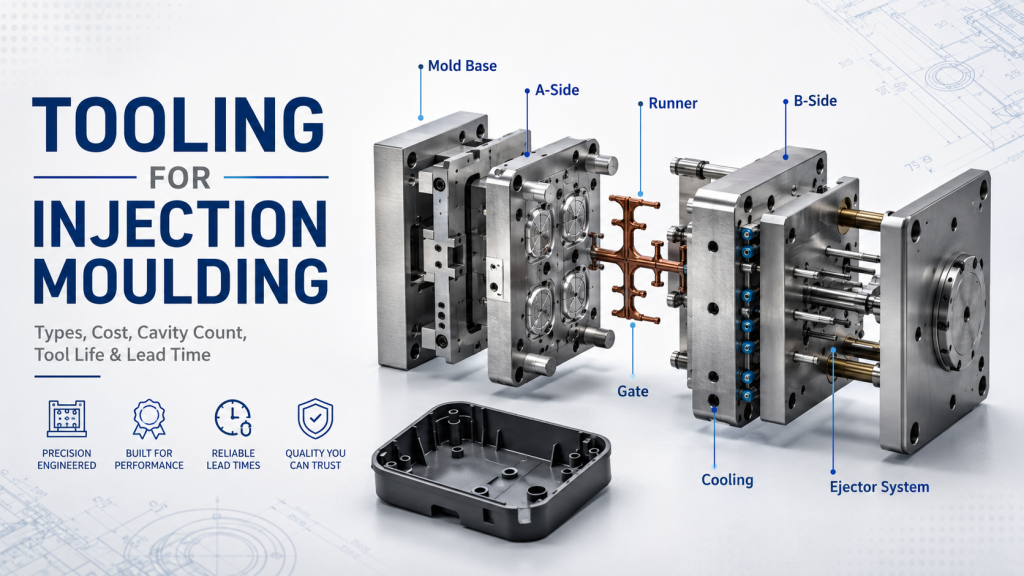
For most hardware startups, tooling lead time often determines whether a product can enter the market as planned. Traditional steel tooling typically requires 4–8 weeks or longer, with costs ranging from several thousand to tens of thousands of dollars. When part geometries are complex, multi-cavity tooling is required, or multiple mold trials are needed, both the timeline and cost increase further. The result is straightforward: design validation is forced into a queue, and launch milestones are delayed.
Rapid tooling offers a path that is better aligned with the pace of startups. Common forms include aluminum molds, soft steel molds, and bridge tooling. When combined with high-speed CNC machining or localized 3D-printed inserts, it is feasible to obtain a moldable tool and produce initial parts within 7–14 days. Its core value is not simply speed. More importantly, it allows teams to obtain plastic parts that are close to production intent much earlier, enabling validation of assemblies, functional interfaces, sealing strategies, and critical dimensions.
For startups, this approach typically delivers three key benefits:
-
Higher iteration efficiency, as design decisions are no longer locked in by long tooling cycles.
-
More controllable upfront investment, avoiding large commitments to expensive production tooling while requirements are still evolving.
-
Earlier risk exposure, particularly around DFM boundaries, deformation trends, cosmetic defects, and the system-level effects of accumulated assembly tolerances.
More importantly, rapid tooling is not a temporary solution disconnected from mass production. When design inputs and tooling strategies are defined correctly, it can transition naturally into subsequent production tooling, reducing redundant trial-and-error.

Understanding Rapid Tooling
What Is Rapid Tooling?
Rapid tooling refers to the use of more easily machinable materials or faster manufacturing paths to produce moldable injection tooling within a short timeframe, primarily for prototype validation or low-volume production. Its core approach is to intentionally trade off part of the tool life and automation level in exchange for shorter tooling lead times and lower upfront investment.

Common implementation methods include:
- Using aluminum or soft steel to machine the mold base and cavity structures
- Introducing additive manufacturing (3D printing) locally as inserts or for fast-iteration regions
These molds are typically used for projects in the 50–10,000 part range. The goal is not long-term production capacity, but to obtain production-representative molded parts as early as possible to validate design and manufacturing boundaries.
Rapid Tooling vs. Traditional Production Tooling

Compared with traditional hardened steel production tooling, rapid tooling differs clearly in material choice, configuration, and project objectives:
- Softer tooling materials: Aluminum and soft steel are easier to machine, with shorter machining cycles and faster mold-trial iterations, but lower wear resistance and thermal stability than hardened steel.
- Simplified configurations: Rapid tooling more often uses single-cavity molds or simplified runner and ejection designs to reduce machining and debugging time, whereas production tooling commonly adopts multi-cavity layouts and higher levels of automation.
- Shorter lead times: Mature rapid tooling projects are typically completed within 5–15 days, while traditional steel tooling usually progresses on a scale of weeks to months.
- Lower cost but shorter tool life: Upfront investment is more controllable, while tool life typically falls in the 10,000–100,000 shot range, depending on resin choice, wear characteristics, and the process window. This makes rapid tooling better suited for validation and early ramp-up stages.
It is important to note that the “shorter life” of rapid tooling does not mean it is uncontrollable. Rather, it reflects more clearly defined material and structural boundaries that must be established at the start of the project.
Types of Rapid Tooling
Based on application purpose and delivery objectives, rapid tooling is commonly categorized into three types:
- Prototype Tooling: Primarily used for design validation. The focus is on dimensional convergence, assembly relationships, key functional interfaces, and basic cosmetic feasibility, rather than long-term stability or high production output.

- Bridge / Transitional Tooling: Used as a temporary solution before full production tooling. Its purpose is to support pilot runs or early market release while validating the process window, quality consistency, and initial ramp-up capability.

- Rapid Injection Molding: Emphasizes short-cycle delivery of production-representative molded parts. It is well-suited for projects that require real material performance data, shrinkage and deformation trends, and molding defect behavior to support the design convergence and risk assessment of subsequent production tooling.

It should be clearly understood that rapid tooling is not equivalent to low-quality tooling. Its role is to make controlled trade-offs in tool life and complexity in order to gain decision speed and risk controllability. When its application boundaries are clearly defined, rapid tooling can be one of the most cost-effective ways to transition from concept validation to production introduction.
Key Challenges Faced by Startups and How Rapid Tooling Addresses Them
At the startup stage, tooling-related issues are rarely isolated technical problems. They are more often systemic constraints formed by the combination of cost, time, and uncertainty. If not managed properly, these constraints can significantly amplify project risk.
Key Challenges
Startups typically face three core challenges during the tooling phase:
- High tooling cost and concentrated investment risk: Traditional production tooling often requires a substantial upfront investment, at a time when product requirements, structural solutions, and market feedback are still not fully stabilized.
- Slow validation and delayed market entry: Tooling lead times are measured in weeks or months. Design errors or requirement changes can only be corrected late in the process, directly pushing back product launch timelines.
- Limited iteration and designs “locked in” by tooling: Once a mold is built, any structural change carries a high modification cost, forcing teams to push forward with insufficient validation.
These challenges do not stem from a lack of engineering capability, but from a mismatch between the tooling strategy and the project stage.
How Rapid Tooling Addresses These Challenges
By adjusting tooling investment models and delivery cadence, rapid tooling provides a more controllable way to address the issues above:
- Significantly shorter lead times: In mature workflows, parts can typically be delivered within 7–10 days, shifting validation cycles from “monthly progress” to “weekly decision-making.”
- Reduced upfront cost pressure: Compared with committing directly to final production tooling, rapid tooling enables key validations to be completed with a much lower budget. Unit or phase-level costs are often reduced by 25% or more.
- Earlier exposure of design and material risks: Before investing USD 50,000 or more in final tooling, teams can validate part geometry, material selection, molding windows, and cosmetic feasibility.
- Greater iteration flexibility: Aluminum molds, soft steel molds, or replaceable inserts make localized changes an acceptable engineering action rather than a project-level risk event.
For startups, the true value of rapid tooling is not simply “cost savings.” It lies in breaking down irreversible, high-risk decisions into a series of smaller, verifiable steps. By making critical judgments earlier, at lower cost and shorter cycle times, teams can significantly reduce failure risk before entering full-scale production—while retaining the flexibility to respond to change.
A Step-by-Step Process to Achieve Rapid Tooling Delivery in 7–14 Days
Compressing tooling lead times to within two weeks does not rely on a single “fast process.” It requires systematic control of input quality, tooling strategy, and collaboration cadence. The following workflow is based on repeatable engineering practice, not idealized assumptions.
Step 1: Design Preparation and Optimization (Days 1–2)

All speed is built on high-quality inputs. The objective at this stage is to minimize the likelihood of downstream rework.
- Start with a manufacturable CAD model, avoiding unresolved cosmetic or structural concepts
- Front-load DFM requirements, including gate location, draft angles, wall-thickness transitions, and critical tolerances (a common target is ±0.003 in)
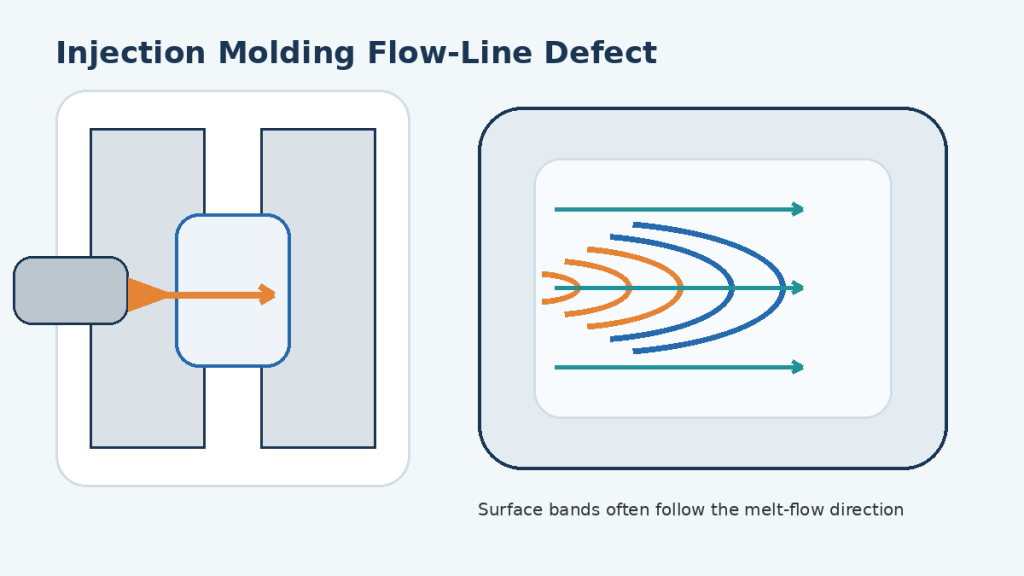
- Use basic simulation or prototype analysis tools to identify potential risks related to filling, weld lines, and uneven cooling
The “cleaner” the design at this stage, the higher the certainty of every step that follows.
Step 2: Tooling Path Selection (Days 2–3)
Select the appropriate tooling combination based on validation objectives, rather than defaulting to a single method:
- Aluminum or soft steel tooling: prioritized to shorten machining cycles and control cost
- 3D-printed inserts: used for complex geometries, frequent revisions, or localized validation areas
- CNC machining: applied to ensure cavity accuracy, parting-line quality, and critical datum consistency
Tooling path decisions should serve what needs to be validated, not which technology is being used.
Step 3: Partner Selection and Quoting (Days 3–4)

Under compressed schedules, supplier capability directly defines the project ceiling. Key evaluation criteria include:
- Rapid quoting capability (typically within 24 hours)
- In-house tooling and molding capacity, reducing scheduling uncertainty caused by outsourcing
- Verifiable project experience and reference cases
- ISO-based quality systems to ensure baseline consistency and traceability
The goal at this stage is not the lowest price, but predictable delivery.
Step 4: Tool Fabrication (Days 4–7 / 10)

Once tooling begins, the focus shifts to controlling complexity:
- Use high-speed CNC machining, or hybrid approaches combining CNC with 3D printing
- Prioritize single-cavity tooling to reduce tuning and balancing time
- Typical lead times:
- Aluminum tooling: approximately 5–8 days
- 3D-printed molds or inserts: from a few hours to 1–2 days
Efficiency at this stage depends heavily on the quality of upstream design and tooling-path decisions.
Step 5: Prototype Production and Iteration (Days 7–10)
After the mold is completed, initial parts can typically be produced within 1–3 days:
- Verify assembly relationships, functional interfaces, and cosmetic performance
- Make localized modifications or parameter adjustments based on test results
- Compared with production tooling, both the modification cost and the cycle time are significantly lower
The objective here is to validate design assumptions using real molded results.
Step 6: Transition to the Production Environment (Days 10–14)
Once rapid tooling validation is complete, production introduction can proceed in parallel:
- Complete low-volume validation runs of 50–10,000 parts
- Capture real process windows, yield data, and consistency metrics
- Initiate the design and fabrication of the final hardened steel tooling while parts are already market-ready
With this parallel approach, production readiness no longer follows a strictly linear “validate first, then start” sequence.
The key to this step-by-step process is not how fast each individual step is, but whether each step reduces uncertainty for the next. When design, tooling, and collaboration cadence form a closed loop, achieving 7–14 day rapid tooling delivery becomes repeatable—rather than a one-time stroke of luck.
Essential Tools and Technologies for Speed
Within a 7–14 day rapid tooling cycle, speed does not come from pushing a single process to its limits. It comes from making deliberate trade-offs across a combination of tools and technologies. The following tools form the core toolkit for fast delivery, each addressing a different dimension of efficiency.
Aluminum Tooling

Aluminum tooling is one of the most common and reliable options in rapid tooling.
- Fast machining speed: In mature workflows, aluminum molds can typically be machined and debugged in about 7 days
- Predictable dimensional control: With proper design and cooling strategies, aluminum tooling can meet the tolerance requirements of most prototype and early ramp-up projects
- Good resin compatibility: Suitable for many common engineering plastics, making it practical when material selection is not yet fully finalized
The strength of aluminum tooling lies in its balance between speed and controllability, which is why it is the most frequently used option for transitioning from prototypes to pre-production.
3D Printed Tooling
Additive manufacturing offers an alternative path for extreme acceleration in rapid tooling.
- Build times are measured in hours, making it ideal for urgent validation or fast-iteration scenarios
- With appropriate materials and structural design, it can support 10,000 or more molding cycles
- Low upfront investment, making it a cost-effective option for validating complex geometries or areas requiring frequent changes
It is important to note that 3D printed tooling is typically more sensitive to resin type, molding temperature, and pressure windows. Its application boundaries must be clearly defined during the design stage.
CNC Machining

CNC machining remains the precision baseline within rapid tooling systems.
- Prototype machining cycles can be controlled to around 3 days
- Used to ensure dimensional consistency of cavities, parting lines, and critical datums
- Provides high-value DFM feedback before and after tooling, helping to converge design and process assumptions
Even in projects that incorporate additive manufacturing, CNC machining remains an indispensable method for achieving and maintaining precision.
Hybrid Manufacturing Approaches
In real-world projects, a single process is rarely sufficient to meet both speed and precision requirements.
- Additive manufacturing is applied to complex or high-change regions
- Machining is reserved for critical dimensions, datums, and sealing surfaces
- Modular or replaceable inserts enable rapid modification and repeated validation
This hybrid approach allows teams to compress tooling lead times as much as possible without sacrificing key quality metrics.
These tools and technologies are not inherently complex. What ultimately determines efficiency is whether they are applied to solve the right problems. When process selection is driven by clear validation objectives, speed becomes a natural outcome rather than an added risk.
Best Practices for Startups
Whether rapid tooling truly improves project efficiency depends on whether startups treat it as a repeatable engineering process, rather than a one-off rush order. The following best practices focus on the four most common points of failure: cost, iteration, risk, and timeline control.
Cost Management
For startups, the priority is not minimizing unit cost, but avoiding irreversible investment at the stage of highest uncertainty.
- Start with low-volume runs: Use the 50–10,000 part range to complete market and engineering validation, rather than committing early to multi-cavity steel tooling or high-automation configurations.
- Use transitional tooling for pilot production: Conduct a 2–3 week pilot run to validate yield, cycle time, assembly consistency, and drift trends of key CTQs before committing to final production tooling.
- Break cost into staged decisions: Divide large one-time investments into milestones such as validation → pilot production → ramp-up, ensuring each step is supported by data.
Iteration Strategy
Speed comes from short feedback loops, not from repeatedly pushing suppliers.
- Design modifications as executable actions: Use replaceable inserts, localized mold changes, and modular structures so that revisions occur in low-cost areas.
- Internally converge changes quickly: Requirement changes should first be prioritized and bounded internally before being released to tooling, avoiding cycle time loss from back-and-forth communication.
- Collect “production-level data” from prototypes: Beyond basic fit checks, record filling behavior, cooling cycles, warpage direction, and sensitivity of critical dimensions to process changes. Real fill and cooling data often determine whether structural changes are required in subsequent steel tooling.
Risk Mitigation
Rapid tooling shortens timelines, but it does not automatically reduce risk. Risk must be managed proactively.
- NDAs and intellectual property protection: Define NDA and IP boundaries before sharing CAD, BOMs, materials, or test specifications to prevent upstream leakage.
- Phased development: Complete structural and material validation with prototype tooling before committing to production tooling. Avoid forcing early uncertainty onto “final” tools.
- Supplier diversification: Prepare backup suppliers or alternative process paths for critical stages to avoid single points of failure. For startups, supply chain resilience is itself a schedule safeguard.
Timeline Optimization
The key to two-week delivery is minimizing information loss and decision latency.
- Clear communication and one-time input delivery: Consolidate CTQs, tolerance datums, cosmetic standards, material grades, target volumes, and validation objectives upfront to avoid repeated waiting caused by fragmented updates.
- Adopt minimalist design early: Without compromising validation goals, reduce unnecessary textures, complex cosmetic surfaces, extremely thin walls, and high-risk side actions to improve first-shot convergence.
- Leverage suppliers for path continuity: Prioritize partners that can cover DFM, tooling, molding, and basic inspection, allowing prototype → pilot → ramp-up to proceed under a single process logic and reducing realignment costs from supplier switching.
The common thread across these best practices is treating rapid tooling as an engineering decision system. When costs are staged, iteration is modularized, risks are front-loaded, and communication is standardized, 7–14 day delivery becomes a repeatable norm—rather than a one-time expedited success.
Case Studies and Real-World Examples
Compared with methodology alone, real-world cases more clearly demonstrate the practical value of rapid tooling in startup environments. The following examples are drawn from common engineering and business decision scenarios.
Startup Validation Case: Using Aluminum Tooling to Avoid High-Risk Investment
A hardware startup needed to validate enclosure structure and internal assembly paths while product definitions were still evolving. The initial plan was to proceed directly with production-grade steel tooling, but during evaluation, several critical dimensions were identified as uncertain.
- The team chose to first use aluminum rapid tooling
- The mold was completed, and approximately 5,000 components were produced within three weeks
- Structural interference and cosmetic deformation issues were identified during real assembly and testing
Had these issues emerged at the production tooling stage, a single mold modification could have cost more than USD 50,000, with a significant impact on the launch schedule. By exposing the problems earlier through rapid tooling, the team corrected the design at much lower cost and locked in the correct solution before entering mass production.
Collaboration Efficiency Case: High-Speed CNC Shortening the Tooling Path
Another startup’s primary objective was to complete market testing as quickly as possible. Functional and cosmetic requirements for the enclosure were clearly defined, but the available time window was extremely tight.
- The team partnered with a supplier that had in-house high-speed CNC capabilities
- A simplified single-cavity tooling design was adopted
- Tool fabrication was completed, and molding trials began within eight days
This collaboration model reduced uncertainty caused by outsourcing schedules and multiple handoffs, allowing the team to conduct real product testing within the market feedback window rather than remaining at the concept-sample stage.
3D Printed Tooling Case: Extreme Acceleration for Trial Runs
In some projects with complex structures and frequent design changes, the traditional tooling path itself becomes the speed bottleneck.
- The team used 3D printed molds or inserts
- Tool fabrication time was compressed from weeks to hours
- Multiple trial runs and parameter adjustments were completed rapidly
While this approach has limitations in tool life and material applicability, it significantly accelerated decision-making during the trial phase, enabling engineering teams to quickly determine which designs were worth advancing into formal tooling processes.
The common thread across these cases is not the specific technology used, but the close alignment between tooling choice and project stage. The value of rapid tooling often lies in helping teams avoid “early overcommitment” and in exchanging minimal cost for the most critical engineering and market insights.
Common Pitfalls and Limitations
Rapid tooling can significantly compress development timelines, but it is not a universal solution. Without a clear understanding of its application boundaries, it can instead amplify the risk of rework and delays. The following are the three most common issues encountered by startups in real projects.

Neglecting Design for Manufacturability (DFM)
The most common cause of failure is not insufficient tooling or process capability, but inadequate consideration of manufacturing boundaries during the design stage.
- Gate, venting, and parting-line locations are not clearly defined in the design
- Excessive wall-thickness variation leads to uneven filling or warpage
- Tolerances are disconnected from functional requirements, with attention placed on nominal dimensions rather than assembly datums
Under rapid tooling schedules, these issues translate directly into increased modification cycles and delivery delays. A lack of DFM often offsets the time savings that rapid tooling is intended to provide.
Tool Life and Application Scope
Rapid tooling typically uses aluminum, soft steel, or additive manufacturing methods, and its life is not designed for large-scale, long-term production.
- Typical target life ranges from 10,000–100,000 shots
- More sensitive to high injection pressures, high glass-fiber content, or abrasive resins
- Limited cooling and thermal control capability make it difficult to support long-term ramp-up with extremely tight consistency requirements
Misusing rapid tooling as production tooling often results in quality fluctuations, frequent maintenance, and even misjudgment of the product’s true production capability.
Boundary Comparison with Other Methods
At very early stages, rapid prototyping or pure additive manufacturing may appear faster, but their information value has clear limitations:
- Lack of real molding data: Unable to reflect injection molding behavior such as filling, shrinkage, weld lines, and internal stress
- Limited dimensional and surface precision: Cannot replace molded results for critical mating surfaces and functional interfaces
- Poor process reproducibility: Difficult to provide reliable design inputs for subsequent production tooling
For this reason, when production feasibility, precision, and consistency must be evaluated, tooling remains an irreplaceable validation method.
Understanding these pitfalls and limitations does not mean abandoning rapid tooling. Instead, it helps teams apply the right tools at the right stage. When rapid tooling is used in the scenarios it is best suited for, it truly shortens timelines rather than introducing new uncertainty.
Additional Resources and Next Steps
After completing rapid tooling validation, the next critical step is to translate validated learnings into scalable production inputs. The following resources and action paths help support this transition.
Rapid Tooling Supplier Resources
In fast-paced projects, supplier capability often defines the execution ceiling. Different types of providers play distinct roles at different stages:
- Protolabs: Known for rapid quoting and short lead times, well-suited for projects that require tooling completion and initial molded parts in roughly 7 days.
- Fictiv: Covers the full path from prototyping to transitional production, making it a good fit for teams that need continuity between validation and early ramp-up.
- Formlabs: Provides mature 3D printing tools and application guidance, suitable for complex geometries, insert validation, or rapid iteration scenarios.
The value of these resources lies not in the brand itself, but in whether they can consistently balance speed, engineering feedback, and delivery predictability.
Tools and Software
Rapid tooling projects place greater emphasis on front-end tools, particularly for shortening communication loops and reducing trial-and-error:
- CAD software: Used to lock in geometry, parting strategy, and critical datums, reducing uncertainty during the tooling phase.
- Simulation and analysis tools: Applied to preliminarily assess filling behavior, cooling trends, and potential defects, helping eliminate clearly unviable options before tooling begins.
These tools are not intended to predict everything, but to reduce low-value iterations within a limited timeframe.
The Next Step Toward Scaling
Once validation objectives in the rapid tooling phase are met, preparation for scale-up should begin promptly:
- Refine designs and DFM inputs based on real molding data obtained from rapid tooling
- Translate validated geometry, materials, and process windows into the design foundation for hardened steel production tooling
- Before entering high-volume production, use transitional data to confirm assumptions around consistency and yield
The core objective of this process is to ensure that steel tooling acts as a validated amplifier, rather than a new source of risk.
By using these resources effectively and advancing through the next steps in a staged manner, rapid tooling can do more than help a project move quickly—it can also establish a clear, executable foundation for stable mass production.
Conclusion
For startups, the value of rapid tooling lies in making the right engineering decisions earlier. By compressing tooling lead times to 7–14 days, teams can complete critical validation of structure, materials, processes, and assembly before committing to high-cost production tooling. This significantly reduces rework risk and capital exposure. At the same time, it establishes a continuous and traceable technical path from prototype to production, rather than a series of disconnected stages.
To fully realize the value of rapid tooling, clear design inputs, executable DFM strategies, and close collaboration with partners that have both engineering depth and delivery capability are essential. The earlier these elements are introduced into a project, the more effectively uncertainty can be pushed forward and resolved within a controllable range. For startups, this represents a more mature and resilient approach to product development.