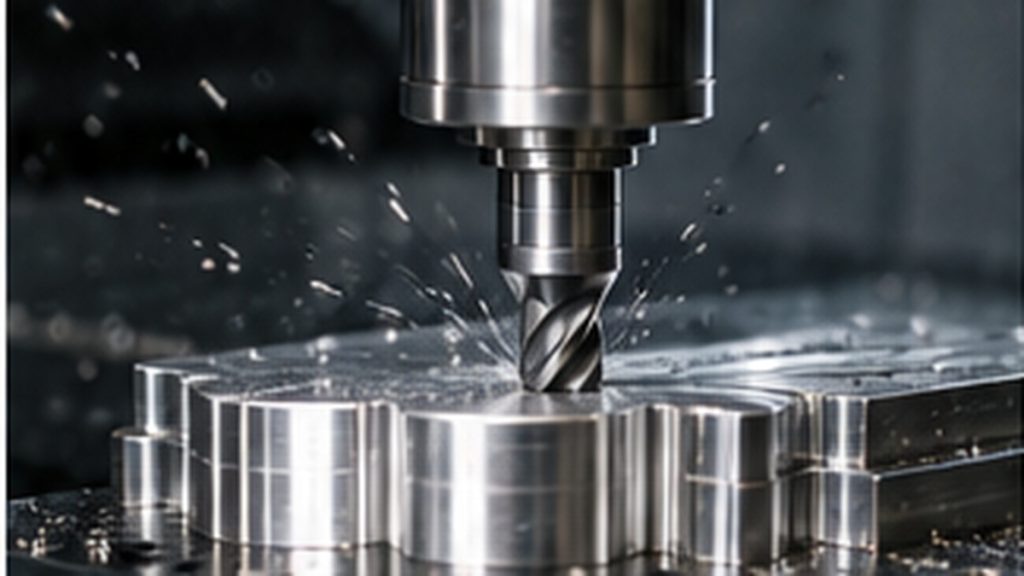
NC and CNC machines both use numerical instructions to control machining motion. Classic NC (numerical control) equipment typically reads a fixed program from punched tape or another limited input system and uses dedicated control logic. CNC (computer numerical control) equipment uses a computer-based controller with program memory, interpolation, diagnostics, offsets, macros, probing, and editable programs.
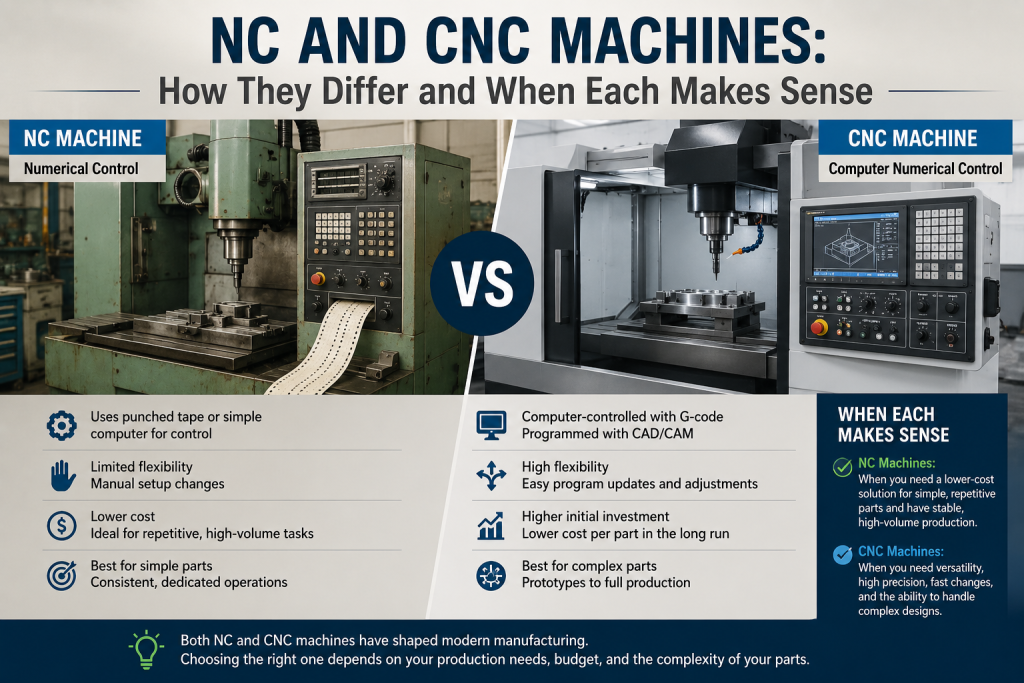
For a new production project, CNC is normally the practical choice because programs can be revised, stored, simulated, measured, and connected to modern tooling and inspection workflows. NC terminology still matters when a buyer is evaluating legacy equipment, a retrofit, an old drawing, or a high-volume process built around a fixed sequence. The controller type alone does not guarantee a tolerance, surface finish, cycle time, or part quality; machine structure, fixturing, tooling, thermal control, programming, material, and inspection remain decisive.
Review CNC machining and DFM requirements with Kemal.
NC vs CNC Machines at a Glance
| Decision factor | Classic NC machine | CNC machine |
| Program input | Punched tape, fixed media, or limited external input | Computer memory, network transfer, USB, CAM output, conversational input, or DNC |
| Editing a program | Slow and often requires new media or manual control changes | Program can be edited, versioned, simulated, and reused |
| Controller | Dedicated numerical-control hardware and logic | Computer-based controller with software, memory, diagnostics, and advanced functions |
| Geometry control | More limited interpolation and program structure | Multi-axis interpolation, macros, probing, tool compensation, and coordinate systems |
| Changeover | Efficient mainly for stable, repetitive work | Efficient for families of parts and frequent revisions |
| Feedback and monitoring | Often limited compared with modern systems | May include encoders, load monitoring, probing, tool-life data, and alarms |
| Data and traceability | More manual records and less connectivity | Easier revision control, program storage, and production data capture |
| Retrofit path | May require controller, drive, and interface replacement | Modern controller is already part of the machine architecture |
| Typical new-project fit | Legacy or specialized repetitive equipment | Prototypes, low-to-high volume production, multi-feature parts, and integrated inspection |
How to use the table: If the project involves frequent design revisions, several part numbers, complex tool paths, in-process measurement, or a need to reproduce a controlled program, CNC capability is generally more suitable. If the process is a stable, dedicated sequence on existing equipment, an NC system may still be relevant as a legacy asset.
What Does “NC” Mean in Manufacturing?
Numerical control is the older foundation of automated machining. A control system interprets coded instructions that define axis movement, feed, speed, tool actions, and auxiliary functions. Early systems commonly used punched paper tape. Changing a program could mean editing or replacing the tape, checking the sequence manually, and repeating setup verification.
NC was a major step beyond manually operated machines because motion could be repeated without the operator turning every handwheel. It also introduced a vocabulary that remains in older factories: NC program, NC tape, numerical-control punch, and NC retrofit. Some people use “NC” loosely to describe any numerically controlled machine, so a supplier should confirm what controller, input method, and capabilities the term actually refers to.
What Does “CNC” Add?
CNC places a computer and software layer between the part program and the machine axes. The controller can store and interpret programs, calculate interpolated motion, apply tool and work offsets, manage multiple coordinate systems, and report alarms or status.
Common CNC functions include:
- G-code and M-code execution from a controlled program;
- CAM-generated tool paths for complex surfaces;
- cutter compensation and tool-length compensation;
- probing for work offsets, tool measurement, and in-process checks;
- subprograms, macros, variables, and repeatable part families;
- spindle and feed overrides with controlled limits;
- tool-life management, alarms, and maintenance data;
- program revision control and backup;
- network or DNC transfer where the factory system supports it.
These functions reduce the cost of change and improve repeatability, but they also create responsibilities. A controlled CNC program needs revision identification, safe prove-out, simulation or verification, tool list, workholding definition, and a process record. More software does not remove the need for a skilled process plan.
CNC Machine Types by Cutting Motion and Process
“CNC machine” is a control category, not one machine shape. The right machine type follows the part’s geometry, material, tolerance, surface, quantity, and secondary operations.
CNC Milling Machines and Machining Centers
CNC mills use rotating tools to remove material from a stationary or indexed workpiece. They suit prismatic parts, pockets, slots, ribs, holes, bosses, and contoured surfaces.
- 3-axis milling: X, Y, and Z movement is suitable for many accessible prismatic features.
- 3+2 or indexed machining: The workpiece or tool is repositioned to reach additional faces while cutting remains largely three-axis.
- 4-axis milling: A rotary axis can expose more features or support indexed work.
- 5-axis machining: Additional rotary motion can reduce setups and improve access to compound surfaces, deep cavities, and multi-face features.
- Vertical machining centers: Common, accessible layouts for general milling and many production parts.
- Horizontal machining centers: Useful for multi-face work, chip evacuation, tombstone fixtures, and palletized production.
More axes can reduce refixturing, but do not automatically improve every tolerance. Workholding, kinematics, thermal stability, post-processing, tool access, and inspection still determine the result.
Learn about CNC milling services and 5-axis CNC machining services.
CNC Turning Machines and Lathes
CNC turning rotates the workpiece while a cutting tool controls diameter, face, groove, thread, and profile features. It is efficient for shafts, pins, bushings, sleeves, fittings, and other rotational parts.
Turning centers may include live tooling, powered tools, sub-spindles, bar feeders, and Y-axis motion. These functions can add cross-holes, flats, slots, and milling features without moving the part to a separate mill. The project still needs a clear datum and inspection plan for concentricity, runout, bore size, and thread function.
See CNC turning services.
Mill-Turn and Multi-Tasking Machines
Mill-turn equipment combines turning and milling operations in one coordinated platform. It can reduce setups and improve the relationship between turned and milled features. The tradeoff is greater programming, fixturing, tool-management, and prove-out complexity. It is most valuable when setup reduction or feature-to-feature control outweighs the extra programming effort.
Swiss-Type CNC Machines
Swiss-type machines support small, slender, high-volume parts by guiding the bar close to the cutting area. The guide-bushing arrangement can reduce deflection on long, small-diameter components. Common evaluation points include bar size, cutoff strategy, tooling, backworking, material utilization, and the quantity required. A Swiss machine is not automatically the best choice for a large prismatic housing or a short, wide turned part.
CNC Drilling, Boring, and Tapping Equipment
Drilling centers and CNC machining centers can create holes, counterbores, reamed bores, threads, and intersecting passages. Hole depth-to-diameter ratio, chip evacuation, tool runout, entry surface, breakthrough, burr control, and inspection access matter more than the word “drilling” on the machine label.
CNC Grinding Machines
CNC grinding removes small amounts of material with an abrasive wheel to achieve controlled size, form, and surface finish. It can be appropriate after heat treatment or for hard materials and precision fits. Grinding introduces its own risks, including wheel selection, dressing, burn, thermal distortion, and allowance planning. It is a finishing process, not a substitute for a poorly planned roughing route.
Electrical Discharge Machining (EDM)
EDM removes electrically conductive material with controlled electrical discharges. Wire EDM cuts profiles through a workpiece; sinker EDM forms cavities or details with an electrode; hole-drilling EDM creates small deep holes. EDM can produce features that are difficult to mill, but it requires conductivity, electrode or wire planning, flushing, recast-layer consideration, and a defined surface and inspection requirement.
CNC Routers
CNC routers use a high-speed spindle and are common for sheets, panels, plastics, wood, foams, composites, and some non-ferrous materials. They may have a lighter structure than a metal-cutting machining center. Confirm rigidity, vacuum or fixture strategy, chip/dust control, toolholding, and material suitability before assuming a router can produce a metal part to machining-center standards.
CNC Laser, Plasma, and Waterjet Cutters
These machines are better understood as CNC profiling or cutting systems rather than conventional chip-making machines.
| Cutting system | Strength | Main limitation to plan for |
| Laser | Narrow kerf, detailed profile capability, fast sheet processing, limited mechanical force | Heat-affected zone, reflection, edge condition, thickness and material limits |
| Plasma | High cutting speed on electrically conductive plate and sheet | Larger heat-affected zone, edge taper/roughness, thickness and finish limitations |
| Waterjet | Cold cutting with broad material compatibility and no conventional heat-affected zone | Kerf taper, abrasive cost, slower cutting, secondary finishing for tight features |
Choose one of these systems when the dominant requirement is profile cutting rather than 3D pocketing, precision boring, or multi-face milling. Secondary machining may still be required for datums, threads, sealing faces, or fit-critical features.
Machine Types by Axis Count
Axis count describes available linear and rotary motion, but it does not fully describe machine capability.
| Configuration | What it can expose or control | Typical decision point |
| 3-axis mill | Three orthogonal linear directions | Accessible prismatic parts and cost-efficient general work |
| 3+2 indexed mill | Multiple faces through rotary positioning | Several sides with fewer manual setups |
| 4-axis mill | An additional rotary/indexing motion | Radial features, repeated faces, and indexed production |
| 5-axis mill | Coordinated rotary and linear motion | Compound surfaces, deep access, and setup reduction |
| Turning center with live tools | Rotation plus driven milling tools | Rotational parts with cross-features and off-axis holes |
| Mill-turn with sub-spindle | Multiple coordinated turning/milling operations | Complete or near-complete machining in fewer setups |
The supplier should state whether the quoted process uses simultaneous 5-axis motion, indexed 3+2 motion, a separate rotary fixture, or multiple setups. These are not interchangeable terms.
How to Choose Between NC and CNC for a Project
Start with the product and production requirements rather than the machine name.
Choose a CNC Route When You Need:
- frequent design or revision changes;
- several part numbers or families;
- complex interpolation, compound surfaces, or coordinated axes;
- probing, tool offsets, and repeatable measurement;
- stored and version-controlled programs;
- integration with CAM, DNC, inspection, or factory data systems;
- prototype-to-production continuity;
- flexible automation or lights-out features where justified.
An Existing NC Asset May Still Make Sense When:
- the part is stable and the sequence is highly repetitive;
- the machine is already qualified and maintained;
- the cost of replacement exceeds the production benefit;
- a retrofit can provide safe, documented, supportable control;
- the process does not require modern probing, data capture, or complex revisions.
Do not assume that an old NC machine is automatically lower cost. Media preparation, manual offsets, setup time, spare parts, safety, downtime, and limited diagnostics can outweigh the purchase price. Compare total cost over the required production life.
CNC Machine Selection by Part Geometry
| Part condition | First process to evaluate | Questions to ask |
| Prismatic housing with pockets and holes | Vertical or horizontal CNC mill | Can datums and critical faces be held in fewer setups? |
| Compound surfaces and multi-face features | 3+2 or 5-axis milling | Is simultaneous motion actually needed, or is indexed work sufficient? |
| Shaft, sleeve, or threaded body | CNC turning center | Are runout, concentricity, sub-spindle, and live-tool features controlled? |
| Long, small-diameter production part | Swiss-type turning | Is guide-bushing support and bar management beneficial at the planned quantity? |
| Hardened precision fit after heat treatment | CNC grinding | What allowance, wheel, cooling, and inspection strategy are required? |
| Deep narrow cavity or fine conductive profile | EDM | What are the conductivity, recast, flushing, and surface requirements? |
| Sheet or plate profile | Laser, plasma, or waterjet | Is heat, edge taper, thickness, or secondary machining the controlling issue? |
| Plastic, wood, foam, or composite panel | CNC router | Is the machine rigid and equipped for the material and dust/chip conditions? |
Accuracy, Tolerance, and Surface Finish
The controller type does not equal part accuracy. A modern CNC controller can execute a path precisely while the part still fails because of thermal growth, tool deflection, fixture movement, vibration, burrs, material stress, or an unsuitable inspection method.
A credible process review connects:
- the drawing datum reference frame;
- the machine and workholding strategy;
- the tool, cutter length, and cutting condition;
- the material condition and stock allowance;
- the thermal and distortion risks;
- the measurement method and uncertainty;
- the acceptance record and revision.
Avoid putting a tight tolerance on every dimension. Identify fit-critical, sealing, locating, bearing, and safety-related features. Use GD&T where functional relationships matter and define the surface-finish direction and measurement location where relevant.
Read Kemal’s ISO tolerances for CNC machining guidance and request confirmation for the actual geometry.
Programming, Tooling, and Process Control
A CNC process is a controlled chain, not only a G-code file. The program should be linked to:
- the model and drawing revision;
- tool list, holders, and preset information;
- workholding and datum setup;
- stock size and material certificate;
- roughing, finishing, deburring, and cleaning steps;
- prove-out and simulation records;
- in-process and final inspection instructions;
- nonconformance and rework controls.
CAM is useful for complex geometry, but the programmer still decides datums, tool access, engagement, stepovers, chip evacuation, rest machining, and sequence. Toolpath simulation can detect collisions and gouges; it cannot by itself prove a stable process or acceptable surface finish.
Cost and Lead-Time Drivers
| Driver | Why it changes the quotation | Buyer action |
| Part geometry | Deep cavities, thin walls, long reach, and multiple faces increase setups and risk | Send native CAD and ask for DFM comments |
| Machine type | A 5-axis, mill-turn, Swiss, EDM, or waterjet route has different setup and tooling economics | Describe the functional need, not only the preferred machine |
| Quantity and repeat demand | Programming and fixture cost are distributed differently between prototypes and production | Provide release quantity and expected repeat schedule |
| Material and stock | Availability, certification, hardness, removal volume, and heat treatment change cost | State grade, condition, and approved alternatives |
| Tolerance and inspection | Tight or complex controls require stable process and measurement time | Mark CTQs and specify report requirements |
| Secondary operations | Finishing, heat treatment, coating, cleaning, and marking add handoffs | Identify specifications and approved sources at RFQ stage |
| Automation | Pallets, bar feeders, robots, probing, and tool monitoring can reduce labor at the right volume | Compare total cost and changeover, not machine features alone |
| Revision control | Late changes can invalidate programs, fixtures, material, and reports | Send a controlled revision and document changes |
The cheapest machine-hour rate is not necessarily the lowest total cost. A process that reduces setups, scrap, inspection, and handling may be the better choice even when its equipment looks more advanced.
Common Misunderstandings About NC and CNC
“More axes always means a better part.”
More axes can improve access and reduce setups, but it also adds kinematic, programming, fixture, and prove-out considerations. Choose the simplest configuration that can hold the functional requirements.
“CNC means the same tolerance on every machine.”
CNC describes control, not universal capability. Machine structure, thermal behavior, tooling, fixturing, material, process window, and inspection determine the result.
“A laser, plasma, or waterjet is the same as a CNC mill.”
They may all use numerical control, but their energy source, edge condition, material limits, and feature capability differ. Select by the dominant manufacturing feature.
“A program is reusable without revision control.”
Programs depend on model revision, tool geometry, offsets, workholding, and machine configuration. Reuse requires controlled verification, not blind copy-and-run.
“NC equipment is always obsolete.”
Some legacy systems remain productive in stable dedicated processes. The decision should include safety, support, spare parts, downtime, retrofit path, changeover, and total cost of ownership.
RFQ Checklist for CNC Machine Selection
Provide the following before asking a supplier to recommend a process or machine type:
- Controlled 3D model and 2D drawing
- Part number, revision, and units
- Material grade, temper, hardness, and certification requirement
- Quantity per release and expected repeat demand
- Critical datums, GD&T, fits, threads, and surface finish
- Part envelope, thin walls, deep features, and access limitations
- Prototype, production, or replacement-part intent
- Desired cycle, delivery stage, and packaging requirement
- Heat treatment, coating, cleaning, marking, or special process
- Inspection report, FAI, sampling, gauge, or traceability requirement
- Current failure, distortion, burr, or finish problem if replacing a process
- Confidentiality, export, and customer-specific requirements
For general process preparation, see the guide to CNC machining.
Frequently Asked Questions
Are NC and CNC machines the same thing?
They share numerical control, but classic NC systems generally use less flexible fixed or external program input, while CNC systems use computer-based control with stored programs, editing, interpolation, diagnostics, and broader automation functions. Industrial terminology can be loose, so confirm the actual controller and capabilities.
Which is better for a new project, NC or CNC?
CNC is normally the better starting point for a new project because it supports revisions, program storage, CAM, probing, and flexible production. A proven NC asset may remain economical for stable, dedicated work when support and safety are acceptable.
What are the most common types of CNC machines?
Common types include CNC mills and machining centers, CNC lathes and turning centers, mill-turn machines, Swiss-type machines, grinders, drilling and boring machines, EDM, routers, laser cutters, plasma cutters, and waterjet cutters. They should be selected by geometry, material, tolerance, quantity, and edge or surface requirements.
Is a 5-axis machine always needed for complex parts?
Not always. Indexed 3+2 work or multiple stable setups may be sufficient. Full simultaneous 5-axis machining is most useful when compound surfaces, tool access, or setup reduction justify the added programming and verification effort.
How do I choose between CNC milling and turning?
Choose milling when the dominant geometry is prismatic, pocketed, or multi-face. Choose turning when the dominant geometry is rotational and concentricity or runout drives the design. Mill-turn can combine both when setup reduction provides a clear benefit.
Can a CNC machine cut every material?
No. Material hardness, conductivity, thermal behavior, abrasiveness, chip formation, dust, and chemical compatibility affect process selection. Tooling, coolant, fixturing, and machine rigidity must match the material.
Does CNC guarantee high precision?
No. CNC provides controlled motion, but achievable part results depend on the full process and inspection method. The supplier should confirm the tolerance from the actual drawing, material, geometry, workholding, and measurement plan.
Content-Refresh
If you are unsure whether your part needs milling, turning, 5-axis, mill-turn, Swiss, EDM, grinding, or profile cutting, send the controlled CAD, drawing, material, quantity, CTQs, and delivery target. Kemal can review the process route and identify the information needed for a reliable quotation.
Send your CAD files and manufacturing requirements to Kemal.