Prototype Injection Molding
Produce functional, injection-molded prototypes in production-grade resins using rapid aluminum or soft-steel tooling. Validate fit, function, assembly, and molding behavior before committing to production tooling.
Prototype Tooling for Injection Molding
Prototype tooling gives you real injection-molded parts in production-grade resin before committing to a production mold. Kemal uses aluminum or soft-steel tooling for functional testing, design verification, and early molding validation.
Before tool build, our engineers review the design for moldability and identify changes that can reduce risk during sampling. T0/T1 parts are then checked in the intended resin so the design can be refined before moving to pilot production or full-scale tooling.
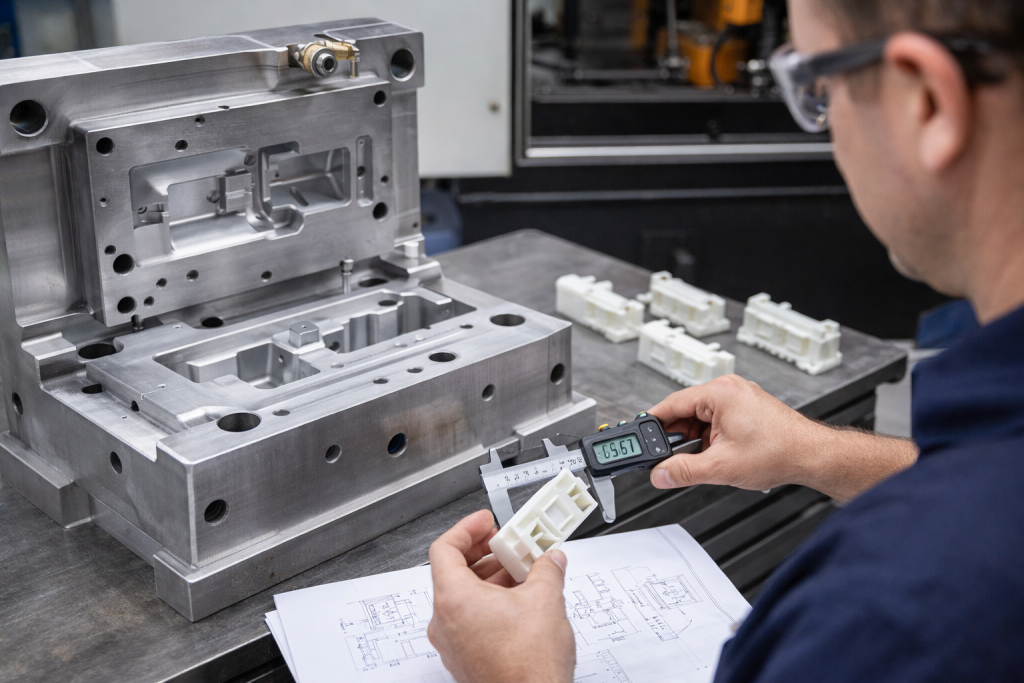
Prototype Injection Molding Capabilities
| Capabilities | Specifics |
|---|---|
|
Press tonnage range |
50 – 1,000 tons (prototype and pilot tooling)
|
|
Typical prototype quantities |
10 – 2,000 pcs per run |
|
Prototype mold types |
Aluminum molds, soft steel molds, simplified prototype tooling |
|
Cavities (prototype tooling) |
Single-cavity or low-cavity tooling, depending on part complexity and volume |
|
Max part size / shot weight |
Up to 800 × 600 mm part size; up to 2 kg shot weight (geometry and resin dependent) |
|
Lead time – DFM & tooling kickoff |
DFM feedback is typically provided before tooling starts; kickoff timing is confirmed during quoting |
|
Lead time (tooling & parts) |
Tooling: approx. 1–3 weeks for prototype molds; parts: approx. 1–2 weeks after T1 approval (confirmed at quote). |
|
Supported materials |
ABS, PC, PC+ABS, PP, PA6/PA66, PBT, POM, TPU; high-performance grades on request |
|
Color / resin selection |
Production-resin prototypes are supported; color matching and special grades are confirmed during quoting |
|
Dimensional tolerances |
Typically ±0.05–0.10 mm, depending on geometry, material shrinkage, and tooling strategy |
|
Wall thickness guidance |
Thin-wall features are supported when flow length and resin allow; final guidance is confirmed during DFM |
|
Surface finish options |
SPI reference finishes, light textures, and functional surfaces; cosmetic limits depend on resin and tooling |
|
Gate / parting line control |
Gate type and parting-line placement are planned to protect cosmetic and CTQ areas when possible |
|
Insert molding |
Supported for prototype builds; insert type, retention features, and validation requirements are reviewed during DFM |
|
Overmolding |
Available on request; feasibility depends on material pairing, shutoffs, and part geometry |
|
Secondary operations |
Trimming, deburring, drilling/reaming, tapping, inserts, and simple assembly (as requested) |
|
Inspection & documentation |
Dimensional inspection reports, CMM data, material certificates, and FAI are available on request |
|
Trial shots & sampling |
Controlled trial shots for T1 sampling; revisions are evaluated based on fit, function, and cosmetic risk |
|
Quality systems |
Process and inspection approach is aligned with drawing requirements and CTQ features (project-dependent) |
Specifications shown are typical ranges and will be confirmed during quoting based on part geometry, resin, quantity, and validation requirements.
Why Use Prototype Injection Molding?

Test with Production-Grade Materials
Prototype injection molding produces parts in production-grade thermoplastics, allowing you to evaluate how the material behaves before production. Check stiffness, surface finish, dimensional response, and other material-dependent characteristics on a real molded part, not just a visual model.

Validate Form, Fit & Assembly
Use injection-molded prototypes to check form and fit with mating components before production. Test snap-fits, mounting points, connectors, clearances, and assembly interfaces on physical parts, where interference or alignment issues are easier to spot.

Functional Testing with Molded Prototypes
Production-grade molded prototypes let you test how a part works in real use, not just how it looks. Depending on the application, you can evaluate movement, load response, retention, flexing, wear, and other functional requirements before moving to production tooling.

Identify Injection Molding Issues Early
Prototype injection molding can reveal problems that may not appear in CAD or earlier prototypes. Molded samples can expose short shots, sink marks, shrinkage, warpage, ejection problems, gate marks, parting lines, and surface defects before production tooling begins.

Refine the Design with T0/T1 Samples
T0/T1 samples give your team real molded parts to measure, assemble, and test. Dimensional results, fit checks, and molding feedback can then be used to adjust the part design or prototype tool before the next sampling round.

Run Low-Volume Parts Before Full Production
When a project needs a small batch before full production, prototype tooling provides real injection-molded parts without requiring the final production mold first. Those parts can move into pilot builds, assembly trials, customer qualification, or early market samples.
Why Choose Kemal for Prototype Injection Molding

DFM & Mold Design
Before prototype tooling starts, Kemal reviews draft, wall thickness, gate location, parting lines, ejection and other moldability concerns. For parts that need deeper analysis, the review extends to Moldflow and 2D/3D mold design before the tool is released for manufacturing.

In-House Mold Manufacturing
Mold making stays in-house, from CNC machining, wire EDM, and sinker EDM through grinding, mold assembly, and trial runs. If a trial exposes a tooling issue, the mold stays with the same team for machining, fitting, and the next mold trial.

Flexible Prototype Tooling
Kemal offers aluminum and soft-steel prototype molds, including single- and low-cavity tooling. Aluminum tooling works well for faster validation and smaller runs, while soft steel is available when the project needs greater tool life or more demanding molding conditions.

Prototype Molding Expertise
Our prototype molding capabilities include conventional single-material parts, insert molding, and overmolding. For parts that combine molded plastic with inserts or a second material, the tooling and molding process are developed around the actual part construction and material requirements.

Dimensional Inspection & FAI
Drawing-controlled or CTQ features can be checked with dimensional inspection and CMM measurement. FAI, dimensional reports, and material certificates are available when the project calls for formal inspection records.

Prototype-to-Production Partner
Start with prototype tooling and T0/T1 sampling, then move into pilot runs, production tooling, and volume injection molding as the project develops. As volumes and production requirements become clearer, we help determine when to move into production tooling and higher-volume molding, with recommendations to lower your costs before full production.
Our Customers
Trusted by 500+ Global Innovators & Industry Leaders


FAQs
What tolerances can you typically hold for prototype parts?
For prototype injection molding, typical tolerances are ±0.05–0.10 mm, depending on part geometry, material shrinkage, and tooling strategy.
Fit-critical dimensions and mating features are reviewed during the DFM review before tooling starts. Tighter tolerances may be possible on selected features and are confirmed during quoting.
Can you mold in production resins for functional testing?
Yes. Prototype parts can be molded in production-grade thermoplastics such as ABS, PC, PC+ABS, PP, PA6/PA66, PBT, POM, and TPU, with high-performance grades available on request. Using the intended production resin gives you a more realistic basis for checking fit, strength, snap performance, dimensional behavior, and other material-dependent requirements before production tooling.
Can you support insert molding or overmolding for prototypes?
Yes. We support insert molding and overmolding for prototype injection molding, when required for functional or assembly validation.
Insert type, retention features, material pairing, and molding sequence are reviewed during DFM before tooling starts. Feasibility depends on part geometry, resin selection, and validation goals, and is confirmed during quoting to ensure reliable prototype builds.
What inspection reports or documentation are available (CMM/FAI/material cert)?
Inspection can be matched to your drawing and approval requirements. Available options include dimensional inspection reports, CMM data, first article inspection (FAI), and material certificates. The inspection scope is confirmed during quoting based on the dimensions and documentation required for your project.
How do I transition from prototype tooling to production tooling?
Once the design has been validated through T0/T1 sampling and prototype builds, the project can move into pilot runs and production tooling. The timing depends on expected volumes, tool life, production requirements, and part-cost targets. Kemal can recommend when it makes sense to move into production tooling and higher-volume injection molding rather than investing in full production tooling too early.
Aluminum vs. Soft Steel Tooling: Which Should I Choose?
It depends on your validation goals, resin, geometry, and expected quantities.
Aluminum tooling is typically the best choice for fast iterations and lower-cost prototype builds. It’s well-suited for functional prototypes and early validation when lead time and flexibility matter most.
Soft steel tooling is often preferred when you need more durability, tighter stability across repeated sampling, or more demanding materials and geometries. It can be a better fit for higher prototype quantities, longer iteration cycles, or parts with more challenging features.
We confirm the tooling recommendation during quoting and DFM based on your CTQ features, resin selection, and target volume.
How long does prototype injection molding take?
Prototype mold tooling typically takes about 1–3 weeks. After T1 approval, molded parts typically require another 1–2 weeks. Final lead time depends on part complexity, resin, tooling revisions, inspection requirements, and the quantity required, and is confirmed during quoting.

