Nylon (polyamide) is one of the most widely used engineering plastics for injection molding, valued for its strength, wear resistance, and chemical stability. However, consistent performance depends on moisture control, shrinkage management, and process discipline. This article explains nylon types, properties, molding best practices, and application-driven material selection.

What Is Nylon (Polyamide)?
Nylon is a semi-crystalline thermoplastic polymer characterized by repeating amide linkages (–CONH–) along the molecular chain. These amide groups create strong intermolecular hydrogen bonding, which is the fundamental reason for nylon’s high strength, toughness, and abrasion resistance.

General characteristics
Nylon is a semi-crystalline engineering thermoplastic commonly used for functional injection-molded parts because it offers:
- Performance: strong strength + toughness, good fatigue and wear/low friction
- Resistance: good durability in contact with oils/greases/fuels
- Tunability: available as unfilled, reinforced (GF/CF), or modified grades to match CTQs
Thermoplastic vs. thermoset behavior
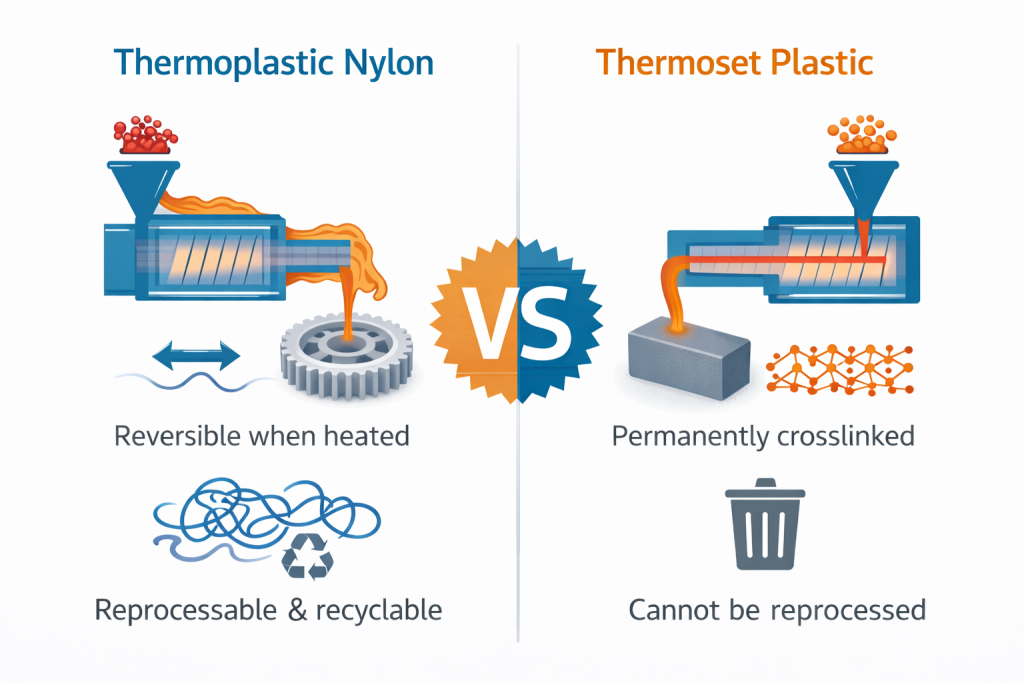
Nylon is a thermoplastic, so it softens when heated and solidifies when cooled—a reversible change. That’s why nylon works well for injection molding: the material can be melted, injected, and reprocessed without the permanent chemical curing seen in thermosets. In contrast, thermosets crosslink during molding and cannot be re-melted, which limits rework and recycling options.
Key Properties of Nylon
1) Mechanical performance (why nylon replaces metal in many parts)
Nylon’s value is not just “high strength”—it’s the combination of toughness + fatigue endurance + wear behavior, which makes it work in moving and load-bearing components.
- Load & impact: strong tensile/flexural strength with good impact resistance (useful for brackets, housings, clips).
- Repeated stress: good fatigue endurance—nylon holds up in parts that flex or cycle (snap features, gears).
- Sliding contact: low friction and abrasion resistance; wear-modified grades further improve tribology for bushings and bearing-like parts.
2) Thermal performance (where nylon can run continuously)
Thermal capability depends heavily on grade (unfilled vs. reinforced/heat-stabilized), but nylon is widely used where parts see moderate heat plus mechanical load.
- Melting point: typically 215–265 °C (grade-dependent).
- HDT: can reach 250 °C+ for glass-filled grades, enabling under-hood and industrial use.
- Continuous use: commonly 100–150 °C; verify with the specific datasheet + environment (load, media exposure).
3) Chemical resistance (why it’s common around oils and fuels)
Nylon generally performs well in oily/greasy environments, which is why it shows up in automotive and industrial assemblies.
- Performs well with oils, fuels, greases, and many solvents.
- Generally acceptable with dilute acids/alkalis (case-by-case).
- Avoiding strong acids and oxidizing agents—material choice should be confirmed against real media + temperature.
4) Electrical properties and density (what this means for connectors)
Nylon is a common connector and switch-housing material because it combines insulation & mechanical toughness.
- Electrical: good insulating performance for many low/medium voltage applications.
- Density: ~1.12–1.15 g/cm³ (unfilled); reinforced grades increase density and stiffness.
The critical variable: moisture absorption (the “hidden” design + process driver)
Nylon is hygroscopic—it absorbs moisture until it reaches equilibrium. This affects both part performance and dimensional stability, and it directly impacts molding quality.
- Equilibrium moisture: typically ~1.5–3.0% (varies by grade and environment).
- What changes as moisture increases:
- Stiffness/strength drop (parts feel “softer” but often tougher).
- Dimensions shift due to swelling—tight fits and CTQ datums need margin or controlled conditioning.
- Molding defects rise (splay/silver streaks, bubbles) if resin is not dried properly before processing.
Manufacturing implication: moisture control is the #1 factor for stable nylon molding—drying, sealed handling, and verified moisture levels should be part of the process plan.
In injection molding, most nylon selection decisions start with three baselines: unfilled PA6, unfilled PA66, and 30–35% glass-filled PA66. The comparison below highlights the practical trade-offs engineers care about—strength/stiffness, moisture sensitivity, and dimensional stability.
PA6 vs PA66 vs Glass-Filled PA66 (GF30–35): Nylon Injection Molding Property Comparison
| Property (Injection Molding Focus) | PA6 (Unfilled) | PA66 (Unfilled) | PA66 GF30–35% |
| Tensile strength (typ.) | ~60–80 MPa | ~75–90 MPa | ~160–220 MPa |
| Stiffness/modulus (typ.) | ~2–3 GPa | ~2.5–3.5 GPa | ~8–12 GPa |
| Moisture absorption (relative) | Higher | Medium | Lower (relative) |
| Dimensional stability | Fair | Good | Excellent |
| Heat resistance (HDT, relative) | Medium | Higher | Highest |
| Mold shrinkage (typ.) | Higher | Medium | Low / more stable (but anisotropic) |
| Typical use | Clips, housings, and general functional parts | Gears, brackets, wear parts | Structural brackets, under-hood parts, load-bearing components |
| Notes | Best flow/toughness; moisture impacts fit | Balanced baseline for functional parts | Highest stiffness; watch fiber orientation/warpage + mold wear |
Common Types and Grades of Nylon for Injection Molding
Nylon in injection molding typically refers to several polyamide families and a wide range of engineered grades. The most common materials are PA6 and PA66, with long-chain and reinforced/modified grades used when specific performance targets are required.
Standard grades
These are the most common nylon families used in injection molding for functional parts.
PA6 (Nylon 6)
PA6 (Nylon 6) is widely used for injection-molded functional parts that must handle assembly flex and everyday handling. Typical examples include snap features, clips, and general housings. In molding, PA6 usually fills thin walls and long flow paths more reliably than PA66, especially on complex geometry. Its main limitation is moisture uptake. If resin drying and the inspection condition are not controlled, dimensional repeatability and part-to-part mechanical results can drift on CTQ features.

PA66 (Nylon 66)
PA66 (Nylon 66) is widely used for parts that operate at higher temperatures and carry heavier loads than PA6 can comfortably handle. You see it in gears, structural brackets, and engine-bay housings. It molds well, but it is less forgiving on process control, especially melt and mold temperatures. Moisture still affects results. If drying and inspection conditions are not controlled, CTQ dimensions and mechanical consistency will vary after conditioning.

PA11 / PA12
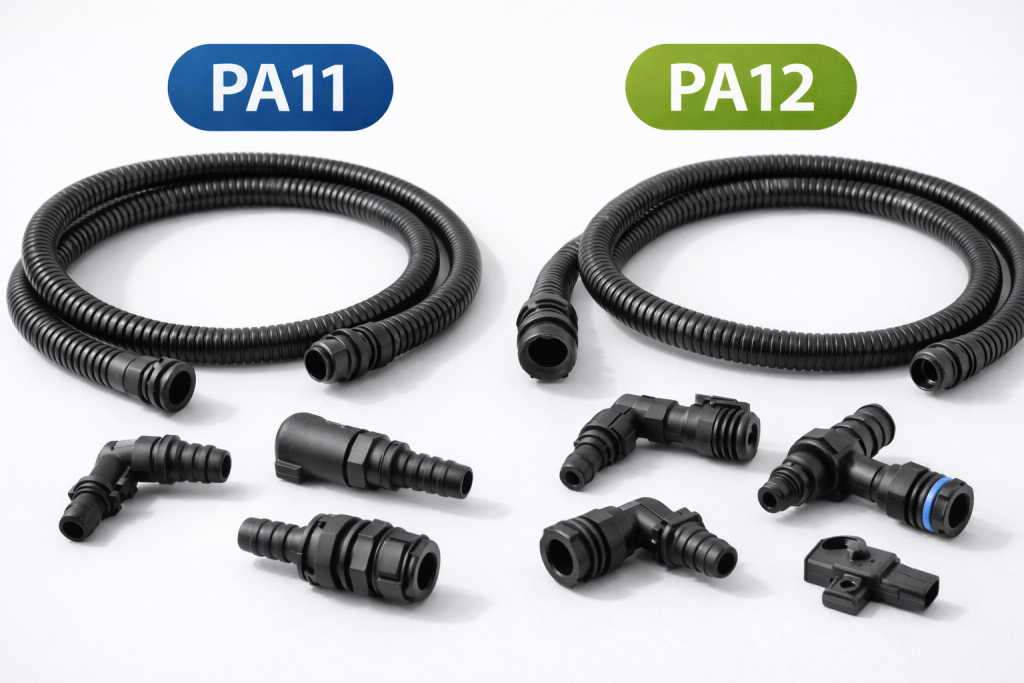
PA11 / PA12 are long-chain nylons used when moisture control and dimensional stability are more critical than maximum stiffness. They are common in tubing and connectors, and in assemblies where fit and sealing must stay stable in humid use conditions. These grades are often specialty materials, so availability and compliance documents should be confirmed early.
High-performance grades
PA46
PA46 is used in nylon parts that must retain stiffness under both heat and mechanical load. It is common in high-temperature mechanical components and under-hood environments where PA66 can start to soften or creep. PA46 is less forgiving in molding, so tight control of melt temperature, mold temperature, and packing is important to avoid warpage and variation.

PA610 / PA612
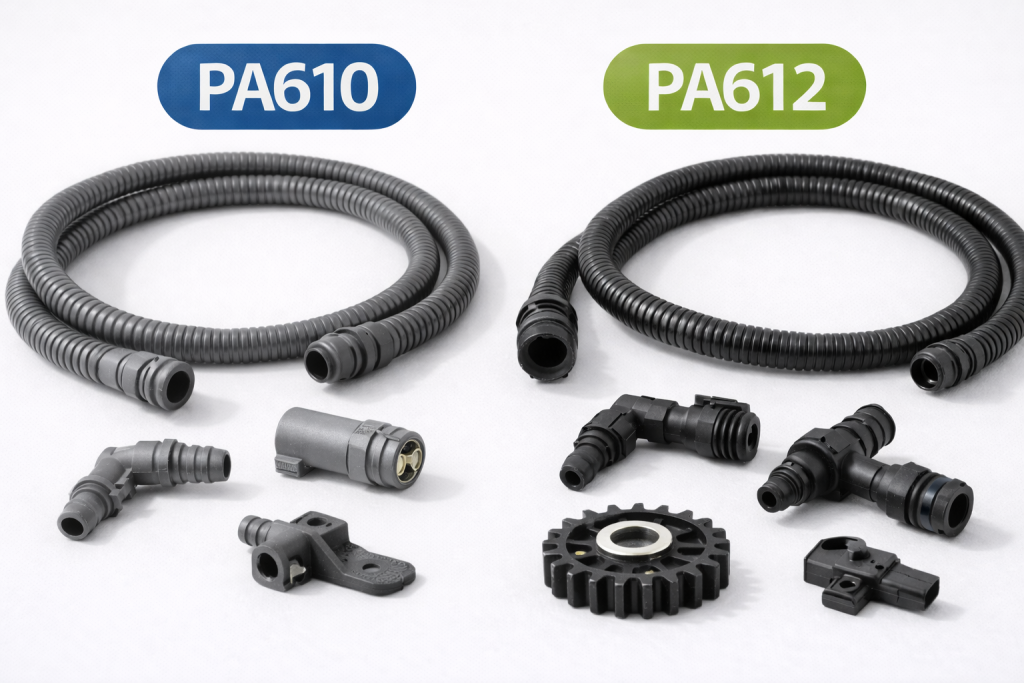
PA610 and PA612 are long-chain nylons chosen to reduce moisture-driven dimensional change compared with PA6 and PA66. They are often used in fit-sensitive functional parts where long-term dimensional stability matters under humidity exposure. These grades are typically more specialty-driven, so confirm grade availability and required documentation early to avoid mid-program material changes.
Reinforced and modified grades
Most production “engineering nylon” is specified as a grade that targets a specific performance requirement. In practice, these grades fall into a few clear groups:
- Reinforced for stiffness and load: Glass fiber (commonly 30–35% GF) and carbon fiber are used to raise stiffness, strength retention, and creep resistance for load-bearing parts.
- Filled for dimensional control: Mineral-filled and glass+mineral hybrids are often chosen to improve dimensional stability and to tune warpage behavior on larger or flatter parts.
- Wear-focused for sliding interfaces: Wear-modified grades with PTFE, graphite, or MoS₂ are used to reduce friction and improve wear life in gears, bushings, and contact surfaces.
- Impact-focused for assembly abuse: Rubber-toughened grades reduce brittle failure when parts see shock loading or repeated snap/assembly stress.
- Compliance and high-heat durability: Flame-retardant and heat-stabilized grades are used for electrical housings and hot environments to meet compliance needs and improve long-term thermal aging performance.
Key Differences Between Nylon Grades for Injection Molding
The real differences between nylon grades appear in molding behavior and long-term stability. PA6 favors easier filling and toughness, while PA66 favors strength and heat resistance. Long-chain nylons improve dimensional stability, and reinforced grades increase stiffness at the cost of tighter process control and higher mold wear.
Nylon Injection Molding Material Selection Guide
| Grade | Best for (typical parts) | Watch (CTQ risk) | Moisture stability | Heat capability |
| PA6 | Snap features, clips, housings | Condition-related size shift; define inspection state | Low | Medium |
| PA66 | Gears, brackets, load-bearing housings | Warpage control needs stable melt/mold temps | Medium | High |
| PA66 GF30 | Structural brackets, under-hood supports | Fiber orientation + mold wear; gate strategy matters | Medium–High | Very high |
| PA12 | Tubing, connectors, sealing-fit assemblies | Specialty grade availability; verify compliance docs | High | Medium |
Injection Molding Nylon: Process, Parameters, and Best Practices
Nylon injection molding is more about controlling a few sensitive variables consistently. Because nylon is hygroscopic and semi-crystalline, moisture control, thermal balance, and packing discipline largely determine whether parts are repeatable or drift over time.
Material preparation and drying
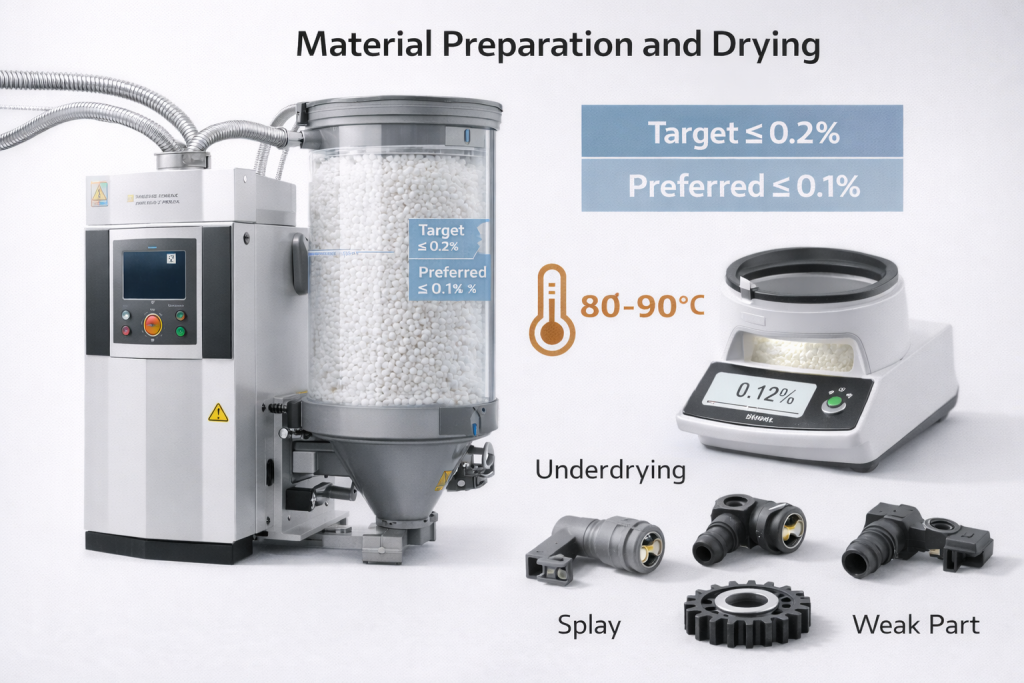
Drying is the single most critical step in nylon molding. Even small amounts of residual moisture can turn into vapor during injection, leading to surface defects and inconsistent mechanical performance.
For most PA6 and PA66 grades, a target moisture level below 0.2% is required, with ≤0.1% preferred for appearance or CTQ parts. Drying is typically done at 80–90 °C for several hours using a desiccant dryer. Under-drying shows up quickly as splay, bubbles, or weak parts, while excessive heat or dwell time during drying can degrade the polymer and reduce toughness.
Processing window and thermal control
Nylon requires a stable thermal window to balance flow, crystallization, and shrinkage.
Melt temperatures generally fall between 240–300 °C, depending on grade and reinforcement, while mold temperatures are commonly kept in the 60–90 °C range and pushed higher for glass-filled materials. Fast filling is often needed to avoid premature freezing, but it must be paired with adequate packing pressure to control shrinkage and dimensional variation. Inconsistent melt or mold temperature is a common root cause of warpage and part-to-part variation.
Shrinkage and warpage behavior
Shrinkage in nylon is strongly grade-dependent and direction-dependent.
Unfilled nylons typically shrink in the 1.0–1.8% range, while glass-filled grades shrink much less, often around 0.2–0.6%, but introduce anisotropy due to fiber orientation. This means warpage is not just a material issue—it is closely tied to gate location, flow direction, and packing strategy.
These factors should be addressed early in DFM and mold design, not corrected after sampling.
Nylon Injection Molding Defects: Causes and Fixes
Most nylon molding defects come from a few controllable variables.
- Splay/bubbles / weak parts: Most often caused by moisture or trapped gas, so dry the resin to spec and confirm venting is open and adequate.
- Fiber float / rough surface (GF grades): Usually driven by an aggressive fill and low mold temperature, so tune the injection speed and raise the mold temperature to stabilize the skin layer.
- Warpage/twist: Typically comes from unbalanced cooling, packing, and fiber orientation, so balance cooling and adjust packing while reviewing gate location and flow direction.
- Sink marks: Most commonly due to insufficient packing at thick sections, so increase hold pressure/time and improve geometry by coring thick areas or using ribs.
- Brittleness/burning: Usually indicates thermal degradation, so reduce melt temperature and residence time, and lower shear from screw speed/back pressure.
- Flash: Most often caused by excessive cavity pressure or worn shutoffs, so reduce peak/pack pressure and check parting lines and shutoff steel condition.
Nylon Injection Molding Part Design Guidelines
- Wall thickness (target 1.0–3.5 mm): Keep walls as uniform as possible to control shrinkage and reduce sink and warpage, especially around ribs, bosses, and thick-to-thin transitions.
- Radii and fillets: Use generous radii at corners and load paths to reduce stress concentration and improve flow, which lowers cracking risk and improves cosmetic consistency.
- Draft (≥ 1°): Provide at least 1° draft for unfilled nylon and increase draft for glass-filled grades to reduce drag marks, improve ejection stability, and protect tool steel.
- Gating and venting: Place gates to support balanced fill and packing across CTQ features, and vent end-of-fill areas to prevent gas traps that show up as splay, burn marks, or short shots.
Nylon Molding Parameters: PA6 vs PA66 vs PA66 GF30
| Parameter | PA6 | PA66 | PA66 GF30 |
| Drying target (moisture) | ≤0.20% (preferred ≤0.10%) | ≤0.20% (preferred ≤0.10%) | ≤0.20% (preferred ≤0.10%) |
| Drying conditions (typ.) | 80–90°C, 4–6 h | 80–90°C, 4–6 h | 80–90°C, 4–6 h |
| Melt temp (°C) | 240–270 | 260–290 | 270–300 |
| Mold temp (°C) | 60–80 | 70–90 | 80–100 |
| Shrinkage (typ.) | 1.0–1.8% | 1.0–1.6% | 0.2–0.6% (orientation-dependent) |
| Process note | More forgiving fill; moisture-sensitive | Higher heat/strength baseline | Highest stiffness; watch fiber orientation/warpage |
Typical Applications of Injection-Molded Nylon Parts
Nylon is used across many industries because it combines load capability, wear resistance, and chemical durability in a moldable material family.
Automotive
Nylon is widely used in automotive because it performs well around oils, fuels, and continuous vibration, while cutting weight versus metal. PA66 and glass-filled PA66 are common for under-hood brackets, housings, and structural supports where stiffness retention matters. For fit-critical interfaces, conditioning state and warpage control must be defined early to avoid drift after moisture exposure.
Industrial and mechanical
In industrial equipment, nylon is chosen for sliding contact, repeated cycles, and abrasion, which is why it shows up in bushings, wear pads, rollers, and pump-related components. Wear-modified grades are often used when friction and service life are CTQ drivers. For parts that see load and heat together, reinforced grades are typical, but mold wear and fiber orientation effects must be managed.
Electrical and electronics
Nylon is a common material for electronics, such as connectors, switch housings, and terminal structures, because it combines insulation performance with mechanical toughness. Flame-retardant grades are used when compliance is required, and glass-filled grades are often selected to hold pin alignment and assembly geometry. The key risks are moisture-driven dimensional change and flash control around fine features.
Consumer products
Consumer applications use nylon where parts see impact, repeated handling, and wear, such as buckles, latches, power-tool housings, and appliance components. PA6 is often selected for its toughness and molding forgiveness on complex geometry, while PA66 is used when higher heat resistance is needed. Cosmetic requirements usually drive gate strategy and surface control more than the base resin choice.
Medical and food-contact
When nylon is used in medical or food-contact assemblies, material choice is driven by compliance and stability, not just strength. PA11 and PA12 are common in tubing and connector-style components because they typically offer better dimensional stability under humidity exposure. These applications require early confirmation of the exact grade, traceability, and documentation requirements.
In practice, we match nylon grades to the part’s CTQs first (fit, wear, heat, compliance), then confirm the process window with a DFM review and sampling plan.
Conclusion
Nylon (polyamide) is a proven engineering plastic for injection molding because it delivers strong functional performance at a practical cost. Results depend on execution: choose the right grade, control moisture, and lock down tool and process stability for CTQ features. As bio-based, recycled-content, and high-performance nylon grades expand, nylon will continue to replace metal in more demanding applications.