Overmolding is a versatile manufacturing process that enhances product performance, durability, and aesthetics by combining multiple materials into a single, integrated part. This technique is widely used across various industries, including automotive, electronics, medical devices, and consumer goods. While overmolding offers significant advantages, such as improved ergonomics and cost efficiency, it also presents a unique set of challenges. Achieving a flawless final product requires careful attention to material selection, mold design, and process control. This article provides a comprehensive guide to troubleshooting the most common problems encountered in overmolding, drawing on insights from leading industry experts.
But where does a failure typically originate? In most cases, it starts with the bond itself—the foundation upon which the entire part is built.
1. Adhesion and Material Compatibility Issues
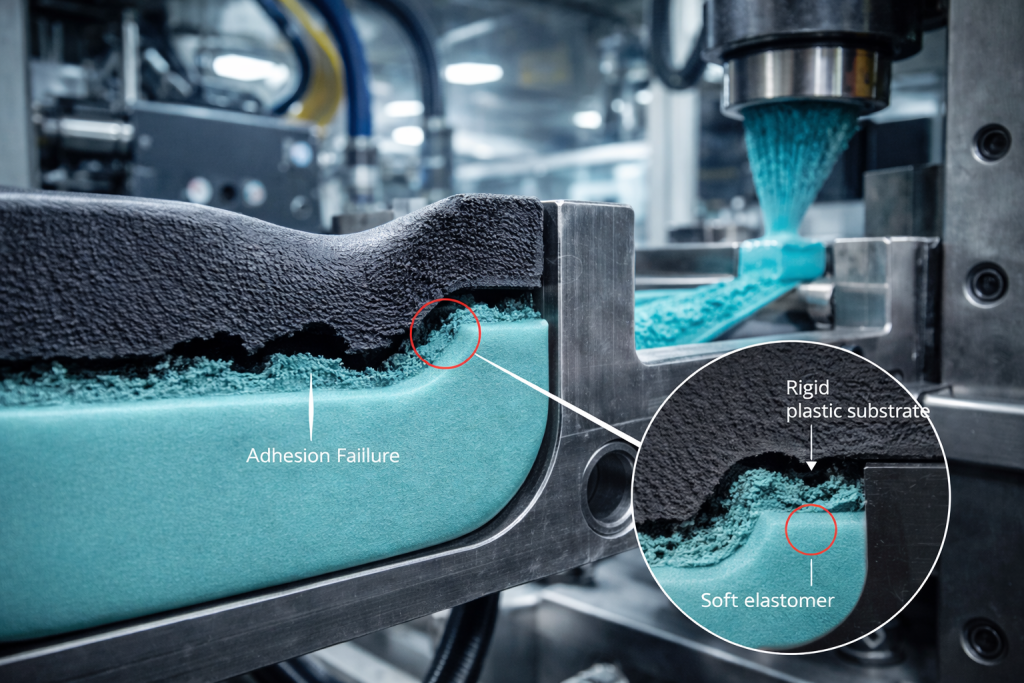
The most critical factor in overmolding success is achieving a strong, durable bond between the substrate and the overmolded material. Adhesion failures, such as delamination, compromise the structural integrity and functionality of the part. These issues often stem from material incompatibility, surface contamination, or improper processing.
Material Compatibility
Not all materials are created equal, and their chemical compatibility is paramount for a successful bond. The choice of materials for both the rigid substrate and the flexible overmold is the foundation of the overmolding process. As a general rule, materials with similar chemical compositions tend to bond well together.
| Substrate Material | Compatible Overmold Material |
| Polypropylene (PP) | Thermoplastic Elastomers (TPEs) |
| Styrenics (PS, ABS) | Styrenic-based Elastomers |
| Nylon (PA) | Flexible Nylons, specialized TPEs |
| PBT Polyester | PBT Polyester-based Elastomers |
| Polycarbonate (PC) | Polyurethane Elastomers, Si-TPV |
Table 1: A summary of generally compatible material combinations for overmolding.
While selecting chemically compatible materials is the foundation, it is not a guarantee of success. Even the most perfect material pairing can fail if the physical interface is compromised by external factors.
Material contamination can also lead to catastrophic adhesion failure. In one case study, a batch of soft-touch knobs with a glass-fiber-reinforced polypropylene substrate suddenly began to fail. Analysis using Differential Scanning Calorimetry (DSC) revealed that the polypropylene had been contaminated with nylon 6, a material for which the styrenic elastomer overmold had no affinity, resulting in a complete loss of adhesion.
Surface Contamination and Preparation
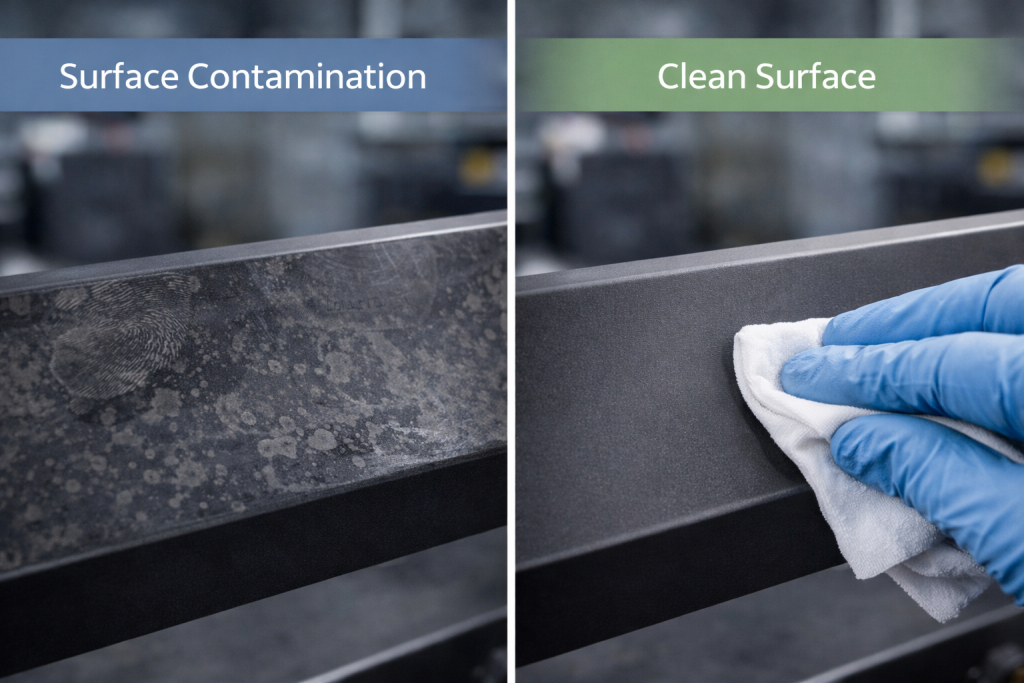
Even with compatible materials, contaminants on the substrate surface can act as a barrier, preventing a strong bond. Common contaminants include dirt, oil, fingerprints, and mold release agents.
Troubleshooting Tip: Thoroughly clean the substrate surface using a suitable solvent, such as alcohol, before overmolding. Ensure the cleaning process leaves no residue. For some materials, surface treatments like plasma treatment, corona treatment, or chemical etching can improve the surface energy and enhance adhesion.
In addition to standard thermoplastics, many high-performance applications now turn to Liquid Silicone Rubber (LSR). However, overmolding with LSR introduces a unique set of variables that go beyond typical bonding techniques.
Special Considerations for Liquid Silicone Rubber (LSR)

Overmolding with Liquid Silicone Rubber (LSR) is increasingly popular, especially in the medical device industry, due to its superior chemical resistance, tensile strength, and biocompatibility [5, 8]. However, LSR presents its own set of challenges, as it does not naturally adhere well to many plastics and metals.
Key best practices for LSR overmolding include:
- Material Selection: Choose a substrate with a glass transition temperature above 300°F and consider using newer “primerless” or “self-adhesive” grades of LSR.
- Avoid Additives: Steer clear of substrate thermoplastics that contain additives like mold releases, sulfur, or amines, which can inhibit the cure of LSR.
- Keep Substrates Warm: The bonding of LSR is a chemical reaction that requires time, temperature, and pressure. Preheating the substrate is often necessary, especially in a transfer overmolding process.
- Mechanical Interlocks: Designing features like through-holes that allow the LSR to create a mechanical lock with the substrate can provide an extra layer of security.
Ensuring chemical and surface compatibility is only half the battle. Once the materials are finalized, the focus must shift to the injection molding environment itself, where pressure, temperature, and tool design dictate the final outcome.
2. Mold and Process-Related Defects
Many overmolding defects are directly related to the mold design and the injection molding process parameters. These issues can often be resolved through careful adjustments and optimization.
| Defect | Possible Causes | Corrective Actions |
| Flash | Poor mold fit, inadequate clamp tonnage, poor shutoff design, high injection pressure | Check tool fit, increase clamp tonnage, decrease injection pressure, and re-cut the tool for a complete shutoff |
| Short Shots | Insufficient material, low injection pressure/speed, cold melt, poor venting | Increase shot size, injection pressure, and speed; raise melt temperature; improve vents |
| Air Traps/Voids | Poor venting, high injection speed, incorrect gate location, and low material temperature | Improve venting channels, reduce injection speed, optimize gate location, and increase material temperature |
| Surface Sinks | Material shrinkage, gate freeze-off too early | Increase pack pressure/hold time, decrease material temperature, increase gate size |
| Knit Lines | Gas trapped between polymer fronts, low melt temperature | Improve vents, increase injection speed, and melt/mold temperature |
Table 2: Common mold and process-related defects and their solutions.
While resolving flash and short shots ensures a functional part, it does not always guarantee a marketable one. Manufacturers must also account for the ‘silent killers’ of quality: warping and aesthetic inconsistencies that appear post-molding.
3. Part Quality and Aesthetic Defects
Aesthetic and dimensional issues can render a part unusable, even if the structural bond is sound. These problems are often related to material properties, cooling, and handling.
Warping and Distortion

Warping occurs when the overmolded part does not maintain its intended shape after cooling, often due to uneven shrinkage or internal stresses.
Troubleshooting Tip: Ensure uniform cooling by optimizing the mold’s cooling channels. For the part design, aim for uniform wall thickness to prevent differential shrinkage. Lowering the molded-in stress in both the substrate and the elastomer can also mitigate warping.
Blisters, Splay, and Color Issues
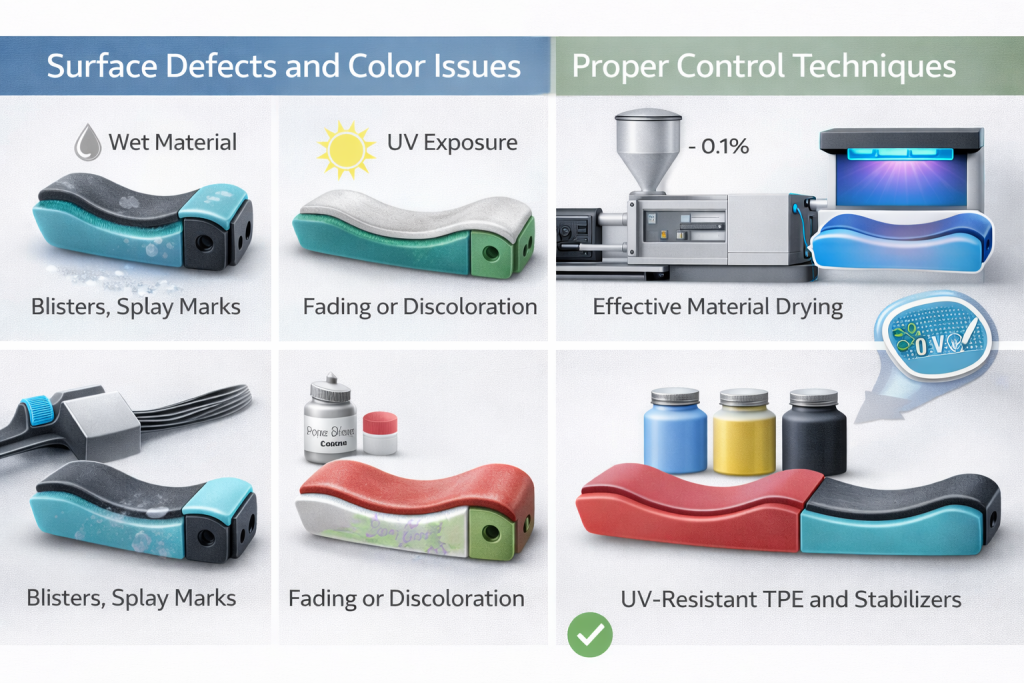
- Blisters and Splay Marks: These surface defects are often caused by moisture in the raw materials or material degradation from excessive heat [1, 3]. Properly drying materials before molding is crucial. For TPEs, this can mean drying for 4-6 hours to get the moisture content below 0.1%.
- Non-Uniform Color or Fading: Incompatible color concentrates or inadequate dispersion can lead to uneven color [1]. Fading, especially in products exposed to the outdoors, can be caused by poor material stability or UV exposure. Using UV-resistant materials and adding stabilizers can prevent this.
From chemical bonding to the final surface finish, mastering overmolding requires balancing multiple technical disciplines. When these elements are properly aligned, the inherent challenges of the process become manageable.
Conclusion
Successful overmolding is a balance of science and art, requiring a deep understanding of material science, mold design, and process engineering. While the process presents numerous challenges, a systematic approach to troubleshooting can resolve most issues. From ensuring material compatibility and a pristine substrate surface to optimizing process parameters and mold design, every step is critical. By addressing these common problems proactively, manufacturers can harness the full potential of overmolding to create high-quality, durable, and aesthetically pleasing products.