The most common pitfall in TPU injection molding is that the prototype passes in one shot, but problems appear repeatedly once mass production begins. One batch shows obvious flow marks, the next batch has bubbles; flash at the parting line appears intermittently; critical dimensions pass inspection right after demolding, but deviate after being left for a while. Many teams’ first reaction is to keep adjusting temperature, injection speed, or hold pressure, but the result is often only a “temporary improvement,” and the problem soon recurs.
To stabilize TPU, you must first firmly grasp the few factors that truly determine the outcome: whether the material is moisture-conditioned, whether filling too fast causes shear overheating, and whether venting and parting surfaces can consistently control trapped air and flash. Once these factors are clarified one by one and a verifiable process window is established, “occasional problems” can be turned into predictable, controllable process results.

Why TPU Injection Molding Is Hard to Stabilize
The difficulty in stabilizing TPU injection molding is not mysterious. Its fluctuations often stem from chain reactions amplified by the material’s inherent properties and process boundaries. The following four points represent the most common and decisive “cause → effect” paths.
Elastic Recovery Causes Time-Dependent Dimensional Drift
TPU is not a typical rigid plastic. Parts continue to release stress and undergo elastic recovery after demolding. The same part may have different dimensions immediately after demolding, once fully cooled, and after being left for a period of time. If the measurement condition is inconsistent, or if cooling and ejection create significant differences in residual stress, the first piece may pass while re-measurement exceeds tolerance. From an engineering perspective, dimensional stability should be treated as a time-dependent issue: unify the measurement condition and pay attention to the impact of cooling and ejection on residual stress.
Moisture Sensitivity Makes Splay and Bubbles a Material-Condition Issue
TPU is highly sensitive to moisture and reabsorption. If moisture enters the plasticizing stage, it may vaporize in the melt or trigger degradation that generates gas, resulting in visible flow marks, bubbles, or surface haze. On-site practices often involve reducing temperature or injection speed to suppress defects, but this usually only addresses the symptom. As long as the material condition is not stabilized, defects will reappear across different batches and times. When troubleshooting flow marks and bubbles, material drying and moisture control should generally take priority over parameter adjustments.
Trapped Gas Can Trigger Burn Marks, Short Shots, and Surface Haze
TPU flows well but is more demanding on venting. Insufficient venting can compress trapped gas, causing burn marks. Gas that cannot escape in time may also lead to short shots and surface defects such as haze or pitting. These problems often appear intermittently: the same process may run normally in some cycles but suddenly show defects in others. The root cause is usually that the venting capability is insufficient to accommodate process fluctuations and melt temperature variations.
Why TPU Flashes Easily: Low Viscosity Amplifies Parting-Line Weakness
“Why TPU flashes easily” rarely corresponds to a single factor. TPU’s low viscosity and strong mold adhesion amplify small parting-line gaps, locally insufficient support, and uneven clamping force into visible flash. High mold temperature, excessive hold pressure, or reduced viscosity make flash more pronounced. If parting surfaces and inserts lack stable clearance, flash may appear intermittently. Simply adjusting parameters usually only mitigates the issue temporarily; long-term stability requires treating parting-line sealing and venting boundaries as foundational conditions.
These four cause-and-effect paths illustrate that TPU injection molding stability is fundamentally a system-level problem. To improve consistency, first lock in the material and measurement states, then control shear-induced heat, and treat venting and parting-line sealing as boundary conditions for the process window. This approach turns defects from occasional occurrences into predictable, controllable outcomes.
TPU Material Factors That Change the Process Window
The stability of TPU injection molding is first determined by the material itself. Different types, hardness levels, and modifications directly affect flow behavior, appearance risks, and dimensional convergence. If the material condition is not locked before trial molding, the process window is difficult to make meaningful or reliable.
Ether vs. Ester TPU: Environment Drives Long-Term Stability
The differences between Ether and Ester TPU are more about environmental adaptability than short-term molding difficulty.
Ether TPU is more hydrolysis-resistant and better suited for applications involving heat and moisture or long-term water exposure. Ester TPU usually offers better wear resistance and mechanical strength in dry environments but is more sensitive to heat and humidity.
At the injection molding level, the differences in flow and filling are not always significant, but long-term appearance stability and weld line strength diverge depending on the service environment. If the target operating conditions are not clearly defined, conclusions about appearance and strength obtained during trial molding often fail during later use.
Shore Hardness: Softer Does Not Mean Easier to Mold
The impact of hardness on the TPU injection molding window is often underestimated.
As Shore hardness decreases, the material is more prone to elastic deformation. During ejection, parts are more likely to tear or incur permanent deformation. After cooling, the extent of elastic recovery is greater, making dimensions more sensitive to storage time and measurement method.
Therefore, low-hardness TPU does not equal “easier to mold.” It demands closer attention to the ejection method, cooling balance, and measurement state. Relying on experience from rigid plastics or high-hardness TPU almost inevitably results in dimensional drift and appearance instability.
Modified and Filled TPU Requires a Separate Process Window
Flame-retardant, wear-resistant, or reinforced TPUs significantly change melt behavior.
Fillers and additives typically increase shear sensitivity, alter temperature distribution at the flow front, and affect surface quality and weld line strength. These materials have smaller tolerance windows for appearance defects, burn marks, and weld lines.
From an engineering perspective, modified TPU should not be treated as “slight parameter adjustments on a base grade.” Each modified system requires a separately established and validated process window; otherwise, defects tend to appear intermittently and unpredictably.
Lock These Three Before Tooling Trials
Before entering trial molding or process validation, the following three key pieces of information must be locked:
- Material type (Ether or Ester TPU): Define the material system to assess hydrolysis risk, long-term appearance stability, and trends in weld line strength under different environmental conditions.
- Target hardness range (Shore hardness): Define the hardness range to evaluate flow behavior, ejection deformation risk, elastic recovery, and dimensional stability.
- Actual service environment of the part: Include heat and moisture conditions, whether the part will have long-term exposure to water or other media, and temperature variations. These factors directly affect material selection and the validity of process validation conclusions.
Only when these three factors are clearly defined and consistent can trial molding and process validation results be used as a reference for mass production. Otherwise, even if the prototype performs well, it may only succeed under specific conditions and cannot be reliably reproduced in subsequent production.
Drying TPU Correctly to Prevent Splay and Bubbles
Flow marks and bubbles are the most easily “misdiagnosed” defects in TPU injection molding. On-site, a common approach is to first adjust temperature, injection speed, or hold pressure. However, if the material’s moisture and reabsorption state are not locked, such adjustments usually only provide temporary improvement. Defects will recur with batch changes, fluctuations in ambient humidity, or machine shutdowns and restarts. A more reliable engineering sequence is to first stabilize the material condition and then optimize the molding window.
Start with Moisture, Not Temperature Changes
The first judgment for flow marks or bubbles should go back to the material’s moisture content, rather than jumping straight into parameter adjustments. This is because fluctuations in TPU moisture directly translate into surface defects and trapped internal gas. Even if process parameters are within a reasonable range, splay and bubbles will intermittently appear as long as the raw material absorbs moisture.
Conversely, if the material condition is stabilized, temperature and speed optimizations become reproducible. For projects aiming to reduce defect recurrence, starting with verifying moisture content is often more effective than repeatedly adjusting melt temperature.
Why “Correct Drying” Still Fails in Production
Many projects have acceptable drying settings, yet defects still recur. The problem often lies in links outside the dryer itself. The most common issues are:
- Inconsistent exposure time after opening: Different batches may have varying moisture conditions when loaded into the machine.
- Reabsorption in hoppers and feed lines: Drying at the dryer outlet does not guarantee the material remains dry before reaching the screw.
- Material management during shutdowns: Material left in the hopper or barrel may absorb moisture or experience thermal history changes during downtime. When production resumes, flow marks and bubbles often concentrate at the initial cycles and then gradually subside, creating the illusion of “random fluctuation.”
Only by bringing these three areas under unified control can the material condition be truly stabilized.
Over-Drying Can Cause Haze and Degradation
The goal of drying is to reduce moisture, but this does not mean higher temperature and longer time are always safer. For some TPU systems, prolonged high-temperature drying or thermal residence can increase the risk of degradation. This often manifests as surface haze, reduced gloss, possible odor changes, and even color shifts. Once such issues appear, further increasing the TPU drying temperature or extending the TPU drying time usually worsens the defects.
From an engineering perspective, both lower and upper limits must be set: the lower limit prevents splay and bubbles caused by moisture, and the upper limit prevents appearance deterioration and performance fluctuations caused by excessive thermal history.
Diagnose Splay vs. Internal Bubbles as Two Different Problems
Flow marks and bubbles may look similar, but the diagnostic logic should be separated.
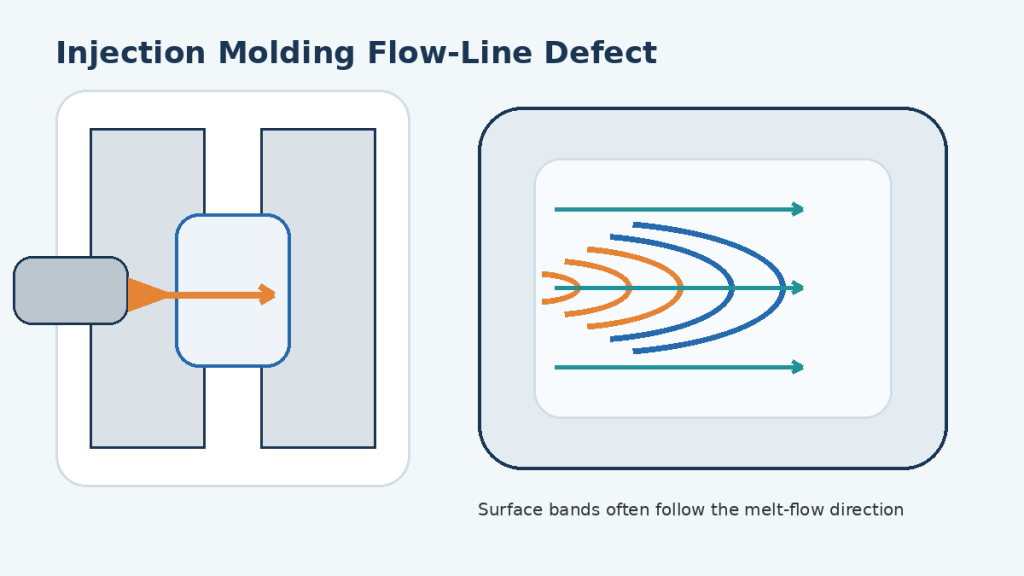
Surface splay in TPU injection molding is usually related to moisture vaporization, slight degradation gases, and amplified shear-heat effects. It typically follows the flow direction and is highly sensitive to material condition.
Internal bubbles or voids require further distinction between trapped gas and shrinkage-type voids in thick sections. The former is more dependent on drying and venting conditions, while the latter depends more on hold pressure and cooling balance.
Only by first distinguishing defect types can subsequent process adjustments avoid “making things worse” through blind tuning.
A Practical Starting Process Window for TPU Injection Molding
In TPU injection molding, establishing a process window that only defines “parameter ranges” often fails to reproduce results in mass production. A more practical approach is to link every parameter adjustment to observable outcomes. Even with differences in equipment or batches, engineering judgment then has a clear direction, rather than relying on experience and repeated trial-and-error.
Think in Adjustment Direction, Not Fixed Numbers
For TPU, temperature, speed, and pressure themselves are not the goal—part response is the real criterion. For example:
- When the melt temperature is increased, if surface flow marks improve but haze or burn marks appear, it indicates that shear heat is approaching the upper limit.
- When the injection speed is reduced, if splay improves but the far end starts to short shot, it shows that the speed lower limit has been reached.
Recording these “phenomenon → direction” relationships is more valuable than memorizing a set of TPU melt temperatures or injection speeds, and makes the knowledge easier to reuse across different projects.
Shear Heat Is a Bigger Risk Than Fill Pressure
Problems in TPU injection molding more often stem from shear heat than insufficient cavity fill pressure.
When the injection speed is too high, shear heat accumulates rapidly during filling, amplifying splay, burn marks, and surface haze. These defects usually appear locally first—near the gate or the flow front—while overall filling may still be “successful.”
Therefore, speed should not be set with the goal of “fastest without short shots,” but rather with the upper limit being the point where surface quality begins to degrade. When appearance becomes highly sensitive to speed changes, shear heat has typically become the dominant factor.
Mold Temperature Couples Surface Quality and Flash Risk
Mold temperature is a key variable for both TPU surface quality and demolding behavior, and is strongly coupled with flash risk.
- Low mold temperature leads to poor surface replication and increased flow marks or ejection drag.
- High mold temperature improves surface quality, but decreases melt viscosity, and increases flash risk at parting lines.
In practice, the “optimal” mold temperature is rarely a single value; it must be evaluated together with parting-line quality and clamp status. Attempting to solve appearance or flash issues by adjusting mold temperature alone often introduces new instability.
Holding Pressure Is About Dimensional Convergence
In TPU molding, the purpose of holding pressure is not to “completely fill the cavity,” but to ensure that critical dimensions converge within a repeatable range.
- Too low holding pressure amplifies shrinkage variation.
- Too high holding pressure may introduce additional residual stress, making post-demold rebound more pronounced.
A more effective way to judge holding pressure is to observe how key dimensions change over time, rather than only looking at measurements immediately after demolding. Holding pressure is truly effective only when dimensions remain within the same window after a period of time.
Back Pressure and Plasticizing Stability Control: Batch Consistency
Back pressure and plasticizing stability directly determine batch-to-batch consistency, especially when using modified TPU.
- Low back pressure reduces melt uniformity, leading to cyclic variation in appearance and dimensions.
- Excessive back pressure increases thermal history and degradation risk.
The engineering focus should not be on a fixed back pressure value, but on ensuring that the melt state entering the cavity is consistent each cycle. When appearance and dimensions start fluctuating with the cycle, the plasticizing stage is usually the first place to review.
Understanding the process window as a combination of “observable outcomes and adjustment directions,” rather than a set of isolated parameter values, is the key to keeping TPU injection molding controllable across different machines and batches. While this approach starts conservatively, it establishes a window that is far easier to reproduce stably in actual production.
Gate, Venting, and Parting Line Choices That Reduce Defects
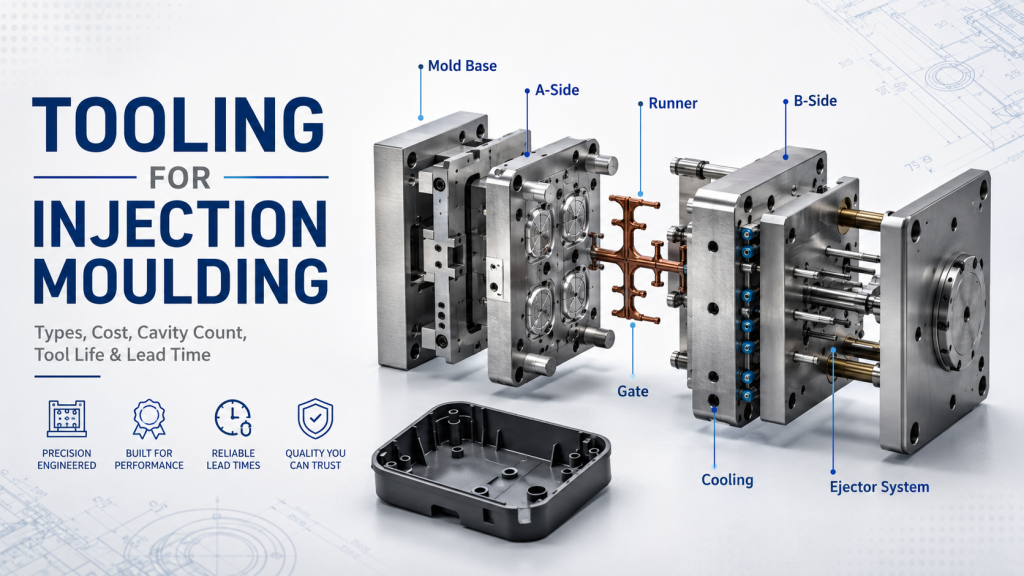
In TPU injection molding projects, many problems labeled as “process instability” actually originate not from parameters but from gas management and parting-line control at the mold level. When venting, parting lines, and ejection strategies do not allow sufficient margin for TPU’s flow and elastic recovery characteristics, the process window is severely compressed, leaving the shop floor to maintain results only through frequent parameter adjustments.
Many “Process Defects” Are Actually Venting and Parting-Line Issues
TPU flows easily, but this does not make it more tolerant of mold conditions. On the contrary, its low viscosity and strong mold adhesion amplify gas and parting-line issues. If venting is insufficient or parting-line sealing is unstable, defects often appear intermittently rather than continuously. This explains why the same process may run normally in some cycles but suddenly fail in others. The problem is not “process drift,” but rather that the mold boundaries themselves cannot accommodate process fluctuations.
Insufficient Venting Often Appears as a Defect Combination
When venting is inadequate, defects rarely appear alone—they usually present as a combination. The most typical manifestation is short shot, burn marks, and surface haze or pitting occurring simultaneously. Gas trapped at the end of filling or in enclosed areas compresses, creating localized high temperatures that form burn marks. Gas that cannot escape also obstructs the melt front, causing short shots. On the surface, this may appear as haze, pitting, or uneven gloss. Once these phenomena occur, simply increasing injection pressure or speed often worsens shear heat and amplifies the defects. Engineering judgment should first assess the mold’s TPU venting capability rather than continue to expand process parameters.
Why TPU Flash Is Not Just a Clamp Force Problem
“TPU flash at the parting line” is rarely caused by a single factor.
Low viscosity makes TPU highly sensitive to parting-line condition, but the severity of flash is usually determined by multiple factors. Parting-line machining quality, insert fit clearance, mold temperature, melt viscosity changes, and holding pressure all affect melt penetration at the parting line. Even with sufficient clamp force, flash can still appear intermittently if the mold temperature is high or viscosity drops due to temperature and shear. Simply increasing clamp force at this point may only mask the problem and can introduce mold wear and long-term stability risks.
Gate Design Must Address Stringing and Gate Blush Risks
In TPU gate design, stringing and gate blush must be treated as independent risk points rather than incidental phenomena. TPU’s elasticity and rebound characteristics make the gate prone to stringing during shear release and demolding, and stress concentration at the gate can cause local whitening or appearance defects. Gate size, location, and shear level must ensure stable filling while avoiding excessive stress in the gate area. If gate issues recur, simply adjusting temperature or speed is usually insufficient for a long-term solution.
Ejection Strategy Should Focus on Preventing Permanent Deformation
Ejection issues in TPU are often underestimated as “demolding difficulty.” In reality, the key concern is permanent deformation risk. Improper ejection location or too rapid an ejection sequence introduces local stretching or compression while the part is still highly elastic, resulting in deformation that cannot fully recover after demolding. Ejection strategy should focus on support uniformity and release sequence, rather than simply increasing ejection force or strokes. When surface scratches, dimensional drift, or abnormal assembly forces correlate strongly with ejection points, the problem is usually beyond the reach of parameter adjustments.
Evaluating gate, venting, parting lines, and ejection as an integrated system is key to reducing defect recurrence in TPU injection molding. Only by establishing sufficiently robust boundaries at the mold level can subsequent process optimization truly be effective, rather than repeatedly struggling within a narrow window.
Part Design Rules for Stable TPU Molding
In TPU injection molding, part design often determines the upper limit of process stability. Many issues that repeatedly appear in mass production—such as dimensional drift, abnormal assembly forces, or appearance defects—are not caused by a “wrong process window,” but by part structures that amplify TPU’s elastic recovery and stress relaxation characteristics. Unlike rigid plastics, TPU design should not focus solely on “can it be molded,” but on whether deformation is predictable and recovery is consistent.
Wall Thickness Is About Elastic Response, Not Just Shrinkage
In TPU, wall thickness effects go far beyond shrinkage. Uneven wall thickness changes local stiffness, creating “hard spots.” These hard spots lead to inconsistent recovery during demolding, cooling, and subsequent assembly. The result often manifests as: dimensions passing initial inspection but drifting after a period of time or under assembly stress, or assembly forces fluctuating significantly between batches.
Thus, the core goal of TPU wall thickness design is not minimizing shrinkage variation, but ensuring the entire part exhibits a consistent elastic response during cooling and under load. Continuous, gradual wall thickness transitions are more favorable for dimensional and assembly stability than localized thick sections.
The “Thin Hinge + Thick Mass” Structure Is a Common Drift Source
In soft structures, a “thin hinge + thick mass” layout is one of the most easily overlooked and common sources of drift. The thin section handles major deformation, while the thick section bears load or assembly alignment. Excessive stiffness difference between the two creates unstable stress-relief paths during cooling and recovery. In the short term, parts may meet functional requirements, but over time or under cyclic loading, assembly forces and positional relationships often change.
This structure is particularly common in TPU snap-fit designs and flexible connectors. If flexible regions are necessary, stiffness changes should be distributed over a longer structural span, rather than concentrated in a single cross-section. This reduces local stress concentration and minimizes the impact of recovery differences on overall dimensions.
Cosmetic Parts and Functional Parts Fail in Different Ways
Design priorities for TPU parts should be clearly differentiated based on their intended use.
- Cosmetic parts: The main risks are weld line location, flow marks, and surface consistency. Whether the weld line falls on the primary visible surface is often more critical than local strength. Adjusting flow paths and sacrificing some local stiffness can actually improve overall appearance consistency.
- Functional parts: Focus is on dimensional stability and permanent deformation risk, which are often more critical than surface defects. For load-bearing or alignment parts, slight weld lines or flow marks may be acceptable, but dimension convergence under assembly forces, temperature changes, or long-term use must be ensured. If these objectives are not differentiated during design, mass production often involves repeated compromises between appearance and function, making true stability difficult to achieve.
Fillets and Transitions Matter More in TPU Than in Rigid Plastics
In TPU, fillets and transitions play a much more significant role. Sharp corners and short-radius transitions not only concentrate stress but also disturb the flow front during filling, increasing the risk of flow tearing and unstable weld lines. Proper fillet design improves flow continuity, reduces local stress, and makes recovery more uniform.
In rib design, root fillets, or internal corners, fillets should not be viewed merely as an “anti-crack” measure, but as an essential tool for controlling stress-relief paths. Compared with rigid plastics, TPU relies more on these geometric details for stable molding and functional performance.
Design Takeaway
Stable TPU injection-molded parts are rarely the result of “thicker” or “harder” material—they result from clear structural logic and consistent elastic response. When wall thickness, transitions, and load paths are designed to be predictable, recovery and assembly forces are no longer random variables. Such a structural foundation supports a stable process window, rather than relying on repeated parameter adjustments in mass production to compensate for design-level uncertainty.
Common TPU Injection Molding Defects and Root-Cause Fixes
Splay and Silver Streaks
Splay in TPU injection molding typically appears as fine streaks or a hazy band along the flow direction, often becoming noticeable near the gate or flow front. Its intermittent nature is usually due to fluctuations in material moisture, not a sudden loss of machine control. Once TPU absorbs moisture, the water vaporizes during plastication and filling, causing splay. If the filling speed is high at the same time, shear heat increases, amplifying a minor moisture issue into a visible surface defect. Therefore, the common “lower temperature helps a bit” observation on the shop floor does not indicate the root cause; it merely reduces the intensity of shear and vaporization effects. If the material state is unstable, splay will recur in the next batch or after a shutdown and restart.
A more reliable approach is to first stabilize drying and moisture control, then determine the upper limits of speed and shear heat, and only afterward examine venting conditions. While insufficient venting can worsen surface haze, it is usually not the primary trigger for splay. Correctly prioritizing these factors increases troubleshooting efficiency and aligns better with the actual causes of TPU splay.
Bubbles and Voids
TPU “bubbles” must first be classified, or adjustments can easily go in the wrong direction. Surface-proximate bubbles are often related to water vaporization, volatiles, or trapped gas, and usually accompany surface irregularities or localized whitening. Voids in thick sections are more shrinkage-related, often caused by uneven cooling or insufficient holding pressure. Both are called bubbles in TPU molding in appearance, but their root causes are entirely different.
Increasing holding pressure without classification may improve shrinkage-related voids but can exacerbate trapped-gas issues, causing burn marks or surface haze. Conversely, simply enhancing drying may reduce vapor-type bubbles but may not address thick-section voids.
The more reliable engineering approach is to first determine the type—“gas-induced” or “shrinkage-induced”—based on defect location and cross-sectional morphology. Gas-type issues should be addressed with drying and venting first; shrinkage-type issues should focus on holding pressure strategy and cooling balance. Classification before adjustment avoids “over-tuning” confusion.
Flash
TPU flash is often misattributed to insufficient clamp force, but in reality, it is a system-coupled problem. TPU’s low viscosity and strong mold adhesion amplify even minor parting-line gaps. High mold temperature further lowers viscosity, making the material easier to creep into the parting line. Excessive holding pressure also pushes the flow to a visible level. This explains why TPU flash parting lines often appear “sometimes yes, sometimes no”: parting-line condition, mold temperature fluctuation, material viscosity changes, and holding pressure all interact, and any slight deviation can trigger flash.
The solution should not start with increasing the clamp force. Raising clamp force may temporarily reduce flash, but the root cause remains and may accelerate parting-line wear. A more rational sequence is to first confirm the stability of parting-line and insert fits, then evaluate mold temperature and viscosity boundaries, and only afterward assess whether holding pressure is excessive. This approach truly reduces flash in TPU injection molding rather than temporarily suppressing it.
Burn Marks
Burn marks in TPU are mainly caused by trapped gas compression, typically occurring at the flow front end or in enclosed regions, appearing as black or brown scorch marks. The key issue is not “temperature too high” but whether gas can escape in time. Insufficient venting compresses gas during filling, creating a diesel effect that rapidly increases local temperature, producing burn marks. Increasing injection speed to “fill better” often worsens gas compression and burn marks; faster speed does not equal higher efficiency.
Troubleshooting should first examine structural locations prone to trapped gas: are there obvious trapped-gas points, effective vents, or regions where gas is sealed at the end? Once venting boundaries are confirmed, then consider speed profiling and end-of-fill deceleration. Simply lowering the melt temperature without improving venting rarely stabilizes burn marks.
Warp and Dimensional Drift
TPU warpage and dimensional drift are often misinterpreted as “incorrect shrinkage,” but the real cause is uneven cooling combined with recovery differences. Residual stress relaxes at different rates across the part, causing dimensions to change over time. A common phenomenon is that dimensions pass immediately after demolding but deviate after a period, or drift becomes more pronounced after assembly stress. TPU warpage here is not just deformation—it is a time-dependent stability issue. Using only “immediate demold” measurements can produce conclusions opposite to real use conditions, making this the most common blind spot in TPU dimensional stability.
Engineering practice should first unify measurement conditions and incorporate time as a variable, while checking cooling balance and stress introduced during ejection. Subsequently, mold temperature and holding pressure strategies can reduce residual stress gradients. Without controlling cooling and stress-relief paths, parameter adjustments alone cannot eliminate drift.
Weak Weld Lines
TPU weld line strength heavily depends on flow-front conditions and gas management. If the weld-line area is too cool, flow-front velocity is inappropriate, or gas is trapped, the melt cannot fully fuse, and weak weld lines appear under load or bending. Many on-site fixes attempt temperature or holding-pressure adjustments, but if the weld-line location is inherently unfavorable or the flow path causes the front to meet in a cooler state, parameter tweaks alone usually do not yield real improvement. The root cause lies in “flow logic,” not “parameter fine-tuning.”
A more effective sequence is to first evaluate the gate and flow path to avoid placing weld lines in high-stress areas and ensure sufficient venting in the weld-line region. Based on that, adjust speed and temperature boundaries to bring the flow front into a fusible window. Only after the flow path is corrected will weld line strength in TPU molding improve consistently.
Shrinkage and Measurement Tips for Predictable TPU Dimensions
In TPU injection molding, controlling dimensions is challenging largely because shrinkage and rebound are not fixed numerical values. Many projects still follow the mindset of “one shrinkage value controls the part,” but with TPU, this approach often fails during the mold trial phase, let alone for consistent mass production. Hardness, wall thickness distribution, cooling conditions, and the material’s elastic recovery behavior all affect the final dimensional outcome. This is the fundamental reason why TPU dimensional stability cannot be managed by a single empirical value.
Why a Single Shrinkage Rate Does Not Work for TPU
TPU shrinkage rate is highly condition-dependent. Changes in hardness directly alter the elastic modulus, which in turn affects post-demold rebound. Wall thickness variations lead to different cooling rates across the part, changing residual stress release paths. Minor adjustments in mold temperature or cooling efficiency can amplify dimensional differences over time.
As a result, even with the same mold and the same process parameters, the way dimensions converge at different locations and orientations may be completely different. In TPU projects, shrinkage should therefore be treated not as a single number but as a set of behavior patterns influenced by multiple factors. Ignoring this often leads to repeated cycles of mold modification or parameter optimization without resolving the underlying issue.
Measurement State Defines the Result You See
Another frequently overlooked issue is the measurement state itself. TPU dimensions are highly sensitive to time and environment. Without consistent measurement conditions, data from different batches are often not comparable. Measurements taken immediately after demolding reflect the instantaneous dimensions under high residual stress; measurements taken after a period of resting may show significant changes. If resting time, environmental temperature, and humidity, or fixture constraints differ, even the same part may yield different conclusions.
Therefore, before discussing how to measure TPU parts, the measurement state must be clearly defined. This includes whether resting time is fixed, whether the measurement environment is consistent, and whether the part is subjected to additional constraints during measurement. Only when these conditions are controlled does the dimensional data have engineering significance.
Using Shrinkage Mapping Instead of Average Values
Rather than relying on an “average shrinkage rate,” a more effective approach is to create shrinkage mapping. This means recording the deviation patterns of critical dimensions (CTQs) at different locations and directions, instead of trying to cover the entire part with a single value. Many TPU parts exhibit asymmetric dimensional behavior along flow and transverse directions, and thick and thin sections often rebound differently in systematic ways.
Shrinkage mapping allows the engineering team to distinguish which dimensional deviations are inherent due to structure and cooling, and which truly require process or mold adjustments. This approach is especially important during mold trials, as it prevents repeatedly modifying the mold for deviations that are inevitable.
Separating Dimensional Drift from Process Variation
When analyzing dimensions, it is essential to distinguish between “dimensional drift” and “process variation.” Dimensional drift is typically a time-dependent, systematic shift, often caused by structural design, uneven cooling, or rebound paths. Process variation, on the other hand, usually arises from material state or plastication stability and manifests as random batch-to-batch scatter.
Mixing these two issues can lead to incorrect conclusions. For example, tightening process parameters to solve a structural or cooling-induced dimensional drift is often ineffective. Conversely, when dimensional spread increases significantly, ignoring moisture content or plastication consistency can misdirect troubleshooting.
Clearly separating shrinkage behavior, measurement state, and variation type is a prerequisite for achieving predictable TPU dimensions. Only on this foundation can subsequent process window optimization and mass-production validation be built on reliable data, rather than being misled by measurement error or rebound effects.
Validation Checklist Before Production Scale-Up
In TPU projects, a mold trial that “works” does not automatically mean the process is ready for stable mass production. Prototypes are often produced under relatively ideal, controlled conditions, whereas production amplifies material variation, equipment differences, and operational rhythms. If the process window and validation logic are not thoroughly verified before scaling, subsequent issues are rarely “occasional” and instead tend to repeat systemically.
Prototype Success Does Not Guarantee Production Stability
Success during mold trials primarily verifies whether the design and material combination is feasible, not whether the process is robust. In TPU injection molding, many issues only emerge after extended runs or minor deviations in conditions—such as gradual surface degradation, dimensional drift over time, or defects concentrated in certain batches.
Therefore, before moving to production scale-up, it is essential to intentionally validate the process’s tolerance to variation, rather than relying solely on performance under nominal parameters.
Using High/Low Trials to Define the Real Process Window
In practice, the most cost-effective method for process window validation is often not repeated prototyping, but deliberate high/low trials. By intentionally testing critical parameters at their acceptable upper and lower limits, then comparing CTQ dimensions and surface quality, engineers can quickly determine whether the process window is sufficiently wide.
If dimensions or appearance deviate significantly with only slight parameter shifts, it indicates that the process is highly sensitive to variation. Even if the current prototypes pass, the process is not yet suitable for scale-up. Conversely, if parts maintain consistent performance at both upper and lower limits, the process demonstrates reproducibility suitable for production.
Environmental Validation Should Match Real Use Conditions
Not all TPU projects require full environmental testing, but any validation must reflect actual use conditions. For parts exposed to humid or hot environments, hydrolysis-related testing is critical; for low-temperature applications, rebound variation and brittleness risk must be evaluated; for parts in contact with oils or chemicals, material and dimensional stability under exposure should be assessed.
The goal of these tests is not to “pass everything,” but to confirm that, under target conditions, appearance, dimensions, and functionality remain within acceptable ranges.
From First Article to Repeatable Conditions
Before scaling up, the value of first article inspection lies not in recording a single set of conforming data, but in extracting repeatable conditions. What ultimately needs to be established are: the allowable parameter variation ranges, the key inspection points to monitor, and clear appearance criteria. Once these are fixed, production can maintain consistency across shifts and batches, rather than relying on individual operator judgment.
When the validation focus shifts from “making a good prototype” to “making a reproducible process,” production risks in TPU injection molding are truly moved upstream and constrained. The more thoroughly this step is completed, the smoother the subsequent production ramp-up, and the less frequent temporary adjustments will be required.
Final Thoughts
The stability of TPU injection molding is not established through a single mold trial or a set of “ideal parameters.” Truly controllable results come from a holistic understanding and coordinated control of material condition, structural boundaries, mold design, and measurement logic. If any one of these factors is simplified or overlooked, defects will reappear in different forms during production.
When TPU injection molding is managed as an integrated engineering system rather than a series of isolated process steps, stability and predictability naturally improve. This distinction is the key difference between being able to “produce parts” and being able to “produce them consistently in mass production.”
FAQ About TPU Injection Molding
Is TPU difficult to injection mold?
TPU is not inherently “difficult to mold,” but it is challenging to stabilize. Issues usually do not come from filling capability, but from fluctuations amplified by material moisture, shear heat, venting, and elastic rebound. If material condition and mold boundaries are not well controlled, TPU injection molding often shows intermittent defects rather than continuous failure.
Why does TPU flash easily?
TPU is prone to flash mainly because of its low viscosity and strong mold adhesion. Even small gaps at the parting line, high mold temperatures, viscosity drops, or excessive holding pressure can amplify material flow into the parting line. Flash usually results from the combination of parting line quality, mold temperature, material condition, and holding pressure—not just insufficient clamp force.
How do I prevent splay in TPU injection molding?
The first step to prevent splay is not adjusting temperature, but verifying whether the material contains moisture or has absorbed water. As long as the material condition is unstable, lowering the temperature or speed usually only provides temporary improvement. Once drying and the feed system are stabilized, controlling injection speed and shear-heat limits will significantly reduce splay recurrence.
What mold temperature improves surface finish for TPU?
Higher mold temperatures generally help improve TPU surface replication and gloss, but they also lower viscosity and increase flash risk. Mold temperature should not be pursued as “higher is better” in isolation; it must be balanced between surface quality and parting-line sealing capability and evaluated in conjunction with holding pressure and material condition.
Does Shore hardness affect shrinkage?
Yes, and the effect is significant. Lower Shore hardness typically results in greater elastic rebound, making dimensions more sensitive to cooling conditions and post-mold timing. Therefore, TPU dimensions cannot be managed with a single shrinkage value. Changes in hardness alter the way final dimensions converge, so shrinkage must be assessed together with part structure and measurement state.