In most cable assembly projects, the value of overmolded cable assemblies does not lie in appearance. It lies in reliability at the termination area, especially at the cable exit behind the connector. This area is subjected to repeated bending, pulling, and vibration over time. Failures are also most concentrated there. Common issues include conductor fatigue breakage, jacket cracking, termination loosening, and degradation of sealing performance. To achieve stable flex life, operating conditions and acceptance criteria must be clearly defined first. Only then should the overmold geometry, material system, and validation methods be determined.

Why Cable Assemblies Fail at the Exit and What Overmolding Actually Fixes
In real cable assembly failure cases, problems rarely occur along the cable length itself. They are highly concentrated at the cable exit behind the connector. This area is where mechanical loads, displacement, and environmental stress overlap. It is also one of the most underestimated areas in design.
Common failure locations and root causes
The most common failure modes include the following:
1. Conductor breakage caused by stress concentration at the exit
During bending or pulling, the highest strain is usually concentrated at the connector edge. Without an effective strain relief structure, repeated cycles act directly on the conductors and eventually lead to fatigue failure.
2. Jacket fatigue cracking
In high-strain zones, the jacket is repeatedly compressed, stretched, or sheared. Microcracks can form easily. Once initiated, these cracks propagate quickly and further increase the load on the internal conductors.
3. Load transfer to terminals or solder joints, causing loosening or poor contact
When external loads are not absorbed by the structure, they are transmitted to the termination area. Crimped terminals or solder joints then experience unintended stresses, resulting in contact resistance drift or intermittent electrical failure.
4. Water ingress along the sealing path in IP-rated applications
The cable exit is also the most common weak point in sealing. After structural deformation or jacket cracking, water or other media can penetrate along the interface and compromise overall sealing performance.
In this context, the role of cable overmolding is not to “add another layer of material.” Its real function is to change how loads are distributed and how failures develop.
Its value lies in three key aspects:
- Converting point loads into distributed load gradients: Through overmold geometry, bending and tensile forces are gradually released away from the connector edge and into the cable. This reduces peak strain and extends the fatigue life of both conductors and the jacket.
- Providing stable mechanical support and physical protection: The overmolded structure supports the cable exit externally. It prevents uncontrolled movement or sharp bending at the termination and protects the termination area from direct mechanical damage.
- Creating designed strain relief geometry and interface constraints: Proper taper, length, and interface features define where bending is allowed to occur. They also limit load transfer to terminals and solder joints, improving overall reliability.
Whether these problems are truly resolved depends on one key factor. The overmold must be designed as a stress management structure, not treated as a simple encapsulation process.
Start with requirements that drive the design
In overmolded cable assemblies projects, rework is rarely caused by an overmold shape that is “not refined enough.” The more common root cause is incomplete input requirements. Overmold geometry, material systems, interface design, tooling strategy, and validation methods all depend on the same set of assumptions. When those assumptions are vague, suppliers can only rely on experience. Samples may appear acceptable at first, but failures often emerge once real operating conditions are introduced or validation criteria change.
For this reason, the following six categories of inputs must be locked down before moving into structural design and DFM.
Operating environment
The environment determines the material system and the dominant failure modes. The following items should be clearly defined:
- Temperature range: Long-term operating temperature, short-term peak temperature, and whether thermal cycling is present. Temperature directly affects material hardness, flexibility, and interface reliability.
- Oils and chemicals: Types of media and exposure modes (immersion, splash, wiping), as well as exposure duration. Certain media can cause overmold materials to swell, soften, or crack.
- UV exposure and outdoor aging: Whether the assembly will be exposed to sunlight over time, and whether UV resistance or long-term appearance stability is required.
- Cleaning and disinfection: Especially in medical or food-related applications, cleaning agents, concentration, frequency, and temperature must be specified. Many cases of interface peeling and cracking originate from long-term exposure to cleaning chemicals.
Installation condition
Installation determines the load path and, ultimately, where bending occurs. At a minimum, the following information should be clarified:
- Fixation method: Whether the cable is clamped, tied, or routed through cable clips, and the distance from the fixation point to the connector.
- Dragging or swinging motion: Handheld devices, robots, and moving mechanisms introduce continuous swinging and random pulling, which are fundamentally different from static installations.
- Actual bend radius: Not the theoretical value, but the minimum bend radius and bending direction after installation. This parameter directly drives overmold length, taper, and flexibility strategy.
Reliability targets
“Durability” must be translated into measurable and verifiable targets; the design cannot converge. It is recommended to define:
- Flex life: Bend angle, radius, frequency, whether the cable is under load, and pass/fail criteria (conductor breakage, resistance change, intermittent failure, etc.).
- Pull-out strength: Target force and hold time, and the failure mode definition (slip, fracture, or termination damage).
- Torsion: Whether torsional loading is present, along with the rotation angle and cycle count.
- Shock and vibration: Drop, impact, or vibration profile requirements. Vibration often amplifies stress concentration at the exit and accelerates termination failures.
Appearance and branding
Appearance requirements directly constrain parting lines, gate locations, and post-processing options. The following should be confirmed early:
- Color and consistency: Whether a specific color is required and whether batch-to-batch color variation is acceptable.
- Parting line and flash tolerance: Allowed locations and acceptable height or length ranges.
- Logos or markings: Raised or recessed logos affect mold structure and demolding direction, and may introduce local stress concentration or appearance risks.
The stricter the appearance requirements, the more important it is to define manufacturability boundaries at an early stage.
Sealing targets
If the project has IP requirements, IP must be treated as a system-level metric, not simply “waterproof.” The following items need to be locked down:
- Target IP rating: For example, IP67 or IP68.
- Test conditions: Spray or immersion, immersion depth, duration, water temperature, and whether pressure differential is applied.
- Test state: Whether the assembly is powered, and whether testing is performed after thermal cycling.
Different test conditions lead to different failure paths and directly determine interface strategy, overmold coverage, and sealing path design.
Production constraints
Production constraints define the tooling strategy, process window, and cost structure. The following items must be clearly defined:
- Annual volume and peak demand: This drives the decision between single-cavity and multi-cavity tooling, and whether the tooling investment is justified.
- Cycle time and delivery targets: These influence cooling strategy, demolding approach, and inspection planning.
- Cost ceiling and NRE tolerance: These determine whether more complex interface designs or secondary operations are feasible.
- Allowance for secondary operations: Such as pre-molding, surface treatment, or overmolding after assembly. Secondary operations can improve reliability, but they also significantly affect consistency control and overall cost.
Once these six categories of inputs are defined and aligned, geometry design, material selection, interface strategy, and validation planning can proceed from a common baseline. The direct result is fewer prototype iterations and earlier risk closure during the DFM stage.
Design rules that directly improve flex life
Use a smooth strain relief profile instead of a hard step
The core objective of a strain-relief structure is to reduce peak strain, not simply to increase stiffness. The purpose of a tapered transition is to gradually distribute displacement and stress during bending, rather than creating an abrupt change at the connector edge. A well-designed taper shifts the maximum bending stress away from the termination area, significantly extending the fatigue life of both the conductors and the jacket.
“Short and steep” overmold profiles are the most failure-prone for straightforward reasons. An overmold that is too short cannot form an effective stress-buffer zone, while a steep geometric step creates a local strain concentration on the jacket surface. Under repeated bending, cracks typically initiate at the step edge, then propagate rapidly, eventually leading to conductor breakage or jacket failure.
In transition-zone design, any sharp boundary should be avoided. The interface between the overmold and the cable jacket requires sufficient radii and continuous surfaces to ensure the jacket is not “cut” or locally pinched under load. From a fatigue perspective, boundary treatment is often more critical than simply increasing material thickness.
Set the overmold length based on bend radius and cable stiffness
Overmold length directly defines the effective bending zone. When the length is insufficient, bending remains concentrated at the connector edge. When the length is appropriate, bending naturally occurs in the cable region outside the overmold. Design should start from the actual minimum bend radius in the assembled state, rather than back-calculating length from generic rules of thumb.
Different cable stiffness levels require different length strategies:
- Flexible cables (thinner jackets or softer materials) are more prone to large bending deformation. They require sufficient overmold length to control where bending occurs and to prevent it from migrating too close to the termination.
- Stiffer cables (thicker jackets or higher hardness) inherently have larger bend radii, but once bending occurs, loads are more concentrated. These cables also require adequate overmold length to reduce peak strain at the exit region.
Exit angle has a significant impact on service life as well. Straight exits tend to have unpredictable bending directions and rely more heavily on overmold length to control failure location. Ninety-degree or oriented exits can predefine the bending direction, but if the angle is overly constrained, high-cycle fatigue may develop along a single direction. Exit angle design should always be evaluated together with the actual installation orientation, rather than in isolation.
Control where the cable is allowed to bend
A key principle in designing overmolded cable assemblies is to clearly define where bending is allowed to occur. Ideally, bending should take place in regions away from terminals and solder joints, not at the connector housing edge or within the termination zone.
This is typically achieved through a combination of geometry and material strategy. On one hand, overmold geometry limits displacement near the exit. On the other, hardness gradients or structural transitions guide bending to shift naturally toward a safer location. It is important that this guidance is gradual rather than forced. Overly rigid constraints often push stress into a new weak point instead of eliminating it.
Avoid sharp edges and clamp-like geometry that cuts the jacket
In practical failure analysis, many jacket damages are not caused by global bending, but by localized wear and cutting effects. If parting lines, gate vestiges, or flash are located in high-strain regions, they can repeatedly abrade the jacket surface during bending cycles and accelerate crack initiation.
Certain structures that “look secure” should be treated with caution. Overly tight clamping zones or clamp-like geometries may improve pull strength in the short term, but over time, they apply continuous compression and shear to the jacket, ultimately reducing flex life. Reliable design requires a balance between retention and strain relief, rather than relying on localized rigid constraints to lock the cable in place.
Interface strategy that prevents pull-out and peeling
When chemical adhesion is unreliable, design for mechanical retention
In overmolded cable assemblies, interface failure often occurs before material failure. A common mistake is relying too heavily on chemical adhesion between materials, while overlooking the fact that different cable jackets respond very differently to adhesion. PVC, TPU, TPE, and silicone differ significantly in surface energy, polarity, and crystallization behavior. Even with the same overmold material, interface bond strength can vary by several times. Environmental media, thermal cycling, and long-term mechanical loading further amplify these differences, ultimately resulting in interface peeling or overall slippage.
When chemical adhesion cannot guarantee long-term stability, the design should shift toward mechanical retention. The core principle is not “the tighter, the better,” but rather using geometry to convert tensile loads into distributed shear or compressive loads. Common approaches include introducing grooves, steps, or circumferential locking features on the jacket profile, allowing the overmold material to form a physical lock after solidification. The key to these features is continuity and generous radii, so new stress concentration points are not introduced.
For projects with higher reliability requirements, pre-molding followed by overmolding is a proven and controllable solution. By first creating a stable anchoring structure on the jacket and then applying a secondary overmold, interface consistency can be significantly improved and sensitivity to adhesion variability reduced. This approach is especially suitable when jacket materials are difficult to bond to, or when high pull-out strength and long flex life are required simultaneously.
Design features that increase pull strength without making the cable too stiff
In termination design, “stronger pull-out resistance” and “better flex durability” are often competing objectives. Overemphasizing pull strength typically results in a much stiffer termination area, forcing bending stress to concentrate at the interface edge and ultimately reducing flex life. On the other hand, focusing only on flexibility can lead to overall slippage or early interface peeling.
An effective approach is to separate the functions of the anchoring zone and the bending zone at the structural level. The anchoring zone is responsible for carrying tensile loads and limiting axial movement, which can be achieved through geometric locking and localized stiffness. The bending zone, by contrast, must provide strain relief and should not be constrained or clamped by rigid structures. The transition between these zones should be gradual rather than abrupt.
This functional separation allows tensile loads to be absorbed within the anchoring zone, while bending is permitted to occur farther away from the termination. As a result, pull-out performance and flex life are no longer directly opposed, but structurally decoupled. This is a key reason why high-reliability overmolded cable assemblies can maintain stable performance over long service life.
Material selection for overmolded cable assemblies
Match the overmold material to the environment first, then to feel and appearance
In the design of overmolded cable assemblies, material selection should prioritize the operating environment, not tactile feel or appearance preferences. Overmold materials are directly exposed to external conditions, and their performance degradation often occurs before any structural failure. For this reason, material selection should start by ranking environmental risks, and only then consider touch, color, or appearance consistency.
A commonly recommended priority order is: low-temperature flexibility and thermal stability → oil and chemical resistance → abrasion and cut resistance → flame-retardancy requirements → UV resistance and appearance stability.
If a material becomes stiff rapidly at low temperatures, or swells, softens, or cracks when exposed to oils or chemicals, long-term reliability will be difficult to maintain, regardless of other favorable properties. Flame retardancy and UV resistance are often regulatory or application-driven constraints and should be balanced only after baseline environmental requirements are met.
It is important to emphasize that “softer material does not mean better flex life.” From an engineering perspective, bending fatigue depends on strain distribution and energy dissipation characteristics, not hardness alone. Materials that are too soft can undergo excessive local deformation during repeated bending, transferring concentrated stress to the jacket or interface region. Materials that are too hard increase termination stiffness, forcing bending to occur at boundary locations. Both conditions are detrimental to service life. Proper material selection must work together with overmold geometry and length to achieve a balance between flexibility and structural support.
Common material options and what they are typically used for
TPU materials
TPU is commonly used in applications requiring abrasion resistance, oil resistance, and good mechanical strength. It maintains stable performance over a relatively wide temperature range, making it suitable for industrial, outdoor, or drag-prone cable terminations. However, TPU hardness and rebound characteristics strongly influence bending behavior. Improper selection can lead to increased stiffness at low temperatures or accelerated fatigue under high-cycle bending.
TPE / TPR materials
TPE and TPR offer wide processing windows, soft touch, and strong appearance customization, and are often used in products with higher tactile or aesthetic requirements. They perform reliably under moderate environmental conditions, but carry a higher risk of property degradation under long-term exposure to oils, chemicals, or elevated temperatures. Clear application boundaries should be defined to avoid use beyond their suitable environments.
PVC materials
PVC offers cost advantages, a mature material ecosystem, and broad options for flame retardancy and color matching. It is commonly used in cost-sensitive applications with relatively mild operating conditions. Its limitations include reduced low-temperature flexibility and lower long-term fatigue performance, making it less suitable for repeated bending or harsh environments. In projects requiring high flex life, PVC should be evaluated with caution.
When higher-performance or special formulations are required
When applications involve extreme temperatures, heavy oil or chemical exposure, long-term outdoor UV aging, or simultaneously demand high flex life and sealing reliability, standard general-purpose materials are often insufficient. These scenarios typically require tailored formulations or higher-performance material systems, validated early through prototype testing for interface integrity and fatigue behavior, rather than reactive adjustments during production.
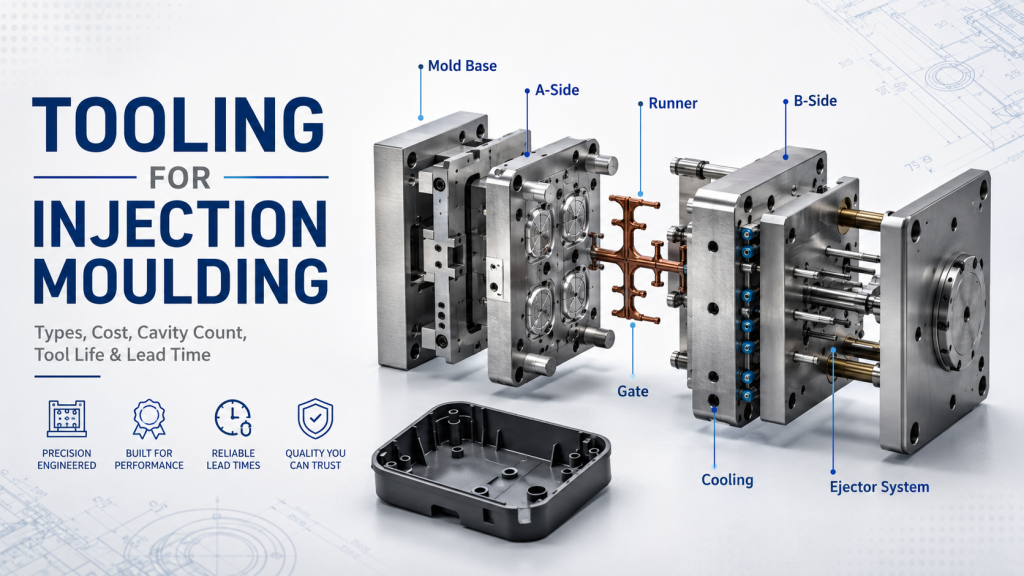
Process and tooling choices that affect reliability
Tooling approach for prototypes versus production
In overmolded cable assemblies projects, the tooling strategy directly determines whether reliability validation is meaningful. The objectives of the prototype stage and the production stage are different, and the tooling path should be clearly differentiated accordingly.
When rapid validation tooling is appropriate
The primary value of rapid validation tooling is to confirm whether the structural concept is sound. This includes evaluating strain-relief geometry, overmold length, exit angle, and the feasibility of the interface locking strategy. Such tooling is best suited for:
- Early comparison of structural design concepts
- Initial screening of material systems and interface strategies
- Trend-level validation of bending and pull-out behavior
It is important to note that rapid tooling typically differs from production tooling in steel grade, cooling efficiency, and dimensional stability. Results from rapid tooling should therefore be used for directional assessment only, not as final evidence for flex life or consistency performance.
When production-grade tooling is required
Once a project enters the reliability freeze stage—especially when validating flex life, IP sealing, or long-term environmental stability—production-grade tooling becomes mandatory. Only under production tooling conditions are overmold filling behavior, cooling characteristics, parting lines, and interface quality truly repeatable. Skipping this step often leads to samples passing validation while production parts fail.
Trade-offs between multi-cavity tooling, cycle time, and consistency risk
Multi-cavity tooling can significantly increase output, but it also introduces consistency risks. Differences in filling balance, cooling behavior, and stress distribution between cavities will be reflected in flex life and interface reliability. In high-reliability projects, consistency must take priority over cycle-time optimization. Otherwise, performance variation across parts is likely to increase.
Critical process variables that influence flex life
Even with correct structural design and material selection, insufficient process control can still lead to early failures. Flex life is highly sensitive to process variation, and the following variables are particularly critical.
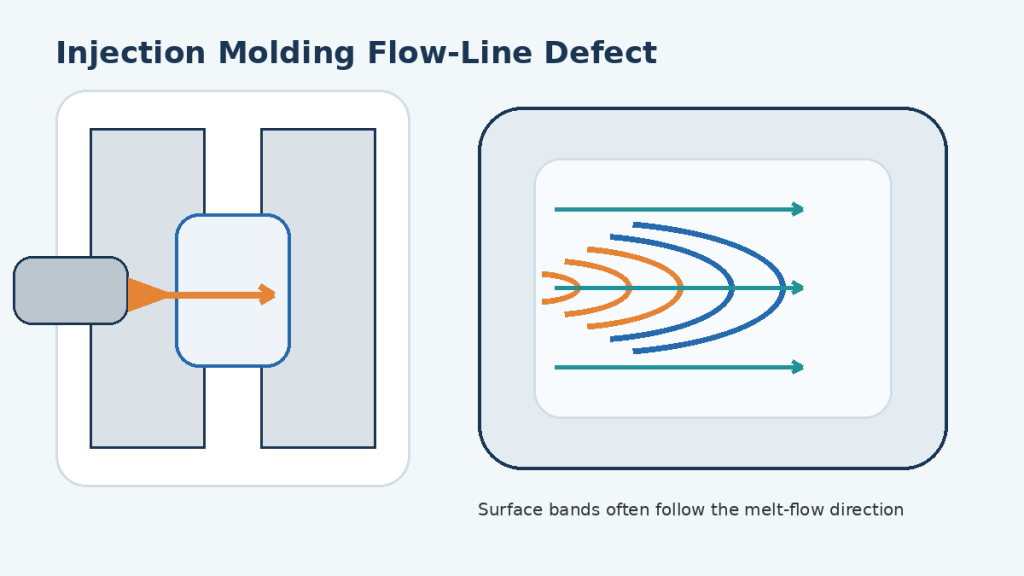
- Filling and encapsulation completeness: The overmold material must fully encapsulate the intended areas without thin sections or internal voids. Incomplete filling reduces interface support and causes stress to reconcentrate at the exit edge, shortening bending life.
- Cooling conditions and residual stress: Uneven cooling or premature demolding can introduce residual stress within the overmold structure. These stresses are gradually released during repeated bending and thermal cycling, ultimately manifesting as interface peeling or surface cracking. Stable and well-controlled cooling is a foundation of long-term reliability.
- Effects of flash, voids, and short shots: Flash, voids, and short shots are not merely cosmetic defects; they are potential failure initiators. Flash can repeatedly abrade the cable jacket during bending, while voids and short shots weaken local structural integrity and serve as crack initiation sites. In IP-rated applications, these defects can also directly compromise sealing paths.
- Process stability comes from window control, not one-time parameter tuning: Reliable overmolding depends on a stable process window, not on a single “perfect” parameter setting. Temperature, pressure, time, and cooling conditions must be controlled within repeatable ranges to ensure consistent flex life across production batches. Only after process stability is established can the reliability of the design itself be fully realized in mass production.
Validation plan that proves flex life and strain relief performance
Flex testing that reflects real use
The purpose of flex testing is not to “bend the sample until it breaks,” but to verify whether the design can remain reliable under real operating conditions over time. For this reason, test conditions must be derived from actual use scenarios, rather than simplified to improve pass rates.
Recommended test elements should include at least the following:
- Bend angle, radius, and frequency: Bend angle and radius should reflect the worst-case condition after installation, not the theoretical values of a free cable. Test frequency should be close to real usage. Excessively high frequencies can introduce unrealistic heating or material behavior, while frequencies that are too low may fail to reveal fatigue-related issues.
- Energized or loaded condition: In many applications, cables are bent while carrying power or signals. Under energized conditions, subtle contact instability often appears earlier than complete conductor breakage and is therefore more meaningful from an engineering standpoint.
- Pass and failure criteria: Evaluation should not be limited to whether the conductor breaks. It should also include resistance changes, signal interruption, contact instability, and visible cracking. The clearer the criteria, the higher the engineering value of the test results.
In practice, there are two common pitfalls to avoid.
First, testing with an excessively large bend radius. This often leads to successful lab results, while failures occur early in the field where the actual bend radius is smaller.
Second, focusing only on conductor continuity. Many early issues in overmolded cable assemblies are not broken conductors, but unstable contacts or resistance drift at the termination. Without monitoring these signals, test results can be overly optimistic.
Pull, twist, and environmental tests that catch early failures
Flex testing alone covers only part of the risk. A complete validation plan should also include pull, torsion, and environmental stress testing to expose interface- and structure-related issues early.
Pull testing must directly correspond to the structural design. Test force levels should not be set based on experience alone. They should be defined based on anchoring design targets and the maximum axial loads expected in actual use. Failure mode interpretation is equally important. Whether failure occurs as overall slippage, local peeling, or jacket or conductor damage points to very different design improvement directions.
Torsion and vibration testing are not required for every project, but they are often decisive in applications involving equipment movement, installation misalignment, or vibration sources. Torsion changes interface load states, while vibration amplifies small structural defects, making the termination area particularly vulnerable.
Environmental testing is used to verify long-term stability:
- Thermal cycling repeatedly stretches and compresses the interface and is an effective way to assess material compatibility and residual stress control.
- Immersion or spray testing evaluates sealing path reliability after structural deformation, not just initial sealing performance.
- Oil and chemical exposure is a common trigger for interface peeling and material degradation. These tests should be combined with flex or pull testing before and after exposure, rather than evaluated in isolation.
By combining these tests into a systematic validation plan, most potential failure modes can be identified at the prototype stage, avoiding significantly higher costs during production or field use.
RFQ checklist that helps you quote and build it right the first time
In overmolded cable assemblies projects, quotation speed and solution accuracy depend heavily on the completeness of the input information. When key details are missing, suppliers can only make assumptions based on experience. This often leads to repeated prototype iterations or critical issues surfacing during validation.
The purpose of the checklist below is to clearly define the conditions that affect structure, materials, tooling, and validation in one step, reducing rework and communication overhead.
Cable information
- Cable gauge and conductor construction (for example, stranded or solid, conductor size and number of cores)
- Jacket material and layer structure (single-layer or multi-layer, presence of inner jacket)
- Outer diameter and allowable tolerances (including OD variation along critical sections)
- Shielding requirement and shielding type (braid, foil, drain wire, etc.)
- Any special requirements, such as minimum bend radius or supplier-recommended limits
Connector information
- Connector model and manufacturer (part number and datasheet preferred)
- Termination method (crimping, soldering, IDC, etc.) and any critical process requirements
- Presence of sealing rings or backshells, and sealing material if applicable
- Whether connector housing overmolding is allowed, the permitted overmold coverage, and areas that must be avoided (such as latches, sealing surfaces, or alignment features)
Target operating conditions
- Bend radius, bend angle, frequency, and target cycle count (flex life target)
- Axial pull force target and usage mode (continuous load, peak load, dragging conditions)
- Installation method (distance to fixation points, presence of cable clips, swinging motion, or vibration sources)
- Environmental media and exposure mode (oil, solvents, cleaning agents, salt spray, outdoor UV, etc.), as well as temperature range and thermal cycling conditions
Target standards
- IP rating and test conditions (spray or immersion, depth, duration, water temperature, pressure differential if applicable)
- Appearance requirements (allowed parting line locations, flash tolerance, surface texture, cosmetic defect criteria)
- Color and markings (color code, batch-to-batch consistency requirements, need for logos, text, or poka-yoke features)
Volume and delivery
- Prototype quantities and phase targets (engineering samples, validation samples, pilot builds)
- Annual demand and expected peak volume (affecting single-cavity vs. multi-cavity tooling and process strategy)
- Target lead time and key milestones (when assembly-ready samples are required, when production-stable parts are needed)
Quality documents and deliverables
- First article inspection requirements (FAI or first-article dimensional reports)
- List of critical dimensions and CTQs (linked to inspection frequency and sampling strategy)
- Process records or batch traceability requirements, if any
- Types of reports required (critical dimension reports, material or incoming inspection certificates, process window documentation, etc.)
Providing this information upfront allows suppliers to perform meaningful DFM analysis and generate accurate quotations, helping ensure the design is built right the first time.
Common design mistakes to avoid
1. Treating overmolding as simple encapsulation instead of a stress-management structure
Many projects treat overmolding as a way to “cover the termination, make it waterproof, and make it look stronger.” As a result, design effort focuses on coverage area and cosmetic completeness, while the actual stress concentration locations remain unresolved. In real use, bending and tensile loads still act on the connector edge and termination area. Service life improves only marginally, and failure locations do not change.
The correct approach is to first identify the regions of maximum strain, then use geometric transitions and structural support to shift stress outward and ensure that bending occurs in a controlled zone.
2. Pursuing higher stiffness and a tighter grip at the expense of flex life
Using harder overmold materials or tighter clamping geometry often improves initial pull-out performance, but it also significantly increases stiffness at the termination. Bending is then forced to concentrate at the overmold boundary, where the jacket is more easily compressed, abraded, or cracked. After repeated cycles, conductor breakage or jacket failure can occur earlier rather than later.
Reliable design requires functional separation and gradual transitions between anchoring and strain-relief regions, instead of relying on localized rigid constraints to solve all problems.
3. Ignoring the interface strategy, leading to pull-out and peeling failures
Different cable jackets respond very differently to adhesion. If a design relies solely on chemical bonding, without mechanical interlocking or pre-mold strategies, samples may perform acceptably in the short term. However, after thermal cycling, media exposure, or long-term loading, interface peeling, slippage, or water ingress can occur.
Interface design should target long-term stability. Proven, repeatable mechanical locking concepts should be prioritized, and expected failure modes should be explicitly included in the validation plan.
4. Failing to define test conditions, forcing suppliers to rely on experience, and causing repeated rework
When flex life, pull-out, torsion, or IP requirements lack clearly defined angles, radii, frequencies, loads, and pass/fail criteria, suppliers tend to select test setups that are easier to pass. The resulting “pass” outcomes have limited engineering value and often fail in real-world use.
More commonly, different test conditions are applied at different project stages, leading to conflicting conclusions and repeated cycling between prototyping and validation. To reduce rework, operating conditions and acceptance criteria must be defined as executable inputs early in the project and frozen together with the design solution.
Final Thoughts
In the design of overmolded cable assemblies, reliability is never the result of a single parameter. It is the combined outcome of requirement definition, structural geometry, interface strategy, and validation methodology. Only when real operating conditions and executable acceptance criteria are clearly defined early can overmold geometry be used to control bending within a safe zone, while stable interface design simultaneously achieves pull-out performance and long-term fatigue life. Ignoring any of these elements simply shifts risk into prototype validation or even into production.
In practical projects, the most effective next step is not further shape iteration, but organizing the critical inputs into a clear RFQ package and working with a supplier experienced in overmolding to complete DFM evaluation and solution convergence. This approach is what moves a design from “buildable as a sample” to “stable in production,” while maintaining consistent reliability under real-world use conditions.