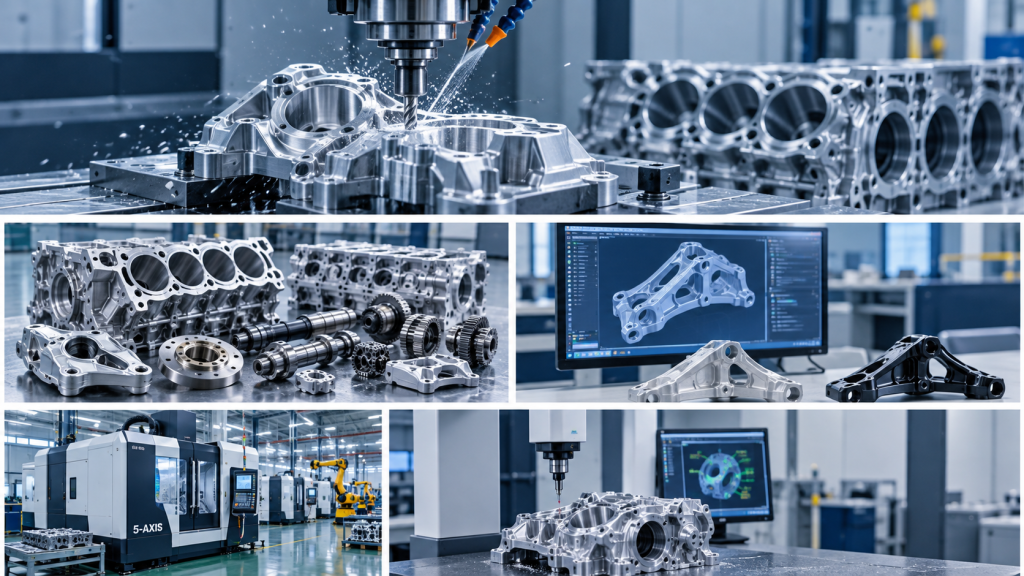
Automotive manufacturing has evolved from manual assembly and conventional machining into highly automated, digitally controlled production. Modern vehicles require tighter tolerances, shorter development cycles, lightweight materials, and increasingly complex components.
The rapid growth of electric vehicles has further expanded these requirements. Battery housings, motor housings, cooling plates, inverter components, and high-voltage connectors all require reliable manufacturing processes capable of producing accurate and repeatable parts.
Automotive CNC machining provides an effective connection between engineering design, functional prototyping, and production. Using computer-controlled machining, manufacturers can produce complex components with consistent dimensions across a wide range of materials and production volumes.
From engine and transmission components to EV battery structures and custom performance parts, CNC machining has become an important manufacturing technology throughout the automotive supply chain.
What Is Automotive CNC Machining?
Automotive CNC machining refers to the use of computer numerical control equipment to manufacture automotive components by precisely removing material from a workpiece.
The process generally begins with a CAD model. CAM software then converts the design into machining toolpaths, which control the movement of the cutting tools.
Depending on the component, CNC equipment can perform:
- Milling
- Turning
- Drilling
- Boring
- Reaming
- Threading
- Pocketing
- Contouring
- Surface finishing
Once the machining process has been programmed and validated, the same process can be repeated with a high level of consistency.
This makes CNC automotive manufacturing particularly suitable for components requiring accurate dimensions, reliable assembly, and repeatable production.
Why Is CNC Automobile Manufacturing Important?
The automotive industry is facing several major manufacturing challenges:
- Increasing component complexity
- Shorter product development cycles
- Growing EV production
- Greater use of lightweight alloys
- More vehicle customization
- Higher quality requirements
- Demand for flexible production
Unlike processes that require dedicated molds or dies, CNC machining can accommodate many design changes simply by modifying the CAD/CAM program.
This flexibility makes it particularly useful during automotive product development and low- to medium-volume production.
Key Advantages of Automotive CNC Machining
2.1 Precision and Tight Tolerances
Automotive components often contain critical interfaces, mounting surfaces, bores, threads, and mating features.
Depending on the machine, material, geometry, tooling, and inspection method, CNC machining can achieve tolerances around ±0.001 in (±0.025 mm) or tighter on selected features.
This capability is useful for applications such as:
- Engine components
- Transmission parts
- Brake components
- Suspension systems
- Steering components
- Electric motor housings
- Precision connectors
However, tolerance should always be specified according to the engineering drawing. Not every feature needs an extremely tight tolerance, and unnecessary tolerances can increase manufacturing costs.
2.2 High Repeatability and Consistent Quality
CNC machines execute programmed toolpaths rather than relying on manual positioning.
After a machining process has been validated, the same program can produce large quantities of components with minimal dimensional variation.
Quality control may include:
- Tool offset management
- First article inspection
- In-process measurement
- Statistical process control
- CMM inspection
- Final dimensional inspection
This repeatability is particularly valuable when automotive components must fit consistently into larger assemblies.
2.3 Efficiency Improvements in Automotive Part Production Using CNC Technology
One of the most important advantages of CNC technology is production efficiency.
A properly optimized CNC process can reduce production time through:
- Automated tool changes
- High-speed cutting
- Fewer manual operations
- Reduced setup time
- Multi-axis machining
- Automated workholding
- Unattended machining cycles
For example, a complex component that previously required several machining setups may be completed in fewer setups using a 5-axis or turn-mill machine.
Fewer setups can reduce handling time while also limiting the positioning errors that may accumulate between operations.
2.4 Broad Material Compatibility
CNC machining can process a wide range of materials used in automotive manufacturing.
| Material | Common Applications |
| Aluminum 6061 | Housings, brackets, prototypes |
| Aluminum 7075 | Lightweight performance components |
| Stainless Steel | Connectors, shafts, brackets |
| Carbon Steel | Mechanical and structural parts |
| Hardened Steel | Wear-resistant components |
| Titanium | High-strength lightweight parts |
| Brass | Fittings and precision hardware |
| POM | Bushings and low-friction components |
| PEEK | High-performance functional parts |
| ABS | Prototypes and trim components |
The appropriate material depends on the component’s mechanical loads, temperature, corrosion exposure, weight requirements, wear conditions, and service environment.
2.5 Flexible Design Changes
Automotive engineering rarely stops at the first design iteration.
A prototype may require changes to:
- Hole locations
- Wall thickness
- Mounting geometry
- Thread specifications
- Cooling channels
- Weight-reduction pockets
- Overall dimensions
With CNC machining, many of these changes can be implemented by modifying the CAD/CAM data instead of producing an entirely new mold.
This makes CNC particularly useful for prototype development, engineering validation, motorsport, and customized automotive components.
CNC Machined Auto Parts: Key Applications
CNC machining is used across many automotive systems. The appropriate manufacturing method depends on the component’s geometry, material, tolerance, production volume, and functional requirements.
3.1 Engine and Drivetrain Components
Traditional powertrain systems contain numerous precision-machined components.
Examples include:
- Engine blocks
- Cylinder heads
- Camshafts
- Crankshafts
- Pistons
- Pump bodies
- Valve components
- Bearing housings
- Mounting components
Some engine parts are initially produced through casting or forging and then CNC machined on critical surfaces.
CNC operations can establish accurate bores, mounting surfaces, threads, sealing areas, and other functional features.
3.2 Transmission and Gearbox Components
Transmission systems depend on accurate alignment between rotating and stationary components.
Typical cnc machined auto parts include:
- Transmission housings
- Gear components
- Shafts
- Bearing seats
- Clutch components
- Hydraulic valve bodies
- Drive components
For these applications, geometric relationships between features can be just as important as individual dimensional tolerances.
3.3 Chassis, Suspension, and Braking Components
CNC machining is also widely used for chassis and vehicle control components.
Examples include:
- Control arms
- Steering knuckles
- Brake calipers
- Wheel hubs
- Suspension mounts
- Steering components
- Structural brackets
Aluminum machining can be useful where weight reduction is an important design objective.
3.4 CNC Machining for Electric Vehicles
The transition from internal-combustion vehicles to EVs is creating new applications for CNC manufacturing.
Common EV components include:
- Battery tray components
- Battery housings
- Motor housings
- Cooling plates
- Inverter housings
- High-voltage connector housings
- Structural brackets
- Charging-system components
Aluminum is particularly attractive for many EV components because it offers relatively low density while providing useful mechanical and thermal properties.
Cooling plates are a good example. Their channels, sealing surfaces, and mounting features must be manufactured accurately to support reliable thermal management.
3.5 Interior and Exterior Components
CNC machining is also suitable for customized interior and exterior components.
Applications include:
- Dashboard components
- Control knobs
- Custom switches
- Interior brackets
- Light housings
- Performance components
- Automotive trim
- Prototype optical components
These applications are common in motorsport, luxury vehicles, aftermarket products, and limited-production vehicle programs.
Automotive Part Machining for Prototypes and Production
CNC machining can support multiple stages of automotive product development, from the first physical prototype to low- and medium-volume production.
4.1 Rapid Prototyping
Before committing to expensive production tooling, engineers often need physical parts for testing.
CNC machining can produce functional prototypes directly from CAD models or engineering drawings.
These prototypes can be used for:
- Assembly verification
- Dimensional validation
- Interference testing
- Functional testing
- Thermal testing
- Structural testing
- Ergonomic evaluation
CNC prototypes can also be manufactured from the intended production material, allowing engineers to evaluate realistic mechanical behavior.
4.2 Design Verification and Testing
Physical prototypes allow engineers to identify problems that may not be visible in digital models.
Depending on the component, testing may involve:
- Mechanical loading
- Vibration
- Heat
- Fluid pressure
- Wear
- Environmental exposure
- Repeated assembly
Finding these problems before production tooling is finalized can reduce downstream development costs.
4.3 High-Mix, Low-Volume Production
CNC machining is especially useful when manufacturers need multiple part variants in relatively small quantities.
Typical applications include:
- Racing vehicles
- Limited-edition vehicles
- Luxury vehicles
- Custom modifications
- Replacement components
- Motorsport parts
- Engineering samples
For these applications, avoiding dedicated tooling can make CNC more economical despite its higher per-part machining cost.
When Should You Choose CNC for Automotive Parts?
CNC machining is generally a strong choice when you need:
- Tight dimensional tolerances
- Complex geometries
- Fast design changes
- Low or medium production volumes
- Multiple material options
- Functional prototypes
- High-quality machined surfaces
For extremely high production volumes and stable designs, processes such as die casting, forging, stamping, or injection molding may provide a lower unit cost.
Types of CNC Machines for the Automotive Industry
Different automotive components require different types of CNC equipment.
5.1 Multi-Axis CNC Milling Machines
3-axis, 4-axis, and 5-axis CNC milling machines can manufacture complex components from different directions.
Five-axis machining is particularly useful for:
- Complex curved surfaces
- Angled holes
- Deep features
- Lightweight structures
- Complex housings
- Components requiring fewer setups
By reducing repositioning, multi-axis machining can improve both productivity and positional accuracy.
5.2 CNC Lathes and Turning Centers
CNC turning is designed for rotationally symmetrical components.
Typical applications include:
- Shafts
- Bushings
- Pins
- Bearing components
- Rotational housings
- Threaded parts
Modern turning centers can combine turning, drilling, threading, boring, and other operations.
5.3 Swiss-Type CNC Machining
Swiss-style CNC machining is designed for small-diameter, high-precision components.
It can be suitable for:
- Sensor components
- Precision pins
- Small valves
- Hydraulic components
- Connectors
- Threaded hardware
The exact size and tolerance capability depends on the machine configuration and production requirements.
5.4 Turn-Mill and Multi-Tasking Equipment
Turn-mill machines combine turning and milling operations within one production platform.
Instead of transferring a component between multiple machines, several operations can be completed within a single cycle.
Benefits may include:
- Fewer setups
- Reduced handling
- Shorter production time
- Improved positional accuracy
- Lower risk of setup-related errors
This makes multi-tasking CNC equipment valuable for complex automotive components.
CNC Machining vs. 3D Printing vs. Die Casting
The best manufacturing process depends on the component, production volume, material, geometry, tolerance, and development stage.
| Factor | CNC Machining | 3D Printing | Die Casting |
| Tooling cost | Low | Low | High |
| Prototype speed | High | Very high | Low |
| Surface finish | Excellent | Process-dependent | Good |
| Dimensional accuracy | Excellent | Process-dependent | Good |
| Material selection | Broad | Process-dependent | Alloy-specific |
| Complex internal geometry | Limited by tool access | Excellent | Good |
| High-volume production | Moderate | Low to moderate | Excellent |
| Design changes | Easy | Very easy | Expensive |
| Best suited for | Precision parts and prototypes | Complex prototypes | High-volume metal parts |
6.1 CNC Machining vs. 3D Printing
3D printing creates parts layer by layer, making it useful for highly complex internal structures and rapid design iterations.
CNC machining generally provides better surface quality and excellent dimensional control. For many functional metal components, it also provides more predictable material properties.
Therefore, CNC is often preferred when mechanical performance, dimensional accuracy, and finished surface quality are key requirements.
6.2 CNC Machining vs. Die Casting
Die casting can be highly economical for large production volumes once tooling costs have been amortized.
The main disadvantage is the initial die investment.
CNC machining requires no dedicated casting die, making it attractive for:
- Prototypes
- Engineering validation
- Low-volume production
- Custom components
- Frequent design changes
- Precision secondary machining
6.3 Hybrid Manufacturing
Automotive manufacturers often combine several processes rather than choosing only one.
A typical production route may be:
Casting or forging → CNC machining → Inspection → Surface finishing → Assembly
Casting or forging provides the basic near-net shape, while CNC machining establishes critical features such as:
- Precision bores
- Sealing surfaces
- Mounting holes
- Threads
- Bearing seats
- Mating surfaces
This approach can reduce machining time and material waste while maintaining functional accuracy.
Quality Control, Standards, and Future Trends
Automotive CNC machining requires more than accurate cutting. A reliable production process must also control material quality, dimensions, process variation, and inspection.
7.1 Automotive Quality Management
Automotive suppliers commonly work with quality systems such as:
- IATF 16949
- ISO 9001
- First Article Inspection
- Statistical Process Control
- Process capability studies
- Traceability procedures
Inspection equipment may include:
- Coordinate Measuring Machines
- Optical measurement systems
- Laser scanners
- Micrometers
- Height gauges
- Surface roughness testers
The inspection method should be selected according to the drawing requirements and critical features of the component.
7.2 Industry 4.0 and Smart Manufacturing
CNC machining is becoming increasingly connected to digital production systems.
Modern manufacturing environments can integrate:
- Tool wear monitoring
- Machine data collection
- Digital twins
- Automated inspection
- Robotic loading and unloading
- Production traceability
- AI-assisted process monitoring
These technologies can help manufacturers detect process deviations earlier and reduce unnecessary scrap and downtime.
7.3 Lightweight Automotive Components
Reducing vehicle weight remains an important engineering objective, particularly for EVs where weight directly affects energy consumption and driving range.
Materials receiving increased attention include:
- Aluminum alloys
- Magnesium alloys
- Titanium
- Carbon fiber composites
Machining lightweight materials requires appropriate cutting tools, speeds, feeds, workholding, and chip-control strategies.
The objective is not simply to remove as much material as possible. Engineers must balance weight, stiffness, strength, thermal behavior, manufacturability, and service life.
How to Choose an Automotive CNC Machining Supplier
Choosing a supplier should involve more than comparing unit prices.
Machine Capability
Check whether the supplier has suitable:
- 3-axis CNC machines
- 4-axis CNC machines
- 5-axis machining centers
- CNC turning centers
- Turn-mill machines
- Swiss-type machines
- Automated production equipment
Material Capability
Confirm that the supplier has experience machining your required material and understands its cutting behavior and finishing requirements.
Tolerance and Inspection Capability
Ask whether the supplier can provide appropriate inspection documentation, such as:
- CMM reports
- First Article Inspection reports
- Material certificates
- Dimensional inspection reports
- Surface finish verification
Production Capacity
A supplier experienced in prototypes may not necessarily be optimized for large production runs.
Choose a supplier whose equipment, process control, and production capacity match your expected quantity.
Engineering Support
A capable supplier should be able to identify potential manufacturability issues before machining begins.
These may include:
- Excessively tight tolerances
- Poor tool access
- Thin walls
- Deep cavities
- Difficult internal features
- Unnecessary machining operations
Early DFM feedback can prevent costly revisions after production starts.
Automotive CNC Machining Services from Kemal Manufacturing
For automotive prototypes, precision components, and custom production parts, Kemal Manufacturing provides CNC machining and related manufacturing capabilities for projects requiring accurate geometry, controlled tolerances, and flexible production volumes.
The appropriate manufacturing approach depends on the material, part geometry, quantity, tolerance requirements, surface finish, and intended application.
When requesting a quotation, provide the following information whenever possible:
- 3D CAD model
- 2D engineering drawing
- Material specification
- Required quantity
- Critical tolerances
- Surface finish
- Heat treatment requirements
- Coating or anodizing requirements
- Intended application or service environment
Providing these details allows the manufacturing team to assess the project more accurately and determine a suitable production method.
If you are developing an automotive component, producing a functional prototype, or looking for a supplier for custom CNC machined auto parts, you can upload your CAD files and contact Kemal Manufacturing to request a project-specific quotation.
Kemal Manufacturing – CNC Machining Services
Frequently Asked Questions About Automotive CNC Machining
What automotive parts can be CNC machined?
CNC machining can produce a wide range of automotive components, including engine parts, transmission housings, shafts, brackets, brake components, suspension parts, motor housings, battery components, cooling plates, connectors, and custom performance parts.
The most suitable process depends on the component’s geometry, material, tolerance, and production volume.
Is CNC machining suitable for automotive prototypes?
Yes. CNC machining is well suited to automotive prototypes because it can produce functional parts directly from CAD data without requiring dedicated production molds.
This allows engineers to verify dimensions, assembly, mechanical performance, and design details before committing to high-volume tooling.
Can CNC machining be used for high-volume automotive production?
Yes, but its economic suitability depends on the component and production volume.
For very high volumes, die casting, forging, stamping, or injection molding may provide a lower unit cost. CNC machining remains valuable for precision features, complex components, low- and medium-volume production, and secondary machining after casting or forging.
What materials are commonly used for CNC machined automotive parts?
Common materials include aluminum 6061, aluminum 7075, stainless steel, carbon steel, hardened steel, titanium, brass, POM, PEEK, and ABS.
The best material depends on strength, weight, temperature, corrosion resistance, wear, electrical properties, and the component’s service environment.
Is 5-axis CNC machining necessary for automotive parts?
Not always.
3-axis machining is sufficient for many relatively simple components. Four- and five-axis machines become useful when parts have complex surfaces, angled features, deep cavities, or multiple machining faces.
Five-axis machining can also reduce the number of setups required for complex components.
What tolerances can automotive CNC machining achieve?
CNC machining can achieve very tight tolerances, but the actual capability depends on the machine, material, geometry, tooling, temperature control, and inspection process.
Tolerances around ±0.001 in (±0.025 mm) may be achievable for suitable features, while tighter requirements should be evaluated on a case-by-case basis.
Is CNC machining more expensive than die casting?
For high-volume production, CNC machining can have a higher per-part cost than die casting.
However, CNC machining has a major advantage during prototyping and low-volume production because it does not require expensive dedicated dies.
The most economical choice depends on tooling cost, production volume, part geometry, tolerances, and material.
What is the difference between CNC machining and automotive machining?
Automotive machining is a broader term covering machining processes used to manufacture automotive components.
Automotive CNC machining specifically refers to computer-controlled machining operations, including CNC milling, turning, drilling, boring, and multi-axis machining.
How should I prepare a CNC automotive parts quotation request?
Provide a 3D CAD model and, if available, a 2D drawing containing material, dimensions, tolerances, surface finish, and other specifications.
Also specify the required quantity and any secondary processes such as anodizing, plating, heat treatment, or coating.
The more complete the engineering information, the more accurately a supplier can evaluate manufacturability and pricing.
Can Kemal Manufacturing make custom automotive CNC parts?
Yes. Kemal Manufacturing can support custom CNC manufacturing projects based on customer CAD files and engineering requirements.
For a project-specific assessment, upload your drawings or 3D models and request a quotation so the manufacturing team can review the geometry, material, tolerances, quantity, and finishing requirements.
Conclusion
Automotive CNC machining has become an important manufacturing technology for precision automotive components, functional prototypes, custom parts, and selected production applications.
Its core advantages include:
- High dimensional accuracy
- Excellent repeatability
- Broad material compatibility
- Flexible design changes
- No dedicated mold for CNC production
- Support for complex geometries
- Suitability for prototypes and low- to medium-volume production
CNC is not necessarily the best process for every automotive component. High-volume parts with stable designs may benefit from casting, forging, stamping, or injection molding.
In many cases, however, the most effective strategy is a combination of processes—for example, casting or forging for near-net-shape production followed by CNC machining of critical features.
When selecting an automotive CNC machining supplier, consider more than equipment availability. Evaluate machining capability, tolerance control, inspection equipment, material experience, production capacity, quality systems, and engineering support.
If you have an automotive component that requires CNC machining, prepare the CAD model, engineering drawing, material, quantity, tolerance, and finishing requirements, then contact a qualified manufacturer for a project-specific evaluation and quotation.