Cleanroom injection molding is used when part performance can be compromised by particles that are invisible to the naked eye. In medical devices, diagnostics, optics, and electronics, a single fiber or speck can become a leak path, a cosmetic reject, or a downstream assembly failure.
Cleanroom molding lowers the particle level in the air. But parts still get contaminated by how they’re handled—how resin is loaded, how parts are picked, where they’re placed, how they’re inspected, and when they’re bagged.
That is why the real work is choosing the right ISO class and locking down the handling, inspection, and packaging rules that keep parts clean.
What Is Cleanroom Injection Molding?
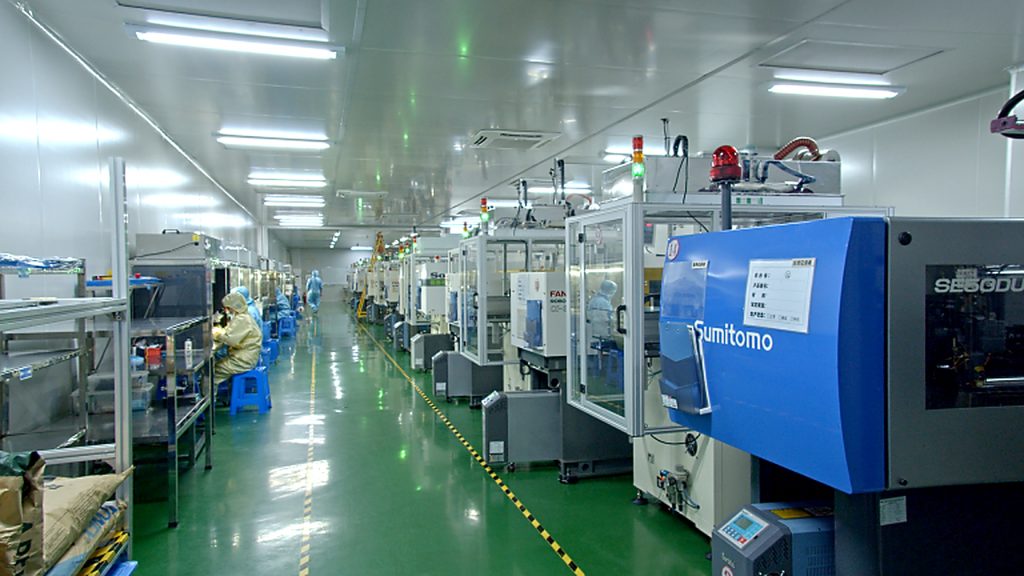
Cleanroom injection molding is molding parts in a particle-controlled environment.
In practice, “cleanroom” does not only mean filtered air. It also means the process is designed to reduce where particles come from and how they reach the part. That includes controlled entry of people and materials, disciplined part handling (minimal touch and clean containers), and sealing parts into the specified packaging before they leave the controlled area.
Cleanroom Injection Molding vs Standard Injection Molding: Key Differences
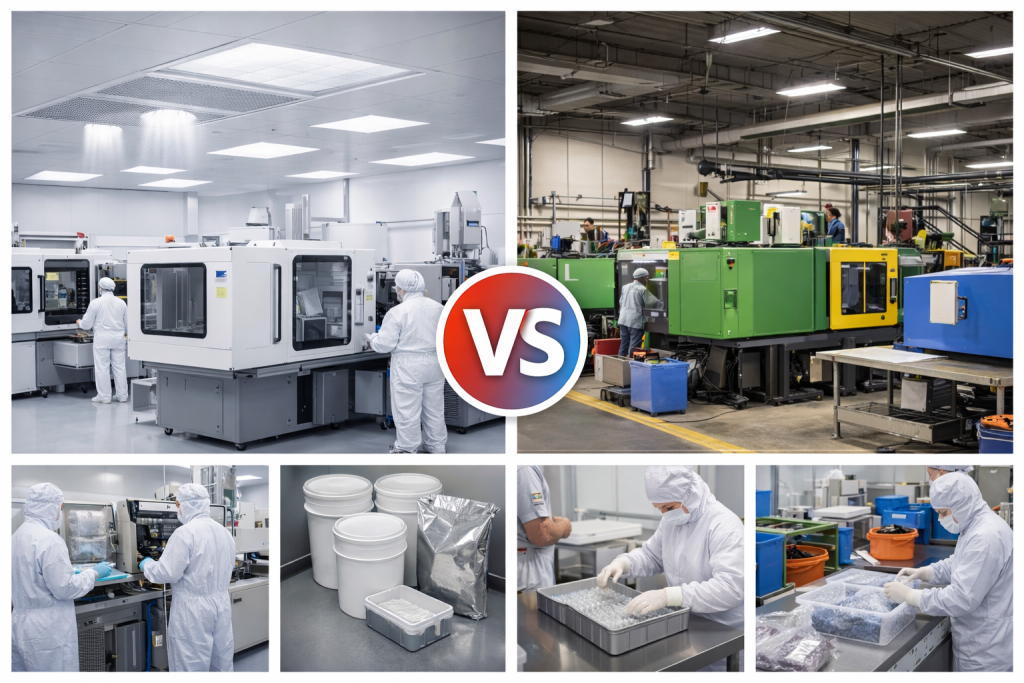
The molding machine may look similar, but the control points are different. Standard molding focuses on dimensions, cycle time, and cosmetic appearance. Cleanroom molding adds another requirement: keep contamination low and repeatable from resin to sealed package.
Key differences are usually:
Air control (baseline cleanliness)
HEPA-filtered supply air, defined cleanliness level (ISO class), and routine monitoring. The goal is fewer airborne particles settling on parts during ejection, staging, and inspection.
Pressure and airflow direction (where particles go)
Positive pressure and controlled airflow patterns help push contaminants away from the cleanest zones, instead of letting them drift back onto parts.
People controls (largest particle generator)
Gowning, restricted motion, and fewer operators near open parts. In cleanroom work, personnel behavior is a process variable, not “shop preference.”
Material handling (closed, traceable, low dust)
Sealed transfer, controlled drying, and clear lot separation. Many “mystery particles” start as resin dust, regrind contamination, or residue from open handling.
Part handling and containers (contact contamination)
Defined pickup methods, clean trays/bins, limited staging time, and clear rules for what can touch the part. In standard molding, parts may be dumped, conveyed, or re-handled freely; in cleanroom molding, those steps are tightly controlled.
Post-processing and packaging (protect the part after it’s made)
Trimming, assembly, inspection, and packaging are either done in controlled space or designed to avoid re-contamination. Packaging is treated as part of the process, not an afterthought.
Parts That Typically Require Cleanroom Injection Molding

Cleanroom molding is most often specified when a particle, fiber, or residue can create a functional issue, not just a cosmetic issue.
Common examples include:
- Sealing parts and fluid-path components: O-ring glands, valve seats, manifolds, microfluidic chips, cartridges, and connectors. Particles can become leak paths or block flow.
- Optical and sensor-facing surfaces: Lens holders, light guides, optical covers, sensor windows. Small contaminants can show up as visible defects or interfere with signal performance.
- Drug-delivery and diagnostic consumables: Inhaler components, pen-injector parts, sampling devices, reagent-contact components. Contamination risk ties directly to compliance and product safety.
- Precision assemblies with tight fit or sliding interfaces: Components where debris causes scratch marks, binding, wear, or assembly failures, especially when parts are assembled soon after molding.
- Cosmetic-critical housings with low defect tolerance: High-visibility medical or electronics enclosures where “one speck” drives scrap, even if function is unaffected.
ISO Cleanroom Classes for Injection Molding (Class 7 vs Class 8)

What ISO cleanroom “class” actually means
An ISO cleanroom class defines how many airborne particles are allowed in a given volume of air. The lower the class number, the fewer particles are permitted. In simple terms, it sets the background cleanliness of the air, not the cleanliness of the part itself.
An ISO cleanroom class defines how many airborne particles are allowed in a given volume of air. The lower the class number, the fewer particles are permitted. In simple terms, it sets the background cleanliness of the air, not the cleanliness of the part itself.
For injection molding, this distinction matters. The ISO class controls how much particulate matter can settle on a part while it is exposed—during ejection, handling, inspection, and packaging. It does not control particles generated by people, materials, tools, or contact. That is why two suppliers operating at the same ISO class can deliver very different results.
Think of the ISO class as the baseline condition. It defines the ceiling for airborne contamination, but actual part cleanliness depends on how the process is run within that environment.
ISO Class 7 vs ISO Class 8 for Injection Molding
ISO Class 7 and Class 8 are by far the most common cleanroom levels used for injection molding. The right choice depends on part sensitivity, downstream steps, and cost tolerance.
| Aspect | ISO Class 7 | ISO Class 8 |
|---|---|---|
| Typical use | Particle-sensitive functional or cosmetic parts | General controlled molding for regulated or semi-sensitive parts |
| Airborne particle level | Lower baseline particle count | Higher particle allowance |
| Common applications | Sealing parts, fluid-path components, optical or cosmetic-critical surfaces | Housings, covers, components without exposed critical interfaces |
| Risk profile | Lower fallout risk during exposure | Acceptable when parts are less sensitive or exposure time is limited |
| Cost impact | Higher operating and monitoring cost | Lower operating cost |
| Yield sensitivity | More forgiving for speck-driven rejects | Requires stronger handling and packaging discipline to protect yield |
However, the ISO class is an air particle limit, not a guarantee of clean parts. Parts can still pick up particles after molding. What matters is how long the part stays exposed after ejection and whether it is sealed in the package inside the clean area.
Cleanroom Injection Molding Requirements Beyond ISO Class
Specifying an ISO class alone is not enough to control cleanliness outcomes. You also need to specify handling, inspection, and packaging.
Key items to specify include:
- Monitoring and records: Whether particle monitoring is required, how often it is checked, and what records must be retained. This matters for audits and root-cause analysis, not day-to-day molding.
- Defined cleanroom zones: Which steps must occur in a controlled space? Molding only, or molding plus inspection and packaging? Mixing clean and non-clean steps without clear boundaries is a common failure point.
- Personnel rules: Gowning level, operator access, and limits on unnecessary movement near exposed parts. People are often the largest particle source.
- Material flow and staging: How resin, inserts, and packaging materials enter the clean area, and where parts are allowed to sit before bagging.
- Temperature and humidity control: Required ranges if material behavior, static buildup, or dimensional stability are sensitive to environmental conditions.
- Pressure control (when relevant): Positive pressure is typical for keeping contaminants out; negative pressure is used only for special containment cases.
Without these, the class number alone provides little protection against contamination-driven defects.
Cleanroom Injection Molding Process: From Material to Packaging
Material handling and drying

Material handling and drying are often the first contamination risks in cleanroom molding.
Resin should be dried in closed, dehumidified systems. Material is then transferred to the machine through sealed hoppers or lines to prevent dust, moisture, and fiber fallout. Material lots must remain separated and traceable through drying and feeding, and any use of regrind should be clearly defined.
The goal is for only clean, dry, and traceable material to reach the screw.
Molding and part handling (minimizing exposure)
Once the part is ejected, exposure begins, and this is where most contamination occurs.
- Parts should be picked using defined methods with tools or gloved hands, avoiding contact with functional or cosmetic surfaces.
- They should be placed directly into clean, approved trays or containers rather than dumped or loosely stacked.
- Exposure time before bagging should be kept as short as possible, since longer open time increases particle fallout regardless of ISO class.
- Static charge and fibers from wipes, garments, or packaging materials are common sources of specks and must be considered.
The goal is not zero contact, but controlled contact at known points.
Secondary operations in a clean environment
Secondary operations are a common contamination point when they are treated as separate from the molding process.
Steps such as trimming, assembly, welding, or marking can introduce debris if they expose critical surfaces. When these operations affect functional or cosmetic areas, they should be performed in a clean environment using dedicated tools and fixtures. Debris generated during these steps must be controlled and removed immediately.
Operations must also be properly sequenced. Parts should be sealed immediately after the final exposure step. Any secondary operation that generates debris must occur before packaging, not after.
Inspection flow that supports cleanliness requirements
Inspection can introduce new contamination if it is not controlled. Inspection should verify part quality without increasing exposure.
Most problems come from extra handling. Every pickup, restage, or “second look” keeps the part open longer and increases the chance that fibers or specks land on critical surfaces.
Keep the inspection step simple. Define what surfaces matter and what counts as a defect before the run starts. Check what is necessary, then move the part forward.
Once inspection is complete, parts should not sit open. They should move directly to the next controlled step, typically packaging.
Packaging and labeling
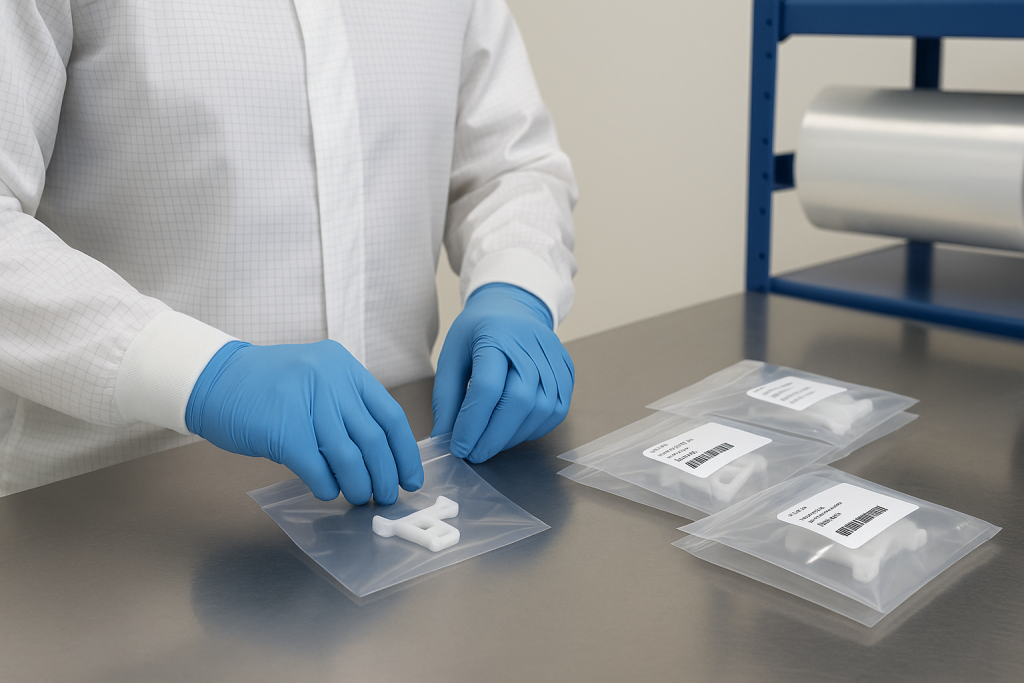
If packaging is done late or done outside the clean area, the benefit of cleanroom molding drops quickly.
The main decision is how the part will be handled after shipment. Single-bag packaging may be enough for short, low-risk transfers. Double-bag packaging is used when parts will be moved, stored, or opened later in a cleaner environment.
Seal the package in the clean area. Then label it with the minimum information needed to control quality and traceability, such as part ID and production lot.
All in all, controlling exposure from material prep through final sealing, not just running a molding machine inside a cleanroom.
Contamination Sources and Control Points
People-based sources (fibers, skin flakes, motion)
People are the largest and least predictable contamination source in a cleanroom. Movement releases fibers and skin flakes, and the closer an operator is to an exposed part, the higher the fallout risk.
In cleanroom molding, control is about reducing unnecessary interaction. Fewer people near open parts, less motion around exposed surfaces, and shorter handling time all reduce particle transfer.
Material and equipment sources (dust, oil mist, deposits)
Not all contamination comes from the air. Materials and equipment often generate particles internally.
Resin dust, dryer residue, oil mist from machinery, carbon buildup, and deposits from hot runner systems can all become particle sources. These contaminants are especially difficult to trace because they originate inside the process rather than from the room environment.
On the material side, resin dust and dryer residue usually enter during open loading or leaky transfer. The control point is closed handling from drying to the machine, with clean dryers and filters so dust does not reach the feed system.
On the equipment side, cleanroom air cannot compensate for particles generated by the machine or hot runner. Oil mist and droplets can come from lubrication near the open mold area, and carbon or deposits can form in the melt path or hot runner. The control point is keeping lubricants away from the exposure zone and preventing buildup inside the melt channel.
Static and airborne particle behavior
Static charge can significantly amplify contamination, even in a cleanroom. Charged surfaces attract airborne particles and hold them in place once they land.
This effect is most noticeable on electronic, optical, and transparent parts, where surface charge and visual sensitivity are high. In these cases, contamination is driven less by room class and more by material behavior and surface condition. Control focuses on reducing static buildup and limiting exposure time, not simply increasing cleanroom grade.
The “post-molding” risk window
The highest contamination risk often occurs after molding, not during the molding cycle itself.
Handling, inspection, staging, and packaging typically create the longest exposure window. Parts may be clean at ejection but pick up particles while waiting, being moved, or being inspected. This is why exposure time and sealing timing are critical control points. Managing what happens after molding often has a greater impact on cleanliness outcomes than tightening parameters during molding.
Common Defects in Cleanroom Injection Molding
Black specks / dark spots
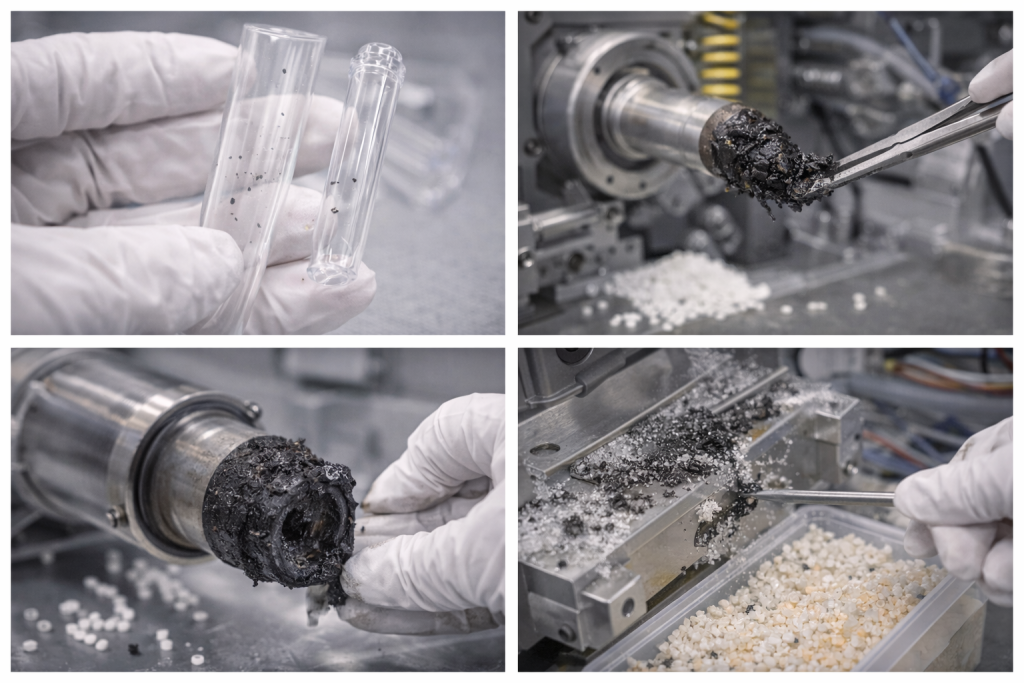
Black specks are among the most common defects in cleanroom molding. They are often misattributed to airborne contamination. In reality, they usually originate from inside the process.
Typical sources include material degradation from excessive heat or long residence time, carbon buildup in the barrel or nozzle, contaminated regrind, or deposits breaking loose from hot runner systems. Because these particles are generated internally, increasing the cleanroom class has little effect.
Control focuses on stabilizing melt history, keeping melt paths clean, and treating hot runner deposits and regrind as contamination sources rather than air-quality issues.
Splay / silver streaks

Splay or silver streaks usually indicate a material condition problem rather than a cleanroom failure.
Moisture, volatiles, or unstable drying conditions cause gas to release during filling, leaving streaks along the flow direction. This defect often appears even in high-grade cleanrooms if dried material is re-exposed to ambient air.
The key control is consistent drying under controlled dew point conditions and sealed material transfer after drying. Clean air cannot compensate for wet or unstable material.
Particle impressions / cosmetic contamination
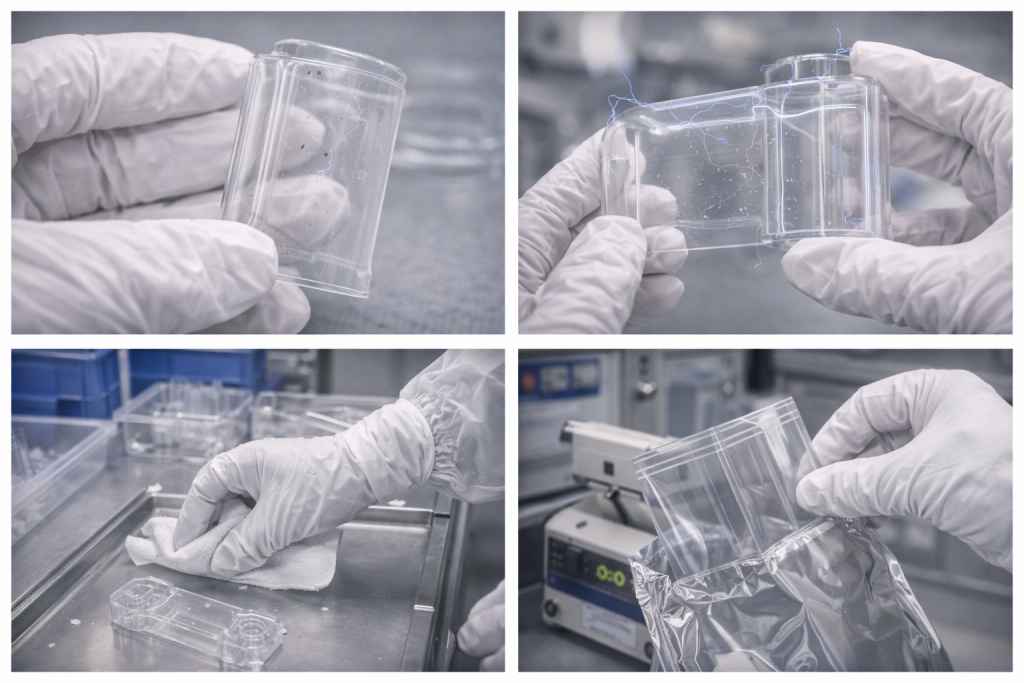
Cosmetic specks and particle impressions are what most people associate with cleanroom molding, but they are typically driven by exposure rather than molding conditions.
Particles settle on parts during handling, staging, inspection, or delayed packaging. Fibers from garments, wipes, or packaging materials are frequent contributors, and static charge can amplify the problem on optical or electronic parts.
Reducing exposure time, limiting handling, managing static, and sealing parts promptly in the clean area are usually more effective than tightening the ISO class.
Burn marks / gas-related defects

Burn marks and gas-related discoloration often appear at flow ends or trapped gas regions and are sometimes confused with contamination.
They are usually caused by trapped air, inadequate venting, or material degradation from excessive temperature or fill speed. While they may look like surface contamination, the root cause is gas management inside the mold.
Improving venting, maintaining parting lines, and balancing fill speed and temperature are more effective controls than changes to cleanroom conditions.
Flash and short shots in cleanliness-sensitive parts

In cleanroom production, flash and short shots often appear together.
Small changes in pressure, clamp force, or tool condition can push the process toward flash or incomplete filling. Flash is especially problematic in clean environments because trimming or deflashing generates debris that can contaminate nearby parts.
Focus on stable settings and tooling conditions. Avoid running so close to the limit that minor variation creates flash or short shots. Flash should be treated as both a dimensional defect and a cleanliness risk.
Most cleanroom-related defects are not solved by choosing a higher ISO class. They are usually tied to material condition, melt history, exposure after molding, or tool condition. Understanding where each defect originates helps target the right control point instead of adding unnecessary cleanroom cost.
Packaging, Traceability, and Change Control
Packaging options and when they’re used
In cleanroom programs, packaging is part of the contamination control strategy, not just a logistics choice.
The first question is where the package is sealed. To protect cleanliness, parts should be bagged inside the clean area immediately after the final exposure step. Bagging outside controlled space undermines the benefit of cleanroom molding.
Single-bag packaging is often sufficient for short transfers or internal use. Double-bag packaging is typically used when parts will be transported, stored for longer periods, or opened later in a cleaner environment. The packaging choice should reflect how the part will be handled after shipment, not just how it is molded.
Traceability essentials
Traceability determines whether contamination issues can be isolated or will repeat.
At a minimum, you should expect a clear linkage between material lot, production lot, and inspection records. When multiple cavities or tools are involved, cavity or tool identification may also be necessary to localize defects.
This helps answer simple questions quickly: Which material lot was used? Which production run was affected? Were inspection results consistent? Without this information, cleanroom issues become difficult to investigate and control.
Change control basics
Cleanroom performance is not static. Changes to material, process settings, tooling condition, or even packaging can alter contamination behavior.
You should ask how changes are evaluated before they are implemented. Material substitutions, process adjustments, or tool repairs should trigger a review of potential cleanliness impact and be recorded accordingly.
Effective change control does not slow production. It prevents cleanroom stability from drifting over time. Without it, parts may still be molded in a cleanroom, but the cleanliness outcome is no longer predictable.
How to Qualify a Cleanroom Injection Molding Supplier (Checklist)
Facility and cleanroom controls
Start with what can be verified on-site or in documentation.
A qualified supplier should clearly state which cleanroom class is used and which steps are performed inside the controlled space (molding only, or molding plus inspection and packaging). Cleanroom zoning should be defined so that clean and non-clean activities do not mix.
Monitoring should exist, but the key question is whether it is routine and recorded, not whether it is overly complex. Buyers should also understand how people and materials enter and exit the clean area. Clear flow logic matters more than the number of posted rules.
Process and documentation capability
Cleanroom performance depends on whether the supplier can show what happened, not just describe how they work.
At a minimum, the supplier should be able to provide process records, inspection results, and lot traceability when requested. For regulated or high-risk parts, the supplier should also support project-specific documentation, such as first article inspection, cleanliness-related records, or validation support if required.
Pilot-to-production consistency
Many cleanroom issues appear after a project moves from pilot runs to full production.
Buyers should ask how the settings and controls used during sampling are carried into production. Process parameters should be locked within defined ranges, and first-article results should reflect what will be produced at scale.
Consistency matters more than optimization. A supplier that can repeat pilot conditions reliably is usually a better cleanroom partner than one that delivers excellent samples but cannot hold the process stable in production.
Final Thoughts
Cleanroom injection molding is not defined by an ISO class alone. Many cleanroom issues are not caused by the room itself, but by gaps in exposure control, traceability, or process consistency.
If you are sourcing cleanroom injection molding, don’t judge a supplier by the ISO class number alone. What matters is whether they can deliver the same cleanliness result run after run.
Kemal provides cleanroom injection molding services for medical devices, diagnostics, optics, and electronics. We operate ISO Class 7 and Class 8 cleanroom environments and align handling, inspection, and packaging with part-specific risk and acceptance criteria.