Many teams encounter a similar pattern during pilot production or first-batch delivery: progress moves quickly in the prototype stage, but slows noticeably once the project enters trial production. These delays often stem from missing critical inputs during the prototyping phase—inputs that are required for pilot production.
A more controllable approach is to connect rapid prototyping and production introduction using a unified set of CTQs, validation plans, and version control logic. 3D printing and CNC machining are used to verify assembly relationships and critical dimensions early. Bridge tooling, low-volume injection molding, and New Product Introduction (NPI) processes are used to define CTQ acceptance criteria, measurement datums, acceptable process windows, and documentation templates in advance. As rework iterations decrease, overall development costs in many projects can be reduced by 25–50%, and delivery cadence becomes easier to maintain according to plan.

Understanding Rapid Prototyping in the MedTech and Electronics Sectors
For many product development teams in medical technology and electronics, similar issues emerge during test assembly, validation, or low-volume pilot builds. Assembly interference may require repeated structural modifications. Reliability testing may reveal warpage, cracking, or unstable sealing performance, leading to adjustments in wall thickness, material selection, or support structures.
Medical projects must also ensure consistency between design revisions, risk analysis, and validation documentation. If version updates are not synchronized, sample batches cannot be reliably matched to their corresponding test results.
Electronics projects, meanwhile, frequently encounter repeated rework in PCB-to-enclosure fit, tolerance stack-up management, connector positioning, thermal paths, and EMI space constraints. Once the BOM is frozen, any structural change becomes significantly more expensive and disruptive.
These issues cannot be resolved through design reviews alone. Physical parts are required to verify whether the assembly path is viable, whether interfaces are installable and measurable, and whether critical dimensions can converge consistently.
To shorten iteration cycles and move risk upstream, projects typically adopt rapid prototyping.
What Is Rapid Prototyping?

Rapid prototyping refers to the use of 3D printing, CNC machining, and other additive manufacturing methods to produce functional models within a shortened timeframe for validation purposes.
The primary objective is not to achieve a near-production appearance, but to enable test assembly, dimensional measurement, and critical functional testing—and to reach clear engineering conclusions based on those results.
If, after a prototype is delivered, the team cannot clearly define what is being measured, how it is being measured, and what constitutes acceptance, then the prototype provides limited value for subsequent pilot production.
What Should Rapid Prototyping Validate?
In medical and electronics projects, prototypes are typically expected to answer four categories of questions. For each category, a clear validation method and acceptance criteria must be defined.

Assembly: Can It Be Completed as Intended?
In medical technology and electronics projects, assembly issues often do not become apparent during the design phase. They gradually surface during physical test assembly. A prototype may be assembled successfully after adjustments, but “assemblable” does not necessarily mean repeatably assemblable.
For example, in an electronics enclosure project, a connector may be aligned at its nominal position in the design. However, during actual assembly, additional displacement of the PCB may be required for insertion into the housing. The assembly process becomes highly sensitive to sequence and operator posture, and the failure rate increases noticeably when personnel change.
Similarly, in a medical device enclosure, screw hole dimensions may be within tolerance. Yet due to structural constraints, tool access angles are insufficient, and fastening can only be completed at a specific orientation.
These issues are often accepted during the prototype stage, but in low-volume builds they translate directly into assembly time variation and rework.
At the prototyping stage, it is critical to identify which assembly steps rely on manual adjustment and which interfaces are highly sensitive to sequence or tooling conditions. This information determines whether structural modifications, fastening strategy changes, or assembly path redefinition are required.
If these issues are not identified during prototyping, assembly-related rework is typically deferred to pilot production, where both cost and schedule impact increase significantly.
Interfaces: Can Critical Interfaces Maintain Stable Positioning?
In many electronics projects, interface issues only become apparent after repeated assembly cycles. The first prototype insertion may appear normal, but after multiple insertions and removals, connectors may develop side loading, inconsistent engagement depth, or in some cases require excessive force for mating. Post-analysis often reveals that interface locations were designed to nominal dimensions without sufficient allowance for assembly variation and tolerance stack-up.
Similar issues occur in sealing structures. Components may appear well-fitted visually, but after fastening, the sealing surface may be interrupted by parting lines or split lines, creating localized leak paths. The problem is not the sealing material itself, but the inability of the interface to remain continuous under assembly load.
Therefore, during prototyping, interfaces must be validated under assembled and loaded conditions—not merely checked against nominal positions. By the end of the prototype phase, the team should clearly define which interfaces are critical, what datums are used for positioning, and the allowable deviation range under assembled conditions.
Critical Dimensions: Do Dimensions Converge, and Are They Measurable?
Many medical and electronics projects become stalled over dimensional issues—not because machining is out of control, but because measured data cannot be used to determine whether structural changes are required. Results from the same batch may vary between inspectors. A part may assemble successfully once, but interfere when replaced with another part or assembled in a different sequence. The team quickly falls into debate: is this a manufacturing issue, or a design issue?
For example, in a plastic enclosure project, dimensions may measure within tolerance immediately after machining, but change after sitting for a period of time. Some hole positions may meet requirements in a free state, yet shift after assembly into the full system, causing connector misalignment. The issue is often not machining capability, but the absence of unified datums and defined measurement conditions from the outset.
During prototyping, the datums that govern assembly relationships must first be fixed. Dimensions should then be evaluated relative to those datums. Measurement conditions must also be defined: whether measurements are taken in a free state or assembled state, and whether dwell time or environmental temperature must be controlled. Without consistent preconditions, measurement results cannot be meaningfully compared.
Structural Behavior: Will It Fail Under Real Operating Conditions?
In many medical and electronics projects, structural weaknesses are overlooked because prototypes appear acceptable under static conditions. Problems emerge only under real use. During repeated insertion and removal, thin-wall areas may whiten or crack. After the screws are tightened to the specified torque, local support regions may deform, shifting interface positions.
For example, in an electronic device, the structure surrounding a connector may appear normal after assembly. However, after repeated mating cycles, cracks may develop at the connector root, eventually causing intermittent contact. Investigation may reveal that the issue is not insufficient material strength, but stress concentration in thin-wall regions where the load path is poorly supported. Similar behavior can occur in sealing structures: a single compression cycle may pass, but repeated compression can cause localized deformation that compromises the sealing path.
The prototype stage must validate structural response under real load conditions. Insertion force, screw torque, drop orientation, and seal compression should each be tested independently. For electronic products, heat sources and thermal paths must also be included in validation to confirm that the structure does not experience significant deformation at operating temperature.
A common misconception is to judge production reliability directly based on the strength performance of 3D printed parts. Printed parts are better suited for exposing geometric and load path issues, rather than serving as substitutes for material-level conclusions.
At the conclusion of this prototype phase, it should be clearly defined where structural failure or deformation occurs, under what load conditions, and which structural features require adjustment—such as adding ribs, modifying radii, or redirecting load paths.
Advantages of Rapid Prototyping

The value of rapid prototyping is primarily reflected in three areas: earlier problem detection, reduced rework, and faster decision convergence.
- Early defect detection: Assembly interference, interface misalignment, tolerance stack-up, wire routing conflicts, and crack risks caused by localized weakness all become less expensive to resolve when identified early. When discovered during the prototype stage, corrective action typically involves CAD updates or localized structural modifications. When discovered during pilot production, however, it often requires reworking fixtures, testing plans, and production schedules simultaneously.
- Risk minimization: Rapid prototyping turns assumptions into measurable results. You do not need to wait until tooling or supply chains are locked before confirming whether interfaces are viable. Especially in projects involving cross-functional collaboration (mechanical, hardware, testing, supply chain), prototypes provide a shared validation reference and reduce repeated debate.
- Accelerated development cadence: The speed of iteration depends less on manufacturing speed and more on how quickly decisions converge. Prototypes ensure that each design revision has a clearly defined validation objective and acceptance criteria, preventing cycles of “changes made without knowing whether performance improved.”
Industry priorities also differ:
- Medical technology: Prototypes place greater emphasis on use pathways, cleaning and sterilization access, sealing structures, and inputs related to biocompatibility and traceability documentation. Many rework cycles arise not because parts cannot be manufactured, but because validation chains do not align.
- Electronic products: Prototypes focus more on PCB and hardware integration stability, including interface positioning, tolerance allowance, thermal paths, EMI space constraints, and assembly sequence. Once the BOM is frozen, interface modifications often create exponentially larger downstream impact.
From Traditional Machining to Fast-Turn 3D Prototyping

In the past, many teams relied on outsourced traditional machining for prototypes. Each iteration required scheduling lead time, and development cycles often progressed in weeks or even months. Slow iteration typically resulted in two consequences:
- Problems were exposed late, increasing modification costs.
- Teams were more likely to freeze designs under time pressure before sufficient information was available.
Today, 3D printing and fast-turn CNC machining make iteration cycles of only a few days feasible. More importantly, they change the development approach:
- Critical interfaces can enter the test assembly and measurement earlier.
- System integration issues can be exposed before the design freeze.
- Decisions shift from experience-based judgment to convergence based on validation data.
For startups operating under tight time and capital constraints, this shift directly affects development strategy. Risk no longer accumulates and erupts during pilot production. Instead, it is distributed into earlier, more controllable prototype iterations.
Tooling Integration: Bridging Prototyping and Production
Have you encountered this gap before? Everything runs smoothly during the prototype phase—assembly works, and interfaces are validated. But once preparation for mass production begins, problems return. For example:
- CNC parts show stable dimensions, but after switching to injection-molded parts, hole positions shift.
- Snap-fit features validated with 3D-printed parts show whitening or cracking when produced in production materials.
- Prototype samples perform well, but during pilot production, yield fluctuates, and the team reopens the debate: should the structure be modified, or should the process be adjusted?
These issues typically arise because prototype validation conditions differ from production conditions. Prototypes validate assembly behavior using printed or CNC-machined parts. Production must additionally confirm whether interfaces and dimensions remain accurate under real injection molding shrinkage and material behavior.
Tooling integration exists to bridge this transition—so validation results can transfer smoothly into production.
What Is Tooling Integration?

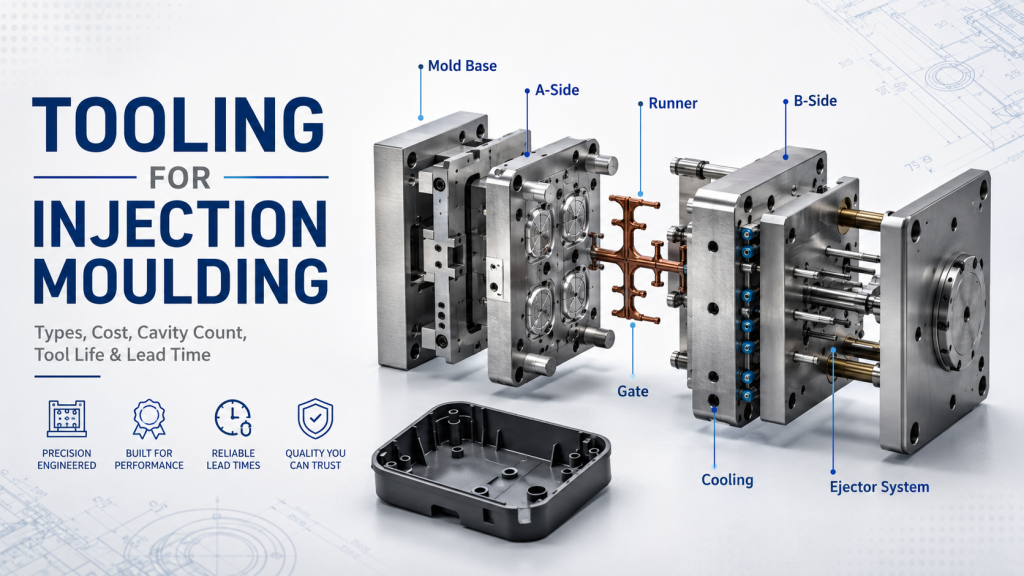
Tooling integration introduces a controlled transition between prototyping and final production tooling. It allows critical structures and interfaces to be validated again under real manufacturing conditions, rather than discovering deviations only after production molds are completed.
More specifically, tooling integration addresses three core issues:
- Consistency of validation conditions: Prototypes are typically produced using 3D printing or CNC machining, whose processing logic and material behavior differ from injection molding or micro-molding. Tooling integration ensures that critical features are reconfirmed under production-like shrinkage, cooling, and material conditions.
- Traceability between versions and validation results: Interface validation, assembly paths, and critical dimensions established during prototyping must be clearly documented before entering production tooling, and tied to specific mold versions. Otherwise, if deviations appear during trial molding, it becomes difficult to determine whether the root cause lies in structural design or process window variation.
- Clear and executable translation from design to process: Structural modifications must be directly mapped to mold modification points and process parameter adjustments, rather than remaining at the CAD level. Tooling integration truly occurs only when design changes can be translated into actionable mold adjustments.
Tooling integration is therefore not a single stage, but a methodology. Before committing to hardened steel molds or micro-molding tools, bridge tooling, low-volume injection molding, and structured NPI processes are used to reconfirm prototype-stage conclusions within real production logic.
The objective is straightforward: to prevent issues that should have been identified during prototyping from resurfacing after production tooling is completed.
What Methods Are Used in Tooling Integration?

Key Method 1: Bridge Tooling
Bringing Production Conditions Forward
The most commonly used approach is bridge tooling. Before committing to hardened steel molds, a round of low-volume injection molding is performed using aluminum molds or soft tooling. The objective is not production capacity, but to evaluate three specific factors:
- Whether interfaces still align after shrinkage, including hole positions, connectors, and locating features.
- Whether warpage affects assembly, such as assembly interference, gap variation, or changes in seal compression.
- Whether appearance and sealing performance are repeatable within a realistic process window. The goal is not to produce a single acceptable part, but to consistently produce a stable batch.
Many issues only become visible during the first injection molding run with production materials. Examples include hole position shifts caused by shrinkage, localized warpage that leads to assembly interference, and changes in seal compression levels.
Key Method 2: Shorten the Feedback Loop Between Design, Process, and Manufacturing
The second key method is reducing the feedback distance between design, process engineering, and manufacturing execution. Fully outsourcing mold development can still produce a functioning tool. However, when design modifications require communication across multiple supply chain layers, structural issues are often not fully resolved during the design phase. Instead, parts are machined or molds are built based on the current drawings, and issues are addressed only after trial molding.
An integrated approach enables:
- Structural changes to be quickly translated into actionable mold modification points.
- Trial molding results to be evaluated using the same decision criteria shared by structural and process teams.
- Avoid repeatedly re-explaining the design intent and realigning objectives at each iteration.
Key Method 3: Use NPI to Convert Prototype Conclusions into Production Control Points
The third key method is using the NPI process to formalize prototype-stage conclusions into production control parameters. During prototyping, the team has already identified critical interfaces, dimensions that require close monitoring, and regions highly sensitive to assembly variation. Before entering mass production, these findings must be translated into executable inputs:
- How datums are defined, prioritizing functional datums rather than relying on nominal dimensions.
- How inspection is performed, including gauges, fixtures, and defined measurement states.
- How the sampling frequency is established, particularly for critical parameters during pilot production.
- How abnormalities are classified, distinguishing structural issues from process window variation.
Without unified datums, measurement methods, and acceptance criteria in place before pilot production, it becomes difficult to determine whether deviations stem from structural design or process variation. As a result, modifications may progress through repeated trial molding cycles without clear root cause identification.
Subtle Differences in Tooling Integration Between Medical and Electronics Industries
Industry priorities differ in how tooling integration is executed.
In medical technology projects, tooling integration must ensure one-to-one alignment between versions, documentation, and validation outputs. The objective is not only to produce compliant parts, but also to maintain a complete evidence chain. Without this alignment, projects can become delayed due to documentation gaps or traceability issues. When SaMD or embedded systems are involved, the hardware version freeze must be synchronized with the software validation cycle. Otherwise, test results cannot be reliably reused, and additional validation work may be required.
In electronic product development, tooling integration often focuses on securing the system integration window. If the enclosure, PCB, connectors, thermal management, and wire harness routing do not converge within a similar timeframe, any interface modification after BOM freeze can trigger cascading impacts. What begins as a single feature adjustment can quickly escalate into redesigning an entire system.
In essence, tooling integration brings prototype-validated conclusions into real production conditions for reconfirmation and formalizes those conclusions into controlled production inputs. As a result, fewer issues arise during pilot production, and root causes become easier to identify when deviations occur.
Core Advantages for Startups
For startups, time and cash flow are the most rigid constraints. Technical direction can be adjusted, but financing windows, clinical milestones, and product launch schedules do not wait indefinitely. The true value of rapid prototyping and tooling integration is reflected in several concrete outcomes.
1. Shorter Time to Market (TTM)
Under traditional models, structural validation and production tooling development are often executed sequentially. Prototyping is completed first, followed by mold development. If issues arise in production parts, the team must return to the design stage for further modification.
When prototype validation progresses in parallel with bridge tooling and low-volume injection molding, critical interfaces and dimensional behavior can be confirmed before full design freeze. Production tooling is no longer launched under uncertainty, but based on validated assumptions.
For medical projects, this means pre-clinical samples can enter real material validation earlier. For electronic products, it reduces the risk of system integration issues accumulating just before launch.
The compression of the timeline does not come from making a single part faster, but from reducing the number of backward revisions.
2. Reduced Upfront Investment and Rework Costs
Startups often overestimate the feasibility of completing a “fully mature” design before opening production tooling. Without real manufacturing feedback, that maturity often exists only at the drawing level.
Through rapid prototyping and bridge tooling, structural risks are exposed earlier. Modifications occur at the CAD stage or during bridge tooling, rather than after hardened steel molds are completed. Mold modification frequency decreases, trial molding cycles are reduced, and the likelihood of repeated fixture and testing investment declines.
In projects with historically high rework rates, it is not uncommon to see overall development costs decrease by approximately 25 percent. These savings come from reducing repeated validation and mold adjustments, not from simply lowering unit manufacturing costs.
3. Faster Technical Validation and Innovation Iteration
One advantage startups possess is a short decision chain. However, if validation cycles are too long, that advantage diminishes.
Rapid prototyping allows teams to test alternative structural solutions more frequently. In medical implant projects, different support structures or wall thickness designs can be compared quickly to evaluate load path behavior. In electronic devices, different thermal strategies or interface layouts can be validated in rapid cycles.
The key is that innovation moves beyond discussion in review meetings and is filtered through physical validation. When failure costs are reduced and iteration frequency increases, the available design space naturally expands.
4. Competitive Timing and Financing Leverage
For medical technology companies, earlier validation under real materials and production conditions helps demonstrate product feasibility to investors and strategic partners. For electronic product companies, earlier system integration convergence allows earlier alignment with supply chain resources and distribution channels.
Market windows do not wait for technical perfection. Teams that complete critical validation earlier typically hold stronger positions in financing timelines and partnership negotiations.
In summary, through rapid prototyping and tooling integration, startups distribute risk into earlier phases rather than allowing it to accumulate and surface during pilot production or product launch.
Step-by-Step Implementation Strategy
In many medical and electronics projects, early samples are primarily used to demonstrate appearance and basic functionality. When preparation for pilot production begins, problems surface in concentrated form: interfaces do not align, seal compression becomes unstable, and dimensional data from different batches cannot be directly compared. Teams then find themselves repeatedly debating whether to modify the structure or adjust the process, disrupting iteration cadence.
Step 1: Identify Critical Risk Points During the Concept Phase
In many projects, the first rework does not occur during pilot production, but during the first physical assembly trial.
For example, an electronics enclosure sample may appear acceptable in appearance and dimensional tolerance. However, during the first test assembly with the PCB and connectors, it may become evident that the tolerance allowance for the connector locating holes is insufficient. Once the tolerance stack-up occurs, insertion requires excessive force. By that stage, the structure may already be fixed around external form and spatial layout, and modifications could affect locating features, support structures, and even PCB mounting strategies.
A similar situation occurs in medical devices. The form of a handheld device may be frozen, but during cleaning or sterilization validation, certain areas prove inaccessible or difficult to wipe. The issue is not manufacturing capability, but the failure to validate the usage path as a risk factor during the design phase.
The common characteristic of these problems is that they should have been identified during concept design.
To move risk upstream, the following risk points should be clearly marked during the early concept stage:
- How interfaces are aligned, including which datums govern connectors, locating features, and sealing surfaces.
- Which dimensions are CTQs, meaning any deviation would cause assembly failure, seal loss, or functional malfunction?
- Which regions carry the highest modification cost, where structural changes would require repeating assembly validation, fixture adjustments, or testing?
AI-based simulations or quick analyses can help identify potential risks, but the critical action is documenting these risks as a checklist and confirming them one by one before the design freeze.
Step 2: Match the Prototyping Process to the Validation Objective
Some rework occurs simply because the wrong prototyping method was selected.
For example, an electronics enclosure may assemble smoothly using 3D printed parts, and interfaces may appear aligned. However, when switched to CNC-machined or injection-molded parts, hole positions shift, and connectors become tight. This occurs because printed parts do not accurately reflect dimensional stability and material behavior.
The reverse scenario also occurs. A structure may be precisely machined using CNC with excellent dimensional control, but the true objective is to validate ergonomics or operational pathways. Only during real-use testing does it become clear that button positions are impractical or difficult to reach. In such cases, early investment in precision did not address the critical validation objective.
The shared issue is a mismatch between validation goals and the prototyping method.
Therefore, when selecting a prototyping process, the first question should be: What is this iteration intended to confirm?
- If validating form, spatial interference, or ergonomic pathways, 3D printing is more efficient.
- If validating interface positioning, tolerance stack-up, and dimensional convergence, CNC machining is closer to production logic.
- If the project is highly sensitive to interface alignment, a hybrid approach is often required: printing to confirm structural pathways and CNC to confirm critical interface dimensions.
Selecting the appropriate method ensures that the intended interfaces, dimensions, or usage paths are validated during that iteration, preventing regression in later stages.
Step 3: Introduce Bridge Tooling Before Hardened Steel Molds to Expose Molding Risks Early
Many teams receive their first true injection-molded parts only after hardened steel tooling has been launched and production schedules are set. At that stage, discovering problems dramatically increases modification cost.
For example, CNC parts may consistently show stable hole positions, but injection molding shrinkage may shift holes by several to dozens of microns, causing connectors to become tight. Alternatively, sealing surfaces may appear acceptable in prototype samples, but after injection molding, localized warpage may reduce or unevenly distribute compression, leading to fluctuating water resistance performance.
The issue is late discovery. After hardened molds are completed, adjusting hole positions or sealing structures may require mold modification and multiple trial runs. In severe cases, core inserts or localized tooling components may require rework.
Bridge tooling directly addresses this risk. Before mold lock-in, aluminum or soft tooling is used to perform low-volume injection molding and identify these changes early.
The purpose of this low-volume molding stage is to confirm three key aspects:
- Whether interfaces still align after shrinkage, including holes, connectors, and locating features within acceptable assembly limits.
- Whether warpage affects assembly and sealing, including gap variation, compression changes, and deformation after fastening.
- Whether parts remain stable when parameters fluctuate slightly, such as minor changes in speed, mold temperature, or packing pressure, without causing dimensional or cosmetic instability.
Successful assembly using CNC or printed parts does not guarantee that injection-molded parts will remain within assembly tolerance. Measuring shrinkage offset and warpage during the bridge stage allows adjustment of hole allowance, rib structures, or sealing geometry before hardened tooling, reducing repeated mold modifications and trial cycles.
Step 4: Test Around Real Usage Actions Rather Than Generic Testing
Some projects generate extensive test data, yet issues still emerge during pilot production or actual use.
For example, an electronics enclosure may pass a single laboratory insertion test. However, after repeated insertions in real usage, whitening or fine cracks may appear near the connector root. Similarly, a medical enclosure may show no issues in static strength tests, but under real fastening torque, localized support areas may deform, shifting interface alignment.
These issues do not necessarily indicate insufficient strength, but rather that tests did not simulate real usage actions.
Generic strength tests often measure overall load capacity, but many failures occur under repeated insertion cycles, fastening load paths, specific drop orientations, or prolonged thermal exposure.
Instead of conducting broader average-load testing, validation should isolate critical usage actions:
- Whether insertion cycles and lateral loads cause interface fatigue.
- Whether the actual fastening torque induces localized deformation.
- Whether different drop orientations alter load paths.
- Whether prolonged heat exposure causes cumulative deformation.
Each validation cycle should answer two specific questions: where does the issue occur, and under what condition does it occur? When testing directly informs structural or process adjustments, iteration can truly converge.
Step 5: Before Production Launch, Use NPI to Formalize Prototype Conclusions into Executable Rules
Many teams only realize during the first pilot production review that the issue lies not only in the part but in how deviations are judged.
For example, a hole deviation measured against Datum A may be considered out of tolerance by the structural team, while the supplier measures against Datum B and considers it acceptable. The quality team may request measurement in a free state, while the assembly team insists on measurement in an assembled state. After extended debate with inconsistent data, the team returns to two options: modify the structure or adjust the process and test again. Pilot production cadence is delayed.
The role of NPI is to define these decision rules before production launch and translate them into executable supply chain inputs. At a minimum, the following should be defined:
- Functional and alignment datums that govern measurement and assembly decisions.
- A CTQ list and acceptance criteria, specifying which dimensions or interfaces must comply and what thresholds apply.
- Measurement methods and states, including gauges, fixtures, and whether measurements occur in free or assembled conditions.
- Sampling strategies and abnormality classification, distinguishing process variation from structural issues.
By aligning version freeze points, pilot production plans, and decision criteria with the contract manufacturer in advance, discussions during pilot production shift from conflicting measurement approaches to structured root cause identification and clear next actions.
Core Technologies and Tools

1. Prototyping: Expose Structural, Interface, and System Issues Early
3D Printing, Including High-Precision Printing
In medical device enclosures, complex curved structures, and miniature component validation, the value of 3D printing lies in rapidly verifying spatial relationships and operational pathways.
For example, grip posture in handheld devices, button travel distance, and probe insertion angles can be adjusted repeatedly within a few days using printed parts.
However, the material stiffness and shrinkage behavior of printed parts differ from production materials. They are not suitable for directly judging the dimensional stability of interfaces. Instead, they are better suited for validating form and assembly pathways.
CNC Machining
When validation priorities shift toward interface positioning, tolerance stack-up, and assembly alignment relationships, CNC machining more closely reflects production logic.
For example, PCB-to-connector alignment, metal insert positioning, and enclosure hole precision require measurable and repeatable dimensional behavior. CNC machining provides a more stable basis for evaluation.
In electronic projects, many cases where connectors “cannot be inserted” can often be traced during the CNC stage to design tolerance settings, confirmed through dimensional data.
Additive Manufacturing and Hybrid Strategies
For geometrically complex structures, internal channels, or miniature assemblies, additive manufacturing allows rapid validation of geometric feasibility.
In practice, a common approach is to use 3D printing to validate structural pathways, CNC machining to confirm critical interface dimensions, and then proceed to bridge injection molding.
2. Tooling Integration and Production Technologies: Bring Validation into Real Manufacturing Conditions
Injection Molding and Tooling Technology
From single-shot molding to two-shot molding and even micro-molding, the core capability is not the number of machines, but the ability to maintain stable control of:
- Shrinkage consistency
- Cooling uniformity
- Batch-to-batch dimensional variation
For example, two-shot molding is often used in medical handheld devices where soft and rigid materials are combined. This affects both sealing performance and long-term fatigue life. If the interface between soft and rigid materials is not fully validated during trial molding, later rework costs can increase significantly.
Embedded Systems and Hardware Integration
In medical devices and intelligent electronic products, hardware structures and embedded systems often evolve in parallel. Changes in enclosure dimensions may affect antenna layout, EMI space, or thermal pathways. Therefore, tooling integration is not only a mold issue; it also requires coordination between hardware version freeze and structural freeze timing.
AI, IoT, and Cloud Platforms
In intelligent device projects, AI and IoT are primarily expressed at the data and system level. From a structural perspective, however, space for sensors, antenna windows, and thermal pathways must be reserved in advance. Structural changes should not be deferred until after software maturity.
3. Emerging Trends: Digitalization and Sustainable Materials
Digital Simulation and Data Analysis
Mold flow analysis, thermal analysis, and drop simulation have become standard tools. Increasingly, teams are applying data analytics to evaluate batch trends, such as correlations between dimensional drift and process parameter variation. The value of these tools lies in predicting risk earlier, rather than explaining deviations after they occur.
Sustainable Materials and Eco-Design
Both the medical and consumer electronics sectors are placing greater emphasis on sustainable materials. Examples include recycled PC/ABS blends and bio-based materials. However, material substitution must be validated simultaneously for mechanical performance, chemical resistance, and dimensional stability. Otherwise, environmental objectives may introduce new structural risks.
Case Studies and Practical Applications
MedTech Startup: Moving Implant Risk Upstream Instead of Deferring It to the Clinical Stage
This project did not begin slowly. The team quickly produced the first structural prototype. Appearance and assembly pathways seemed reasonable. The real difficulty emerged when they prepared to move into the next validation round and found two recurring issues.
First, surface conformity was consistently slightly off. The deviation was small each time, but persistent: localized pressure points, lifted edges, and several degrees of angular shift after assembly. As long as conformity remained unstable, downstream validation data lacked clarity because it was difficult to distinguish whether issues stemmed from design or assembly posture.
Second, the fixation hole alignment was highly sensitive. Hole positions appeared within tolerance, yet when assembled with actual mating components, the parts could be installed but not smoothly. For implant structures, this “forced fit” condition represents risk because assembly force and load paths change accordingly.
Initially, the team relied on traditional outsourced machining. Each CAD revision required three to four weeks for new samples. The issue was not just time delay. Before sufficient data could confirm whether an adjustment was correct, the schedule had already moved forward. Validation cadence became dependent on sample lead time. Design freeze occurred not because validation was complete, but because waiting for another iteration was no longer feasible.
In the second phase, they adjusted their approach. Instead of machining every iteration, they separated the features requiring repeated trials and used high-precision 3D printing for rapid iteration.
Printing was not intended to replace production material. It was used to answer two key questions quickly:
- How should the surface geometry be adjusted to achieve stable conformity?
- Are screw channel orientation, tool access angle, and assembly accessibility valid?
The result was immediate. Iteration cycles shifted from monthly to weekly. Many issues that previously required waiting for machined samples could converge within one or two print cycles.
However, they did not proceed directly to tooling after printing convergence. They added a critical step: validating key interfaces with low-volume CNC machining.
The reason was practical. Hole positions and mating surfaces require reliable dimensional data that printed parts cannot provide. The CNC phase transitioned validation from “can fit” to “can align, measure, and reproduce.”
At that point, the development cadence stabilized. The team was not producing more prototypes; they were closing specific risks with appropriate processes. Printing addressed spatial and assembly pathway risks. CNC addressed interface and dimensional risks. When moving into bridge or production tooling, rework points were significantly reduced.
What they ultimately obtained was not simply an attractive prototype, but a defensible evidence set. Each revision corresponded to a defined validation objective, with documented data and rationale for progressing to higher-cost stages. In investor discussions, this evidence proved valuable because stakeholders care less about the number of versions produced and more about whether risk has been reduced to a controllable range.
For teams developing similar implant structures, the recommendation is straightforward. Use rapid iteration to stabilize fit pathways and assembly accessibility first. Then use CNC to measure and confirm hole positions and mating interfaces. Entering the bridge and production tooling under these conditions significantly reduces rework.
Electronics Company: Validating Interfaces in Parallel with Bridge Molding
This company developed an IoT terminal device. During prototyping, progress appeared smooth. The enclosure was 3D printed. The PCB fit inside. Connectors could be inserted. The team believed the structure was nearly ready for tooling.
Problems emerged after the first trial molding. Once injection-molded parts were produced, issues that had not appeared during prototyping surfaced simultaneously:
- Connector alignment became tight, requiring additional insertion force.
- Slight warpage appeared near ventilation openings, leading to uneven assembly gaps.
- EMI clearance was reduced by reinforcing ribs, causing interference between shielding components and wire routing.
The primary issue was not the number of problems, but the interruption of development cadence. Tooling schedules were already underway, yet structural revisions became necessary. Each adjustment required new trial molding, measurement, and assembly validation cycles.
In the next product iteration, the team revised its strategy. Instead of relying on a single prototyping method, they separated validation objectives:
- Printed parts were used to validate spatial layout and operational pathways, including antenna windows, wire routing, and assembly accessibility.
- CNC parts were used specifically to validate interface positioning and tolerance stack-up, including connector location and hole-to-datum relationships.
- Before hardened steel tooling, an aluminum bridge mold was introduced to evaluate shrinkage and warpage effects on interfaces and assembly gaps.
During the bridge stage, they discovered that interface allowances were too small. Injection-induced shifts pushed insertion feel beyond an acceptable threshold. Hole tolerances and localized rib layouts were adjusted before entering hardened tooling. As a result, formal pilot production required only minor parameter tuning. Structural rollback was avoided, and development cadence improved significantly.
For teams developing intelligent hardware enclosures, especially those balancing connectors, thermal paths, and EMI constraints simultaneously, relying solely on printed parts to judge interface validity is insufficient. Confirm interface positioning and datum relationships with CNC, then quantify shrinkage and warpage through bridge molding before committing to hardened tooling. This approach substantially reduces rework.
Contract Manufacturer Case: Reducing the Gap from Concept to Production
Some startup teams initially evaluate contract manufacturers based on equipment capacity. After collaboration begins, they discover that schedule control depends less on equipment and more on whether engineering decisions are moved upstream.
In a typical case, a client approached a manufacturer with a structure that had undergone several prototype iterations. Samples assembled successfully, and functionality appeared acceptable. However, once the discussion moved toward pilot production, questions became specific: Which datum governs critical hole alignment? How is seal compression measured? Which dimensions qualify as CTQ? When variation appears during pilot runs, how is root cause classified between structural and process factors?
Some suppliers proceed directly to mold fabrication according to drawings. Initial progress appears rapid. After the first trial molding, the team often enters a loop: minor structural changes are made, process parameters are adjusted, outcomes shift, but root cause remains unclear. Pilot production time is consumed by repeated testing without convergence.
Experienced contract manufacturers, such as firms similar to Integer or Robling, typically follow a different approach. They break early-stage work into defined engineering steps rather than immediately launching tooling:
- Converting DFM into specific modification points, identifying warpage-prone regions, short-shot risks, and sealing vulnerabilities at the structural feature and tooling strategy level.
- Validating CTQs during bridge molding using actual molded parts, quantifying shrinkage offsets, warpage magnitude, and seal compression behavior.
- Formalizing decision criteria into executable pilot production rules, defining datums, measurement states, inspection priorities, and escalation thresholds.
The result is practical. During pilot production, discussion shifts from debating structural versus process changes to identifying which control parameter corresponds to a given deviation and what corrective action should follow. Development cadence becomes more stable.
When selecting a contract manufacturer, the evaluation should focus on engineering capability. Can they define CTQs, measurement datums, and bridge validation plans before hardened tooling begins? Suppliers who can perform this alignment often contribute more to smooth pilot production than those who simply offer larger equipment capacity.
Common Challenges, Pitfalls, and Solutions

Common Challenges
1. Underestimating Regulatory Cadence: The Bottleneck Is the Evidence Chain, Not Technical Complexity
Some medical projects progress smoothly from a technical standpoint. Structures are optimized through multiple iterations, and functional testing is conducted repeatedly. However, once the project enters regulatory submission or clinical preparation, progress suddenly slows.
Typical scenarios include:
- The structure has advanced to Version 3, but the risk analysis remains at Version 2.
- A critical interface has been modified, yet the validation plan was not updated accordingly.
- Biocompatibility or sterilization validation was conducted on sample versions that no longer match the current design.
These issues are not visible during prototyping because the focus at that stage is on structural viability and functional performance. When preparing complete technical documentation, the alignment between version control and validation becomes critical.
The true delay is not design complexity, but a broken evidence chain. When versions and validation results cannot be directly mapped, additional testing, rework, or reinterpretation becomes necessary, consuming time passively.
Therefore, while advancing structural iterations during prototyping, the following actions must occur in parallel:
- For every critical structural modification, confirm whether validation inputs must also change.
- Bind test reports to specific version numbers.
- Before entering bridge or production tooling, confirm that validation logic aligns with the current design.
The objective is not merely complete documentation, but to prevent forced retesting caused by misaligned traceability during regulatory review.
2. Underestimating Material and Molding Behavior: Prototype Conclusions Cannot Be Directly Applied to Production
Many projects appear successful during prototyping. Printed parts assemble properly, CNC parts show stable dimensions, and teams conclude that the structure is resolved. Problems often emerge during the first injection molding or pilot production stage.
Common situations include:
- Snap-fit features perform repeatedly in printed parts, but production material exhibits whitening, brittle cracking, or reduced fatigue life.
- CNC hole positions and connector alignment are stable, yet injection molding shrinkage shifts holes, causing tight assembly or forced insertion.
- Small batch samples perform well, but when scaling to pilot cadence, dimensional variation and warpage increase, and yield stability declines.
These are not sudden manufacturing failures. Rather, the prototyping processes masked factors that inevitably appear in production: shrinkage, cooling deformation, material stiffness differences, long-term fatigue, and thermal effects. Printing and CNC validate geometry and alignment logic, but they do not predict molded behavior under real cooling and shrinkage conditions.
Passing prototype validation only confirms structural viability under prototype conditions. Injection molding introduces shrinkage, cooling deformation, and material behavior differences that can alter interface positioning and assembly performance. If these molding effects are not validated before hardened tooling lock-in, issues will surface during trial molding or pilot production, when changes are slower and more expensive.
A more robust approach is to move these risks upstream:
- Use bridge molding in critical interface and sealing areas to quantify shrinkage offset and warpage magnitude.
- For snap-fits, thin walls, and stress concentration zones, avoid relying on printed part strength. Instead, test with samples close to production material under targeted load conditions.
- Provide a reasonable tolerance allowance in the interface design so the tolerance stack-up remains assemblable under production variation.
3. Scaling Challenges: Small-Batch Success Does Not Guarantee Production Stability
Many medical and electronics projects appear smooth during small-batch production. One hundred to five hundred units assemble successfully, and testing passes. Teams may conclude that mass production poses no major risk. The real pressure often begins during scale-up.
Common scenarios include: High yield in small batches, but during production cadence, certain batches show tight assembly, inconsistent gaps, or fluctuating seal compression. Dimensional data begins to disperse, not as a single out-of-tolerance event, but as inconsistent results across batches, machines, or shifts. To maintain delivery, assembly lines rely on rework, sorting, or manual adjustments, quickly reducing efficiency.
These issues typically stem not from insufficient capacity, but from undefined control points.
In small batches, experience and manual adjustment may compensate for variation. Once cadence increases and personnel or equipment expands, the lack of unified criteria becomes amplified. CTQs may not be clearly defined, measurement datums and states may be inconsistent, and process windows may lack defined stability ranges. When anomalies arise, teams debate whether the issue is structural or process-related, and repeated adjustments follow.
The principle of scaling is straightforward: define how deviations are judged and controlled before increasing volume, rather than reacting after variation appears.
More stable practice includes moving the following actions into the bridge and NPI stages:
- Clearly define CTQs tied to functional datums, specifying which dimensions or interfaces directly affect assembly, sealing, or performance.
- Standardize measurement methods and measurement states, including gauges, fixtures, and whether measurement occurs in free or assembled condition.
- Define process windows and abnormality classification, clarifying parameter stability ranges and escalation triggers for structural review.
With these elements in place, pilot production deviations become attributable and manageable rather than random variation. Only then can mass production progress with stability.
Common Pitfall: Misaligned Integration Timing Leading to Rework
Many rework cycles result from misaligned integration timing.
For example, a structural team may freeze enclosure and interface positions to meet schedule pressure, and tooling proceeds based on the current drawing. Meanwhile, PCB revisions continue. A change in connector height or locating method may eliminate the existing tolerance allowance. Alternatively, after BOM freeze, supply shortages may force connector or insert substitution, altering geometry by one or two millimeters and tightening the assembly.
When these issues surface during trial molding or pilot production, the scope expands from adjusting a single interface to modifying tooling, fixtures, and validation plans.
The most time-consuming aspect is not the modification itself, but repeated alignment discussions. Mechanical, hardware, and supply chain teams debate root cause while schedules continue to advance.
Interface-related freeze decisions must therefore occur only after system convergence, not because time is limited. If interface conditions remain fluid, launching tooling early amplifies downstream rework.
A more stable approach includes moving alignment actions upstream:
- Conduct version alignment before freeze, confirming structural, PCB, connector or insert models, and thermal and EMI constraints are all stable.
- Define interface changes as mandatory linkage triggers. When connectors or inserts change, evaluate hole allowance, tooling modification scope, fixture impact, and validation implications simultaneously.
- Involve manufacturing early during DFM and bridge stages to align substitution boundaries, interface allowance, and validation plans.
The goal is to prevent issues that could be clarified before freeze from being deferred to trial production, where resolution costs are significantly higher.
Solutions: Expert Collaboration, Virtual Validation, and Earlier Clinical or Electronics Testing
Many late-stage rework cycles occur because key engineering decisions are made too late or lack practical grounding. A more stable approach brings three capabilities forward so that risks are closed during prototyping and bridge stages.
1. Collaborate with Experts to Move Decisions Upstream
Experts in this context are not merely process specialists. They are teams capable of translating compliance, manufacturing, and validation into concrete engineering inputs.
For medical projects, teams familiar with ISO 13485 alignment between versions, documentation, and validation are valuable. For electronics projects, engineers experienced in interface control, assembly mechanics, thermal management, and EMI constraints are critical.
Working with such teams allows CTQs, datum strategies, measurement states, and bridge validation plans to be aligned before hardened tooling and BOM freeze, preventing pilot-stage debates over structure versus process adjustments.
2. Use Virtual Validation to Eliminate Invalid Concepts Early
Virtual validation does not replace physical sampling. It reduces ineffective iteration.
Typical applications include:
- Mold flow and warpage prediction to identify shrinkage offset and warpage-sensitive regions, guiding bridge validation focus.
- Thermal path and assembly space checks to identify conflicts between heat sources, cooling interfaces, and EMI constraints while hardware and structure evolve in parallel.
Virtual validation highlights high-risk regions earlier, allowing each physical prototype cycle to be more focused.
3. Prioritize Early Clinical or Electronics Testing Around Real Usage Conditions
Generic testing often fails to expose failure modes. Validation must focus on real usage actions and real interfaces.
Medical projects emphasize usage pathways, cleaning and sterilization accessibility, sealing integrity, and deformation after assembly. Electronics projects focus on PCB and connector alignment, tolerance stack-up, insertion fatigue, thermal deformation under operating conditions, and substitution effects after BOM freeze.
The earlier these action-level tests are conducted, the greater the ability to adjust the structure before tooling is locked and modifications become costly.
Conclusion
What many MedTech and electronics startups ultimately want is to invest their time in validation that truly advances decision-making. Rapid prototyping addresses iteration speed. Tooling integration addresses the gap between samples and mass production, where rework most commonly occurs. When combined, they allow critical factors such as interfaces, tolerance stack-up, sealing performance, and reliability to be clarified before hardened tooling and pilot production, reducing repeated mold modifications, retesting, and trial cycles.
If you are preparing to move a project from “functional prototype” to “pilot-ready and deliverable,” progression should follow an agile cadence. When acceleration is required, prioritize partners capable of covering DFM, bridge tooling, and NPI within an integrated framework, and involve teams with ISO system experience early to avoid delays caused by evidence chain misalignment and version traceability issues.
In the next two to three years, AI and automation will continue reducing nonproductive waiting time. Simulation will become faster, process windows will converge more easily, and deviations will be easier to attribute. However, regardless of tool advancement, the core logic remains unchanged: move critical validation upstream, ensure each prototype answers a specific engineering question, and formalize conclusions into production control points. Only under these conditions can time to market truly become controllable.