Startups face high risks and costs when launching products. While demand is still being validated and design and assembly may require further adjustments, traditional mass production injection molding often demands large Minimum Order Quantities (MOQs), frequently exceeding 100,000 units. Once quantities scale up, inventory tie-ups and warehousing costs are incurred immediately; furthermore, if design revisions are made, existing stock risks becoming scrap or incurring rework costs.
Low-Volume Injection Molding (LVIM) lowers the production threshold to between 100 and 10,000 units, typically achieving faster turnaround times through the use of aluminum or soft molds. You can obtain assemblable, deliverable parts using production-grade materials and actual injection molding processes, which can be used for trial assembly, reliability validation, and pilot market releases. With controlled quantities, inventory and warehousing pressures become more manageable, making it suitable for products with fluctuating demand, pilot testing needs, and niche markets.
When MOQs can be extremely low—even down to a single unit—the logic of LVIM is clear: validate with a small batch first, then decide whether to upgrade tooling and production volume. Design, assembly, and market feedback can be validated in a closed loop at low quantities, and version iterations are more flexible, thereby keeping capital commitment and inventory risks within a manageable range.

Understanding Low-Volume Injection Molding and Single-Unit MOQs
What is Low-Volume Injection Molding?

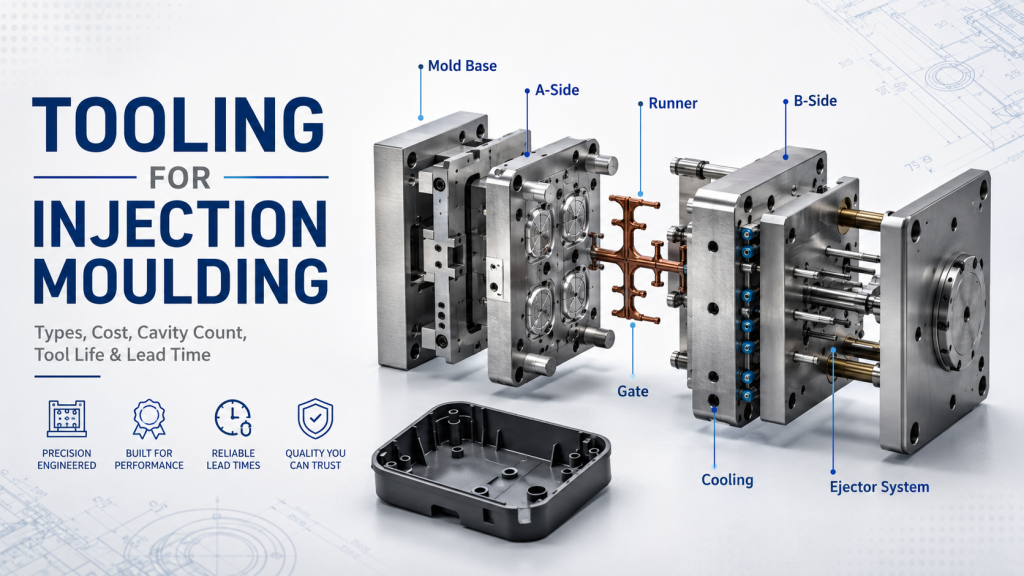
You can think of low-volume injection molding as “applying injection molding early in the verification stage.” It typically does not start with fully hardened steel mass-production molds. Most projects utilize aluminum molds, soft steel molds, or hybrid molds with steel inserts in critical areas to obtain injection-molded parts for verification with lower upfront investment and shorter lead times. The purpose is clear: to produce parts using the actual injection molding process first to verify assembly, cosmetic consistency, and functional performance, rather than paying upfront for long-term tool life and the lowest unit price.
In terms of quantity, LVIM commonly covers 1–10,000 units. Delivery lead times are typically days to weeks. You do not need to wait until “the mold is fully completed to mass-production standards” to begin testing; instead, you receive a batch of usable parts sooner, pushing engineering verification forward.
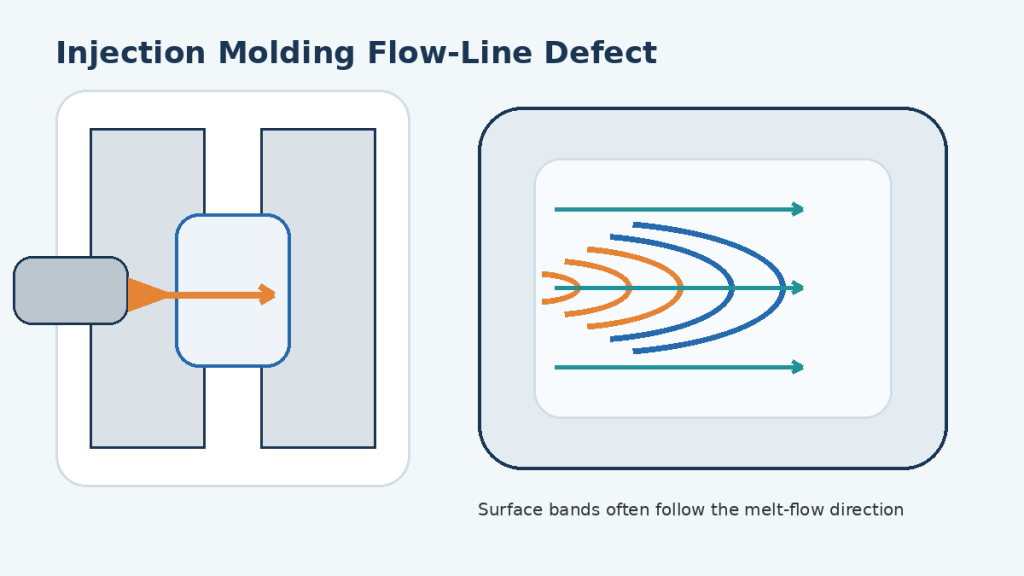
A typical scenario involves housing parts. While 3D-printed prototypes may assemble correctly, issues such as snap-fit resilience, boss cracking, and reduced strength at weld line locations only genuinely emerge after switching to injection molding. LVIM allows you to produce a few dozen parts first, exposing these issues all at once, before deciding whether to upgrade the tooling or freeze the design version.
Differences Between LVIM and Mass Production Injection Molding
Many customers first ask, “What is the difference in tooling costs between LVIM and mass production injection molding?” This is indeed one of the most obvious differences between the two: LVIM tooling is typically lower cost. Taking a common plastic part with a relatively simple structure and low cavity count as an example, rapid tooling might fall within the range of approximately $1,000–$5,000, whereas mass production steel molds are commonly upwards of $50,000. Actual prices depend on size, cavity count, slider mechanisms, and tolerance requirements.
However, the more critical difference is actually this: Low-volume injection molding and mass production injection molding solve different problems.
Mass production injection molding prioritizes longevity and efficiency. Molds are more complex, featuring multiple cavities and more refined cooling, while the process window leans more towards long-term stability and cycle time efficiency. Its prerequisite is that demand is relatively clear and the design version is basically frozen, allowing fixed costs to be amortized through scale.
LVIM pursues a “prove out first, then iterate” approach. Mold structures are simplified, and modifications are faster, allowing you to proceed in batches based on testing goals. For many projects, the issue isn’t that parts cannot be made, but rather that “changes will happen.” The value of LVIM lies in allowing changes to occur during the low-volume stage, rather than after a massive inventory has already been built up.
Differences in MOQ (Minimum Order Quantity) Between LVIM and Mass Production Injection Molding
The MOQ limitations of LVIM are typically not due to an inability to produce smaller quantities via injection molding, but because fixed startup costs must be borne with every production run. Mold changeovers, machine setup, first-article confirmation, trial production, and process window establishment, as well as material unpacking and colorant switching, all incur inevitable time and material costs.
In contrast, mass production injection molding typically utilizes larger orders to amortize these fixed costs over individual units, which is why MOQs tend to be set higher.
Therefore, when your primary objective is to lower unit costs and establish a long-term, stable production line, a high MOQ is reasonable. When your objective is to validate design and the market while uncertainty remains high, the value of a low MOQ lies in preventing risks from prematurely ballooning into inventory.
Commodity Plastics vs. Specialty Plastics: Why Minimum Order Quantities Differ Significantly

When undertaking low-MOQ projects, many customers find that the first bottleneck is not the mold, but the material: “I only need 50–200 units; why does the supplier still require me to procure a larger quantity? Or why is the material cost in the quotation clearly disproportionate?”
This typically occurs when you select specialty materials, as the logic behind MOQs for commodity plastics versus specialty plastics is inherently different.
If you are using commodity materials like ABS or PP, low-volume production is often easier to execute. Raw material supply is more readily available, breaking bulk and material preparation are more flexible, and waste during material changeovers and purging is more controllable. For example, when producing 200 consumer electronics housings, production using commodity materials can usually be organized based on the “quantity required for verification,” without the material costs being excessively inflated.
However, when the material is switched to flame-retardant grades, medical-grade, or high-temperature engineering plastics, the MOQ is often driven up by “material handling costs.” You may only need 80 flame-retardant housings (e.g., UL 94 V-0), yet the supplier needs to procure material based on fixed packaging units and bear the requirements for drying, machine purging, and the isolation/traceability of leftover material. As a result, what you pay for is not the “material usage for 80 units,” but something closer to the cost structure of a “single changeover batch.” This is why, although both are termed “low minimum order quantities,” different materials can vary significantly in terms of cost and feasibility.
To avoid being put in a passive position regarding materials, you can ask more specific questions during the RFQ stage:
- What is the minimum packaging unit for this grade? Is breaking bulk supported?
- Is strict drying required? What is the estimated loss for machine purging/material changeover?
- Can leftover material be reused? If flame-retardant/medical grades are involved, are isolation management and traceability required?
By clarifying these three points, you can determine whether the low MOQ for this material represents a “viable small batch” or a case where “the quantity is small, but costs will be amplified by material handling.”
Why Single-Unit MOQs Are Important for Startups
In fact, a single-unit MOQ allows you to produce a small number of prototypes first to verify assembly and function, confirming the direction before scaling up, thus avoiding immediate overproduction.
At this stage, you typically only want to confirm a few things: Can the design be assembled consistently? Is cosmetic consistency controllable? Does user feedback upon receiving the physical product support continued investment? If the MOQ is high, these issues are often not exposed until after mass production, with costs directly translating into tied-up inventory, scrap from revisions, and delivery delays.
Low MOQs allow you to break validation down into several steps, with each step having a clear objective. For example:
- Produce 10 units first, strictly to verify the assembly path and critical interferences;
- Then produce 50–200 units to verify cosmetic consistency and conduct small-scale pilot releases;
- Once the direction is confirmed, then decide whether to upgrade to multi-cavity molds or higher-longevity tooling solutions.
This approach aligns better with the actual rhythm of lean/agile development: every investment yields usable information, rather than generating massive output first and then looking back to correct assumptions. For startups, this ability to “advance in batches based on verification goals” is often more important than the unit cost itself.
Major Advantages of Market Testing

Cost Efficiency
The most common pitfall you are likely to encounter during the market testing phase isn’t slightly higher unit costs, but rather having order quantities pushed far beyond verification needs just to amortize fixed costs like mold changes, machine setup, first article confirmation, material drying, and color switching. Before testing is even finished, inventory tie-ups and warehousing costs are already incurred. Subsequently, if structural or cosmetic changes are required, existing stock risks becoming scrap or incurring rework costs.
The cost advantage of LVIM comes from “spending money where it counts.” The first step usually doesn’t require multi-cavity, hot-runner, or hardened steel molds built for long-term life. A more common practice is to start with single-cavity aluminum or hybrid molds to produce dozens to hundreds of units for assembly verification, cosmetic consistency checks, and critical structural failure troubleshooting. Once the direction is confirmed, decisions on upgrading cavity count or mold life can be made.
In projects where versions are subject to adjustment, a phased approach can typically reduce overall spending during the pilot phase by 25–50%; these savings come primarily from avoiding extra costs associated with inventory disposal, rework, and secondary mold modifications.
Faster Time-to-Market
Many startup teams feel progress is slow; actually, this isn’t due to machining time, but time consumed in repetitive loops: waiting for mold completion and scheduling → trial shots → discovering assembly or cosmetic issues → modifying mold/structure → rescheduling trial shots.
While 3D printed prototypes can validate dimensions and shape, they struggle to expose issues specific to injection molding in advance: insufficient snap-fit resilience, deformation in thin-walled areas, cracking at boss bases, or strength reductions/cosmetic defects at weld lines. If these issues only emerge after mass production molds are completed, modification cycles are often calculated in weeks or even months.
The advantage of LVIM is getting real injection-molded parts sooner. Generally, within days to weeks, you can receive a batch of assemblable, usable parts for trial assembly, reliability checks, and small-scale releases.
To take a common example: housing snap-fits might look normal in 3D printing, but after injection molding, due to material shrinkage and cooling differences, interference increases, and assembly force exceeds limits. Producing 30–50 units via LVIM allows you to quickly confirm the need for snap-fit chamfers, base radii, or wall thickness transitions, rather than waiting to rework a completed mass production mold.
Risk Mitigation
Many startup teams worry about one issue during market testing: “The prototype is fine, but if we go straight to thousands of units, will issues explode?”
The reason is simple—design is still being adjusted, the assembly path isn’t fully proven, and market feedback is insufficient. If these uncertainties are carried directly into mass production, they often amplify simultaneously, manifesting as inventory backlogs, extended lead times, and scrap from version changes.
The value of LVIM lies in confirming whether critical risks are controllable with a small batch first, before deciding to increase production quantities. In actual projects, small batches usually need to validate at least three things:
- Design: Is the critical structure stable under injection conditions (e.g., thin-wall warpage, boss cracking, stress around inserts)?
- Assembly: Are hole positions, tolerance stack-ups, snap-fit forces, and screw fastening repeatable?
- Market: Does the consumption rate and feedback after pilot release support continued investment?
For example, a housing assembled normally during the prototype stage, but after producing 100 injection-molded units via LVIM, it was found that the snap-fit force was too high and caused local stress whitening. The team completed structural adjustments during the low-volume stage; the issue only affected the current batch, not subsequent inventory.
If these validations are delayed until after mass production, the object of rework shifts from samples to inventory. Validating with small batches first means adjustments only affect the current batch, keeping risks and losses more manageable.
Flexibility
Many startups face a practical issue early in product development: materials and colors are not yet finalized, but placing a large one-time order now turns subsequent adjustments directly into inventory disposal issues.
LVIM allows these judgments to be made during the low-volume stage. You can validate the performance of different materials or colors under appearance, assembly, and usage conditions with a limited quantity first, then determine the final configuration based on results; procurement proceeds based on current testing or delivery needs, rather than locking in a long-term plan prematurely.
For example, produce 100 units of the same housing in two different colors: one batch for user trials, the other for assembly and drop testing. Once test results are clear, adjust the material, color, and quantity for subsequent orders, rather than committing to a specific mass-production scheme at the outset.
In this way, when demand rhythm or feedback direction changes, the next order can be placed directly according to the latest conclusions, without needing to deal with excess inventory already produced, or prematurely inflating procurement scale just to avoid material shortages.
Step-by-Step Guide for Startups Implementing LVIM
Step 1: Design Preparation and Optimization
If your product development project is at a stage where appearance and dimensions are basically finalized, but structural stability and assembly smoothness after injection molding are still uncertain, it is not yet suitable to proceed directly to the mold-making phase. At this point, the key is not to “make the mold as soon as possible,” but to identify the areas in the design most prone to issues in the injection-molded state, enabling the supplier’s DFM (Design for Manufacturability) to have clear inspection priorities.

In actual projects, the following three types of areas are the most common sources of rework and should be self-checked first:
- Wall thickness transitions: Areas with excessive differences in thickness are prone to concentrated sink marks and warpage. You do not need to make all wall thicknesses identical, but you need to avoid sudden local thickening and should use transition structures to disperse shrinkage and cooling differences.
- Snap-fits, thin ribs, and bosses: These structures are the most sensitive in the injection-molded state. Common issues include insufficient snap-fit resilience, short shots on thin ribs, and cracking at the base of bosses. Issues not apparent during the prototyping phase are often exposed collectively after injection molding.
- Draft directions and parting lines: If the parting line location cannot be defined during the design phase, it will be difficult during mold trials to distinguish whether problems arise from the structure, the mold, or process parameters, which also increases uncertainty for subsequent modifications.
Using CAD or simulation tools at this stage should focus on defining critical boundaries such as gates, venting, weld lines, and ejection; there is no need to push analysis accuracy to mass-production levels. their value lies in answering key questions in advance: Where can gates be placed? Are there closed areas where venting is difficult? Where will weld lines likely fall? Is there sufficient space for ejection?
Marking these risk points in advance makes communication regarding DFM with suppliers significantly more efficient.
File preparation also requires scope control. You do not need to provide the complete assembly, full BOM, or all version history in the first round. A safer approach is: sign an NDA first, then provide the minimum file set for quotation and DFM, such as 3D models, descriptions of critical mating relationships, CTQ dimensions, and material/finish requirements. Non-critical details can be edited or hidden first, to be supplemented gradually once the structure and direction are stable.
Step 2: Tooling and Method Selection
Many customers ask this most frequently at this step: “What level of upfront tooling investment is appropriate? We need credible verification results but also need to retain room for subsequent modifications.”

The answer depends on what you currently need to verify, as well as the project’s tolerance for lead time, budget, and modification rounds.
- If your goal is to get real injection-molded parts as soon as possible for checking assembly interference and cosmetic consistency, aluminum molds or soft molds are usually more suitable. They are easier to modify after the first round of parts is produced. For example, if you need 100–300 housings for trial assembly and cosmetic inspection, aluminum/soft molds are often sufficient and allow for faster adjustment rhythms. 3D-printed molds can also be used, but they are more suitable for earlier morphological reference parts, not for verifying dimensional consistency or pilot delivery.
- If you have identified several critical mating features that need to maintain dimensional consistency (e.g., dimensions related to snap-fit assembly force, sliding mating surfaces, mating surfaces around inserts), hybrid molds are more appropriate. The approach is to use steel inserts in these areas while keeping rapid tooling structures for the rest. For example, snap-fit bases or sliding surfaces are more prone to dimensional drift due to wear after multiple trial runs; hybrid molds can improve dimensional retention in these locations, preventing test conclusions from being compromised by mold wear.
- If you only need a few dozen parts and the verification focus is on structural relationships, hole position stack-ups, and assembly sequence, CNC or thermoforming is often more direct. For instance, making only 20–50 units to confirm the assembly path and evaluate hand-feel using CNC to finalize the structural direction first, followed by LVIM to verify performance under injection molding conditions, usually saves more time and budget overall.
Step 3: Partnering with Suppliers
Many teams fall into a trap here: thinking that finding a “no MOQ” supplier is enough. However, what truly determines the success of a project is usually whether the supplier is willing to handle low volumes with an engineering approach, rather than just treating it as a small order inserted into the production line.
When screening suppliers, “no minimum order quantity” can serve as the first threshold. Platform-based suppliers like Protolabs or RevPart, known for rapid quoting and standardized delivery, are often more supportive of low-volume rhythms. However, do not look only at price and lead time. You need to simultaneously request actionable DFM feedback: gating schemes, parting line locations, venting and ejection suggestions, potential sink/warp risk points, and which structures need adjustment to reduce trial mold rework rounds. If they only give a price but do not confirm the gating scheme, parting line location, venting/ejection methods, and potential molding risk points, you will often be forced into passive rework during the trial mold phase.
Additionally, if your product involves medical, electronic, or electrical safety, or requires material traceability and inspection records, the supplier’s quality system will directly impact whether you can smoothly move from verification to low-volume delivery. Prioritize teams with ISO systems (and corresponding document output capabilities) that can at least provide material batch information, inspection records, and process documents. For example, if you are making a housing or functional part with regulatory requirements, you will likely need to trace material and inspection data later; screening in suppliers with system capabilities early on saves more time than trying to patch up documentation later.
Step 4: Prototyping and Testing
The most common mistake teams make at this stage is producing a large quantity in the first batch without setting clear verification goals for these parts. For early-stage projects, quantity itself is not the goal; the goal is to obtain usable conclusions with the minimum quantity.
A more stable approach is to split 1–100 units into two layers of utility.
- First, produce 1–10 units strictly to confirm basic assembly and critical interferences: are snap-fits too tight? Do bosses crack when screwed? Do hole stack-ups require forcing to align? Once issues appear, prioritize redesigning or adjusting critical structures rather than increasing quantity.
- Then, produce 20–100 units to observe consistency and collect real user data: are cosmetic defects concentrated in certain locations or colors? Is assembly force stable? Do users repeatedly complain about the same detail in real-world usage?
For example, A team produces 30 units of housing in the first batch. They use 10 for internal assembly and drop testing, and give the other 20 to target users for trial, recording reasons for returns/exchanges and concentrated feedback. After finding issues, they only modify snap-fit chamfers and boss base radii, then produce a second batch of 50 to verify if the changes are effective. In this way, every production run corresponds to a clear verification purpose, and modifications only affect the small batch, avoiding turning design adjustments into an inventory disposal problem.
When these prototypes are used for consumer testing or promotions, it is recommended to define boundaries before distribution: Is this a trial batch or a deliverable batch? What are the acceptable cosmetic and functional standards? What data needs to be retrieved (e.g., assembly experience, hand-feel evaluation, common failure points)? The more focused the data, the faster the next round of modifications will be, and the more controllable the trial production costs.
Step 5: Scaling from Testing to Production
Many teams get stuck on two questions at this step: “Do we need to introduce multi-cavity molds to increase output efficiency? And has demand stabilized enough to support this investment?”
The core judgment here is not “does the order look large,” but whether you have entered a more predictable delivery rhythm.
Multi-cavity molds only make sense when the single-cavity mold begins to frequently become a delivery bottleneck (e.g., scheduling leads to extended lead times, or single-cavity capacity cannot cover stable weekly/monthly shipping needs). The function of multi-cavity molds is to increase output per unit of time, but it does not automatically solve dimensional or cosmetic fluctuation issues. A safer approach is to first confirm that critical conclusions from the single-cavity stage are stable: critical mating dimensions, cosmetic defect distribution, assembly force, and process windows have no significant drift, and then copy the same verified solution to more cavities.
To avoid over-investment, expansion decisions should look at demand signals. More valuable for reference than “a single order volume” are the sustained consumption rate and repeat purchasing behavior: for example, whether the interval between consecutive low-volume orders is stable, whether customer demand shows a predictable rhythm, whether version changes have significantly decreased, and whether reasons for returns/exchanges are concentrated and controllable. As long as these signals are not yet established, investing prematurely in multi-cavity or higher-longevity molds risks betting capital and capacity on unstable demand. In this case, the safer path is to continue organizing production in smaller batches and use actual consumption data to decide the magnitude of the next capacity upgrade.
Best Practices
If you want this path to be smoother, the following three points are usually the most effective:
- Advance in batches: Use LVIM as a phased production and verification process. The first phase produces a small number of trial parts to confirm that assembly, critical dimensions, and cosmetic defect distribution are within acceptable ranges; only after confirming and addressing issues should you enter the second phase of low-volume delivery, using a rhythm closer to actual delivery to observe consistency, repair rates, and user feedback. This way, every increase in quantity has a clear prerequisite: critical issues from the previous stage have been identified and handled.
- Place 3D printing at an earlier stage: Use 3D printing to quickly validate structural direction and assembly paths, reducing the number of times you “open a mold to verify structure.” Wait until structural relationships are basically clear before using injection-molded parts to verify real performance under injection conditions (shrinkage, warpage, snap-fit resilience, surface texture, etc.). The value of this combination lies in sorting out the verification order: use the fastest method to eliminate structural errors first, then use the actual process to confirm deliverability.
- Prioritize solving the “most sensitive parts”: With limited resources, prioritize your energy on the parts that are most sensitive and most likely to determine success or failure, such as components with high cosmetic requirements, sensitive assembly, or high material/reliability requirements. Stabilizing these parts first often does more to reduce rework and delays than simultaneously advancing a pile of “low-risk parts,” and it makes it easier to drive down overall project costs and speed up delivery rhythm.
Basic Technologies and Materials
In the LVIM stage, technology and material selection directly impact whether testing runs smoothly, whether costs are amplified prematurely, and the ease of subsequent scaling. Many issues are not about “choosing wrongly,” but rather choosing solutions that are too heavy or implemented too early.
Mold Selection: Choose Based on Verification Goals First, Then Discuss Efficiency
The most frequent question from customers at this step is: “What mold solution should we use now to get credible verification results without driving upfront investment too high?”
For early-stage projects, single-cavity aluminum molds or soft molds are usually more suitable. The reason is straightforward: the purpose of the first trial run is often to pinpoint issues and modify quickly. A single cavity makes it easier to determine the source of problems and easier to modify. The value of multi-cavity molds lies mainly in increasing output per unit of time; this typically becomes relevant after the structure and critical dimensions have stabilized and single-cavity capacity begins to impact delivery rhythm.
For example, if a housing shows warpage or excessive snap-fit assembly force during the first trial, it is easier with a single cavity to judge whether it is caused by structure, cooling, or parameters, and to modify the mold quickly. If you start with a multi-cavity mold, the same issue will appear in multiple cavities simultaneously, making diagnosis and modification costs significantly higher. As for 3D-printed molds, they are more suitable for quickly obtaining injection-molded form reference parts in the early stages (e.g., confirming whether local structures can be demolded), but are not suitable for stages requiring dimensional consistency or small-scale delivery.
Material Selection: Different Low-MOQ Cost Structures for Commodity vs. Specialty Materials

Many teams underestimate the impact of materials during the low-volume stage: “The quantity isn’t large, so why are material-related costs still so high?”
Commodity materials (such as ABS, PP) are easier to organize for small batches, offering more flexibility in stocking and changeovers. Specialty materials (flame retardant, medical-grade, high-temperature engineering plastics, etc.) are often affected by minimum packaging units, drying requirements, purging losses, and traceability requirements. Even if producing only a few hundred units, material-related costs can be amplified.
For example: producing 200 housings using ABS/PP can often be organized based on the verification quantity. However, if switching to a flame-retardant or medical-grade, the supplier may need to stock based on fixed packaging units and perform strict drying, with stricter management of machine purging and leftover material isolation. The final cost is closer to a “single changeover batch” rather than the “material usage for 200 units.” If the product involves medical technology applications, you also need to confirm that the specific grade can provide biocompatibility certification, batch traceability, and inspection records, rather than just looking at the material name.
Emerging Tools: Means to Accelerate, Not Substitutes for Upfront Judgment
Many customers ask: “Are there tools that can further shorten the prototyping cycle?”
Desktop molding machines are suitable for internal rapid screening of obvious risks, such as local short shots, incorrect draft directions, or insufficient ejection space. AI/algorithm optimization is better suited for shortening parameter adjustment time and reducing repetitive trial-and-error once mold structure and material boundaries are defined. They can improve efficiency, but cannot replace upfront engineering judgment regarding structure, venting, cooling, and material conditions.
For example, if you have already determined the gate location and cooling scheme and only need to find a stable process window faster, algorithm optimization tools can reduce trial rounds. However, if the design has obvious wall thickness transitions or insufficient venting, no amount of “intelligent parameter adjustment” can fundamentally eliminate the defects.
Case Studies and Real-World Examples
What many clients truly care about isn’t what problems LVIM can solve in theory, but rather: how others have used it step-by-step in real projects to drive down uncertainty.
The following three scenarios occur at three different stages, but the logic remains the same.
Startup Validation: 100 Housings in Exchange for Critical Direction Confirmation

A startup team developing a smart device did not immediately move to mass production tooling after the product’s appearance was basically finalized. They were well aware that issues invisible during the prototyping stage often only become fully exposed once injection-molded parts are produced.
So, they chose to use LVIM to produce 100 housings first. These 100 units were not for sale, but to answer a few very practical questions: Is assembly smooth? Can cosmetic appearance remain consistent during continuous production? Will users get stuck on a specific detail during actual use?
After the first batch came out, the situation was clearer than expected. Snap-fit assembly force was on the high side, and slight warpage occurred in specific areas at certain temperatures. These issues were not obvious during the prototyping stage, but were amplified once entering the injection molding state.
The team did not continue to increase volume; instead, they stopped to modify the structure, then re-tested with a small batch to confirm the issues were resolved.
Later, during fundraising discussions, what they showcased was not a “design concept,” but a product that had already undergone one round of injection molding verification and iteration. For investors, this meant that a portion of the risk had already been mitigated in advance.
In this project, LVIM did not speed up mass production but rather allowed critical judgments to happen earlier.
Market Entry: Testing the Waters with an MOQ of 1
Another scenario comes from small consumer products. This team’s problem lay not in manufacturing, but in the market: How big is the demand? Which versions will be accepted?
They did not attempt to produce the answer all at once, but instead used LVIM to break the problem down.
Small batches of different versions were launched simultaneously, with MOQs as low as 1 unit. Fast-sellers were restocked, while those with average feedback naturally stopped.
Throughout the process, the team was never dragged down by inventory. Every restocking was based on actual sales data that had already occurred, not forecasts. What ultimately remained were the versions that had been filtered by the market.
Here, the significance of LVIM was not to lower manufacturing costs, but rather to prevent inventory from making decisions for you when demand is still unclear.
Supplier Practice: Prototype to Low-Volume, Without Interruption from “Stage Switching”
There is another type of story that happens on the supply chain side.
Some platform-based manufacturers, such as Fictiv or PTS, specifically cater to projects with uncertain rhythms like these.
Clients often start with prototypes and proceed down to low-volume production using the same manufacturing logic. DFM judgments from the previous stage are not overturned, and design intent does not need to be repeatedly explained. When test results support scaling up, the path to expansion is already there.
For clients, the benefit of this continuity is direct: it’s not about “switching to a bigger supplier,” but avoiding the need to re-adapt to a new set of manufacturing logic at a critical node.
In these three stories, the project backgrounds differ, but one common point is obvious: LVIM is not about proving that a product will definitely succeed, but about making failure happen earlier and more cheaply.
When every investment in the testing phase is exchanged for a clearer judgment, market and production decisions naturally become much more assured.
Common Challenges, Pitfalls, and Solutions
What are the Common Challenges in Low-Volume Injection Molding?

Challenge 1: Tool Life Limitations (e.g., 10,000 shots)
You might ask: “We are just doing low-volume verification, is 10,000 shots enough?” In most cases, it is sufficient, but note one thing: the life of rapid tooling is more like a “risk boundary,” not a guaranteed value. The first few thousand parts usually run smoothly, but the further you go, the more likely drift becomes, such as flash caused by parting line wear, or critical mating dimensions slowly drifting. A common scenario: housing snap-fits assemble normally for the first 2,000 units, but by 6,000 units, they start to become tight, show stress whitening, or even require forceful pressing. You might think it is material fluctuation, but in reality, it is often small changes caused by local wear, uneven cooling, or ejection stress being amplified on sensitive structures like snap-fits. Therefore, the safer approach is to clarify the “planned total shots, critical CTQs, and allowable drift range” from the start, allowing the supplier to plan for lifespan in terms of structure and material selection in advance.
Challenge 2: Material Limitations
The easiest pitfall to fall into with low-volume projects is treating “material selection” as a purely procurement issue. In reality, the material determines whether you can establish a stable process window. For example, transparent parts and cosmetic parts are very sensitive to mold temperature, shear, and venting. You can suppress haze or flow marks to some extent with parameters, but if the mold cooling and venting boundaries are not locked down, you will experience “good this time, bad next time” fluctuations. For startup teams, this instability is more time-consuming than simply “not being able to make it.”
A more practical strategy is to divide materials into the following two categories for discussion:
- Materials used to verify structure/assembly/function (get the engineering logic running first).
- Materials used to verify final appearance/reliability/regulatory requirements (switch to the final material for confirmation at a critical node). This way, you are not verifying all variables in one stage simultaneously, making verification more controllable.
Challenge 3: Finding Reliable No-MOQ Suppliers
“No MOQ” sounds friendly, but what you really need to confirm is: is the other party willing to treat a small order as a project, rather than just inserting it as a filler order?
A very intuitive way to judge is: after you provide the CAD and drawings, does the other party follow up with critical DFM-related inputs—parting line, gate, venting, wall thickness, shrinkage, critical assembly datums, and how CTQs are accepted?
If they only reply with “price + lead time,” it will likely turn into repeated trial shots and repeated mold modifications later, with time being consumed by rework. In other words, you are not looking for a “factory that can do small orders,” but a “partner willing to do small orders stably using an engineering approach.”
Pitfalls in Low-Volume Injection Molding

Pitfall A: Ignoring Design for Manufacturability (DFM) Leading to Rework
Many projects are not slow in machining, but slow because “problems that could have been discovered early were delayed until trial shots to be exposed.”
For example, excessive wall thickness variation leading to sink marks/warpage, unclear parting line locations leading to flash, or insufficient gating/venting leading to burns, short shots, or gas marks. Once these issues occur in rapid projects, the rework cycle directly cancels out the value of “speed.”
You don’t need to do heavy DFM, but at least clarify the “possibility of mold modifications, where to modify, and how many rounds” in advance.
Pitfall B: Ignoring Intellectual Property Protection During the Testing Phase
Many IP risks do not occur during mass production, but during the “trial mold—modify mold—retry mold” testing phase. Because this phase involves the most versions, the most frequent file transfers, and is most likely to involve subcontracting chains.
A common misconception is that signing a general NDA is enough, but critical behaviors are not included, such as: ownership of molds/fixtures, prohibition of subcontracting or requirement for written approval, obligation to return/destroy samples and data, and ownership of derivative design outputs. As a result, the agreement “looks like it exists,” but the behaviors that actually need restriction are not defined.
Pitfall C: Assuming Low Volume Equals Low Quality
Low volume does not mean it can be “done casually.” Many quality issues treated as “normal fluctuations” during the sample stage will only be amplified in mass production.
For example, if 20% of samples need to be “forced to align” during assembly, many teams will say “they are just samples anyway.” But this often implies systemic issues with hole position stack-up, deformation paths, or assembly sequence. If not treated as a risk during the sample stage, it will turn into rework, screening, or even structural redesign later.
Solutions for These Low-Volume Injection Molding Issues
Solution 1: Leverage Partner Expertise for Optimization
You can treat the supplier as “capacity” or as an “engineering resource.” For low-volume projects, it is recommended to choose the latter: Have them output DFM conclusions, risk lists, trial report/measurement report templates, and clarify CTQ acceptance methods. This way, every round of trial molding is converging risk, rather than testing luck.
Solution 2: Use Non-Disclosure Agreements (NDAs) and Write Boundaries into Enforceable Clauses

It is recommended to write confidentiality from “principles” into “action constraints,” especially covering:
- Ownership and usage rights of molds/fixtures/tooling.
- Subcontracting chain (whether allowed, how to approve, how to trace).
- Return/destruction of files and samples.
- Ownership of derivative designs and machining programs, etc.
The purpose is not to add process, but to avoid losing control of information flow during the testing phase.
Solution 3: Supplier Diversification to Avoid Single-Point Dependency
The biggest fear in the low-volume stage is getting stuck by one link: material supply shortage, critical process scheduling, or unstable secondary process outsourcing. A safer way is to prepare backup paths in advance: leave a switchable option for at least material channels, critical processes (e.g., secondary machining/surface treatment/assembly), or backup factories.
Solution 4: Start Small, Build the Partnership, Then Scale Up
Don’t bet “long-term mass production” on the very first collaboration. A more realistic rhythm is: use a small project first to verify the other party’s response speed, engineering closed-loop capability, quality delivery stability, and document output quality; once these are running smoothly, then consider bridge tooling/mass production molds or larger delivery plans.
For startups, this saves more time and cost than “blindly chasing the lowest price or fastest lead time.”
Additional Resources and Next Steps
At this stage, what many clients care about is no longer “whether it can be done,” but how to make the process smoother and more stable moving forward. The following resources and actions are a toolbox we frequently use in real projects to “avoid detours.”
1) Supplier Resources: When is it appropriate to use whom?
- If you need a path with no minimum order quantity, fast pace, and standardized processes, suppliers like Protolabs are suitable for early structural and functional verification. Their advantage lies not in “optimal cost,” but in fast feedback and clear boundaries, making them very friendly for projects with tight time windows.
- If your verification focus leans towards structural complexity or rapid local modifications—for example, requiring 3D-printed mold rails or locally replaceable structures—Formlabs‘ solutions are more flexible during the early exploration phase. It acts more like an “engineering verification tool” rather than a mass production solution.
- When you need an alternative that balances cost and flexibility, especially if you hope to gradually transition to a manufacturing path closer to mass production logic while maintaining rapid response, suppliers like HLH Rapid often provide more room for adjustment. The key is not “who is best,” but using suppliers in different roles at different stages.
In short, do not expect one supplier to cover all needs from prototyping to mass production. Treating suppliers as “phasic tools” rather than a “one-time decision” is actually more stable.
2) Tool Resources: Shift Judgment Upfront, Rather Than Relying on Trial and Error
- Free or Lightweight DFM Tools: Many online platforms now provide basic DFM prompts, such as wall thickness, undercuts, draft angles, and potential short shot risks. They cannot replace engineering judgment, but are very suitable for a self-check before you formally send an RFQ. If a design exposes a pile of basic issues during the free DFM stage, it means it is better suited to return to the design end first, rather than rushing to open molds.
- Online Quoting Platforms: The real value of online quoting is not just “speed,” but allowing you to see the trend of how different process choices impact cost and lead time. Even if you ultimately do not place an order on the platform, treating it as a “comparator” can help you judge more rationally: for this structure, is the material driving up the cost, or is the mold complexity driving up the risk?
3) Scaling Tips: When Should You Move from “Small” to “Big”?
A very common question is: “When should we consider high-volume molds?” The answer usually depends not on the order volume itself, but on whether uncertainty has been compressed.
Here are a few practical signals for your reference:
- Design Stability: Are critical dimensions, assembly paths, and functional verification established repeatedly, rather than scraping by with “micro-adjusted parameters”?
- Rework Reduction: During mold trials and low-volume production, have mold modifications and anomalies significantly decreased?
- Data Continuity: Do critical CTQs have repeatable measurement results, rather than scattered samples?
- Sell-Through Rate/Digestion Speed: Is the product starting to be digested by the market at a predictable rhythm, rather than stagnant for a long time after a one-time shipment?
When these signals appear simultaneously, transitioning to molds and processes with higher longevity and more stable windows is usually the logical next step, rather than a gamble.
4) Next Steps: Turning “Tried” into “Repeatable”
If you zoom out to look at the whole process, the ideal rhythm is usually as follows:
- Use low-volume and rapid tools to validate engineering assumptions.
- Use clear DFM and test results to compress uncertainty.
- Use limited but real data to decide whether to scale up investment.
In this process, the most important thing is not “getting it right the first time,” but whether every step is reducing the risk for the next step.
As long as you use resources, tools, and suppliers at the correct stages, starting small will not slow down progress; on the contrary, it will make subsequent scaling more controllable.
Conclusion
For startups, the value of LVIM lies not in “minimizing costs to the absolute lowest,” but in reducing decision-making risks to a controllable range. An MOQ of 1 unit means you do not need to commit to large-scale investment before demand is verified; instead, you can use real parts to validate structure, assembly, function, and market feedback. Every low-volume iteration exchanges lower costs for more certain judgments.
More importantly, LVIM allows engineering rhythms and market rhythms to advance in sync. Design can converge while being validated, and the supply chain can scale up gradually based on verification results, rather than making a one-time bet. This approach is particularly important for teams with limited resources and sensitive time windows.
The next steps are also clear: first, obtain supplier quotes and DFM feedback to bring uncertainties forward and make them explicit; then, advance iterations using a lean strategy—validate on a small scale, correct quickly, and ramp up volume gradually. As long as every step reduces the risk for the next, growth and innovation will naturally be faster and more stable.