If you need a few dozen to a few thousand functional parts (for validation, pilot runs, or custom orders), low-volume injection molding, typically using prototype or bridge tooling (often aluminum), helps you get to market fast without committing to full production steel.
In this guide, we’ll break down the process, costs vs. 3D printing/CNC, real trade-offs in tooling and materials, and how to pick a supplier that can scale with you.
What Counts as Low Volume?
“Low volume” varies by industry, part complexity, and production goals. In injection molding, it generally refers to runs from a few dozen up to a few thousand parts, produced with tooling designed for speed and flexibility rather than maximum lifespan.
Industry Benchmarks
- Prototyping & Product Validation: 50–500 parts per design iteration.
- Pilot or Bridge Production: 500–5,000 parts to meet early orders or bridge the gap until full-scale production.
- Custom or Replacement Parts: Low ongoing demand where tooling stays idle between small batches.
Tooling for Low Volume
- Rapid Tooling: Machined from aluminum or soft steel, optimized for quick turnaround.
- Aluminum Molds: Most common for low volume; lighter, faster to machine, and less expensive than hardened steel.
- Small Steel Molds: Chosen when slightly higher volume or abrasive materials are involved, offering longer life but higher cost.
Mold Lifespan Comparison
| Mold Type | Material | Typical Lifespan (Shots) | Lead Time | Relative Cost | Best For |
| Rapid Tooling | Aluminum | 1,000–5,000 | 1–3 weeks | Low | Prototypes, short pilot runs |
| Aluminum Production | High-grade Al | 5,000–20,000 | 2–4 weeks | Low–Medium | Low-to-mid volume, multiple design changes |
| Soft Steel (P20) | Pre-hardened | 20,000–50,000 | 4–6 weeks | Medium–High | Bridge to high volume, abrasive materials |
| Hardened Steel (H13) | Hardened steel | 100,000+ | 6–12 weeks | High | Full-scale production |
If your goal is to validate a design or meet early orders fast, aluminum tooling usually strikes the best balance of speed and cost. If you expect frequent repeat orders or need to run abrasive-filled materials, soft steel may be worth the investment despite longer lead times.
How Low Volume Injection Molding Works
At its core, low-volume injection molding follows the same fundamental steps as high-volume molding: the mold closes, molten thermoplastic is injected, the part cools, and the mold opens to eject the finished piece. But behind those familiar stages, there are important differences in tooling, cooling, and cycle strategy that make it faster and more cost-effective for small runs.
Similarities to Standard Injection Molding
- Injection: Thermoplastic resin is heated to its melt temperature and injected under pressure into the mold cavity.
- Cooling: The part solidifies as the molten plastic transfers heat into the mold.
- Ejection: Ejector pins or plates push the solidified part out of the cavity.
These core steps remain unchanged regardless of whether you’re making 100 parts or 1 million.
Key Differences in Low Volume
- Tooling Materials: Prototype and bridge tools often use aluminum instead of hardened steel. This reduces machining time and cost, though it limits tool lifespan.
- Cooling System Simplification: Fewer or simpler cooling channels can be used when cycle time is less critical, further reducing tooling lead time.
- Design Flexibility: Because tooling costs are lower, it’s more feasible to make iterative design changes between runs.
- Cycle Time Strategy: In low volume, the goal is often quick setup and reliable quality rather than shaving fractions of a second from the cycle.
Molding Process Comparison
| Step | Low-Volume Molding | High-Volume Molding |
| Tool Material | Aluminum or soft steel | Hardened steel (H13, S7) |
| Lead Time to Tool | 1–4 weeks | 6–12+ weeks |
| Cooling System | Simplified, fewer channels | Optimized, complex channels |
| Tool Life (Shots) | 1,000–50,000 | 100,000+ |
| Change Flexibility | High (low sunk cost) | Low (expensive to modify) |
| Cycle Time Optimization | Moderate priority | High priority |
Low-volume molding is about speed, adaptability, and getting usable parts quickly, even if that means a slightly longer cycle or reduced tool life compared to hardened steel production molds.
When to Choose Low Volume Molding
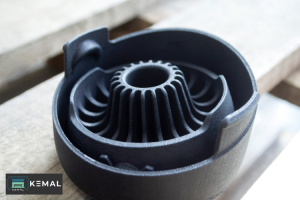
Low-volume injection molding isn’t just “smaller runs”—it’s a strategic choice when speed, flexibility, and risk control outweigh the benefits of full-scale tooling. Let’s look at where it makes the most sense in real-world projects.
Design Validation Stage
When you’re past the 3D-printed prototype and need production-grade materials for functional testing, low-volume molding bridges the gap. For example, a medical device startup we worked with produced 300 housing units from an aluminum mold to verify fit with off-the-shelf electronics before committing to expensive multi-cavity steel tooling.
Market Entry & Pilot Runs
If you’re launching a new product into an uncertain market, the last thing you want is to sit on tens of thousands of unsold units. Low-volume molding allows a first batch—say 1,000 units—to test sales channels and collect user feedback. If sales pick up, you can scale the mold or build a new one for high-volume production.
Frequent Design Iterations
Some industries—like consumer electronics—change product designs annually or even seasonally. Building a full-hardened steel mold for a part that might be obsolete in six months is hard to justify. With aluminum or soft steel tooling, modifications are faster and less costly, making rapid iteration viable.
Uncertain or Sporadic Demand
Replacement parts, custom components, or seasonal products often need small, irregular production runs. Here, low-volume molds can be stored and re-used as needed without tying up capital in a high-volume tool that sits idle most of the year.
Decision Flow for Choosing Molding Approach
| Question | If YES | If NO |
| Is annual demand under 5,000 units? | Consider low-volume injection molding. | High-volume steel tooling may be more cost-effective. |
| Is design likely to change in the next 12 months? | Use low-cost tooling for flexibility. | Invest in durable steel molds. |
| Is time-to-market critical? | Opt for rapid tooling (aluminum). | Lead time is less critical—optimize for long-term cost. |
| Is material identical to final production grade? | Test with low-volume molding for accurate performance data. | Use alternative prototyping methods (e.g., CNC machining, 3D printing) first. |
Low-volume molding is best when you want to de-risk production, gather real-world feedback, and maintain flexibility—without overcommitting to high-volume infrastructure before the market proves itself.
Advantages and Limitations
Low-volume injection molding offers distinct benefits when your production goals and timelines don’t align with the cost and lead time of high-volume tooling. But those benefits come with trade-offs. Understanding both sides will help you set realistic expectations and avoid costly surprises.
Advantages
- Lower Tooling Cost: Aluminum or soft steel molds are significantly less expensive than hardened steel, often cutting initial investment by 50–80%.
- Faster Lead Time: Rapid tooling can be delivered in as little as 1–4 weeks, enabling quick market entry.
- Design Flexibility: Lower tooling cost and faster build time make design changes more feasible between runs.
- Production-Grade Parts: Unlike some prototyping methods, parts are made from the same thermoplastics you’d use in full-scale production.
Limitations
- Shorter Mold Life: Aluminum molds may last 1,000–20,000 cycles, depending on material and maintenance.
- Higher Unit Cost: Without economies of scale, per-part pricing is higher than in high-volume production.
- Capacity Limits: Best for pilot runs, validation batches, or sporadic demand—not sustained high-output production.
Manufacturing Process Comparison
| Factor | Low-Volume Injection Molding | High-Volume Injection Molding | 3D Printing | CNC Machining |
| Tooling Cost | Low (aluminum, soft steel) | High (hardened steel) | None | None |
| Lead Time to First Parts | 1–4 weeks | 6–12+ weeks | 1–5 days | 3–10 days |
| Unit Cost (at 1,000 pcs) | Medium–High | Low | Very High | High |
| Material Options | Wide range of thermoplastics | Wide range of thermoplastics | Limited to printable materials | Wide range, including metals |
| Surface Finish | High (production-grade) | High (production-grade) | Medium–High, post-processing needed | High, machining marks possible |
| Dimensional Accuracy | ±0.1–0.2 mm | ±0.05–0.1 mm | ±0.1–0.5 mm | ±0.01–0.05 mm |
| Best Use Case | Prototypes, pilot runs, bridge production | Long-term, high-output production | Complex, one-off parts | High-strength, low-quantity parts |
If speed and flexibility are critical, low-volume molding is hard to beat. But if your design is locked and long-term demand is high, the higher upfront cost of steel tooling will pay for itself in lower per-part costs over time.
Cost Factors
Understanding what drives the cost of low-volume injection molding helps you decide if it’s the right choice and avoid surprises in budgeting.
1. Tooling Cost (Aluminum vs. Steel)
- Aluminum tooling: Faster to machine, lower material cost, and easier to modify. Typically 50–80% cheaper than hardened steel molds, but with a shorter lifespan (1,000–20,000 shots).
- Steel tooling: Higher upfront investment, longer lead times, and better suited to volumes over 50,000 parts. Offers better wear resistance for abrasive materials.
2. Unit Cost by Volume
Per-part pricing in low-volume runs is driven more by amortizing the tooling cost over fewer units. As volume rises, the impact of tooling cost on each part drops sharply, but material and machine time remain fixed.
3. Material Selection and Cost Impact
Material choice affects both raw resin cost and tool wear. For example, glass-filled nylon is more expensive than PP and can reduce tool life, increasing the long-term cost of repeat runs.
Cost Breakdown Example (1,000 ABS Parts)
| Cost Component | Aluminum Mold | Steel Mold |
| Tooling | $6,000 | $18,000 |
| Material (ABS @ $2.5/kg) | $1,250 | $1,250 |
| Machine Time & Labor | $2,200 | $2,200 |
| QC & Overhead | $800 | $800 |
| Total Cost | $10,250 | $22,250 |
| Unit Cost | $10.25 | $22.25 |
Note: At higher volumes, the steel mold’s higher initial cost becomes justified as unit cost drops significantly.
4. Unit Cost vs. Volume Trend
| Quantity | Aluminum Mold Unit Cost | Steel Mold Unit Cost |
| 500 pcs | $17.00 | $40.00 |
| 1,000 pcs | $10.25 | $22.25 |
| 5,000 pcs | $4.90 | $6.60 |
Below ~2,000 pcs, aluminum tooling usually delivers the lowest total cost. Beyond that, steel tooling’s lower per-part cost can outweigh its higher initial investment.
Material and Design Considerations
Material and design choices directly affect tooling life, production speed, part quality, and cost—especially in low-volume injection molding, where each design change is easier to implement but every iteration still costs time and money.
Common Thermoplastics for Low Volume
- ABS: Good impact resistance, easy to mold, good surface finish. Common for housings, prototypes.
- PP: Lightweight, chemical-resistant, flexible; ideal for functional testing in consumer products.
- PC: High toughness and optical clarity; suitable for transparent or impact-critical parts.
- PA (Nylon): High strength and wear resistance; can be reinforced with glass fiber for extra stiffness.
Tip: In low-volume runs, it’s common to use the same resin planned for mass production, so you get accurate performance data before scaling up.
Matching Material to Tool Life and Volume
- Aluminum molds handle unfilled and low-abrasion resins best. Glass-filled or mineral-filled grades wear aluminum faster—consider soft steel in those cases.
- Short-run projects benefit from materials that flow easily and have predictable shrinkage, reducing the risk of dimensional issues in limited trials.
Design Guidelines for Low Volume
- Wall Thickness: Keep uniform where possible (typ. 2–3 mm for ABS/PP) to reduce warpage.
- Draft Angles: At least 1°–2° per side for untextured surfaces; more for textured or deep features to ease ejection.
- Ribs and Bosses: Rib thickness ~60% of adjoining wall to avoid sink marks; boss diameters ~2× screw size with fillets at base.
Shrinkage Compensation Example
If you’re designing an ABS part with a nominal dimension of 100.00 mm and the material’s shrink rate is 0.6%:
Mold cavity size = Nominal size × (1 + shrink rate)
= 100.00 mm × (1 + 0.006)
= 100.60 mm
If you later switch to PP with a shrink rate of 1.8%, the same nominal size would require:
= 100.00 mm × (1 + 0.018)
= 101.80 mm
Notice: Even small changes in shrink rate can significantly impact mold dimensions, especially in precision-fit parts. Always confirm with your resin supplier’s datasheet and validate with test shots before finalizing tooling.
Always calculate total cost across your expected production horizon, not just tooling price. A mold that’s cheaper today may cost more in the long run if you underestimate demand.
Common Challenges and Solutions
Even with the best planning, low-volume injection molding projects can face quality and consistency issues. However, most problems have well-understood causes and proven fixes—especially when they’re identified early.
Typical Issues in Low-Volume Runs
| Issue | Likely Cause | Solution |
| Premature Mold Wear | Abrasive resins (e.g., glass-filled nylon) running in aluminum tools; inadequate mold maintenance | Use soft steel (P20) or higher-grade aluminum; reduce abrasive filler content if possible; implement a maintenance schedule (cleaning, polishing, coating) |
| Dimensional Variation | Inconsistent cooling, inadequate process control, or shrinkage differences between batches | Add or balance cooling channels; tighten process parameters (melt temp, injection pressure, cooling time); confirm resin shrink rates before production |
| Surface Defects (sink marks, weld lines) | Non-uniform wall thickness, improper gate location, low injection pressure | Adjust part design for uniform wall thickness; relocate or add gates; increase packing pressure/time |
| Color Inconsistency Between Batches | Resin lot variation, improper mixing of masterbatch, regrind contamination | Source resin from the same lot for the whole run; pre-blend colorants consistently; limit or eliminate regrind for cosmetic parts |
| Flash Formation | Excessive injection pressure, worn mold parting lines, poor clamping force | Reduce injection pressure; inspect and repair mold; verify clamping tonnage matches part size |
| Short Shots | Insufficient fill due to low melt temperature, inadequate injection pressure, or venting issues | Raise melt or mold temperature; increase injection speed/pressure; improve venting in the mold cavity |
In low-volume production, tooling and process flexibility are your allies. Because molds are easier (and cheaper) to modify, catching and correcting issues early can save a project without major cost overruns or delays.
Choosing the Right Injection Molding Supplier
The right injection molding partner does more than just make parts—they help you validate designs, reduce costs, and avoid production risks. In low-volume molding, where timelines are short and flexibility is key, supplier capability can make or break your project.
Key Evaluation Criteria
- Technical Capability
- Do they have the machines to handle your part size and resin type (including abrasive or filled grades)?
- Can they meet your tolerance and cosmetic requirements consistently?
- Rapid Tooling Expertise
- Experience with aluminum and soft-steel molds for quick turnaround.
- Ability to design for short-run optimization without compromising part quality.
- Quality Systems & Certifications
- ISO 9001 for general manufacturing, ISO 13485 for medical, or IATF 16949 for automotive.
- Documented quality control procedures and inspection equipment (CMM, vision systems).
- Scalability
- Can they transition your part from low-volume to higher-volume production without major retooling?
- Do they have relationships with toolmakers for upgrading or duplicating molds?
- Project Management & Communication
- Transparent timelines and proactive updates.
- A dedicated contact who understands both engineering and production constraints.
Supplier Evaluation Checklist
| Criteria | Why It Matters | Questions to Ask |
| Relevant Material Experience | Avoids learning curve errors with your resin. | Have you run this material before? What grades? |
| Tooling In-House or Outsourced | Impacts lead time and control. | Do you design/build molds internally? |
| Quality Assurance | Reduces rejects and rework. | What inspection methods and certifications do you hold? |
| Lead Time Reliability | Keeps your market launch on track. | What is your average delivery time for similar projects? |
| Post-Launch Support | Covers repeat orders or design changes. | How do you handle mold maintenance and storage? |
| Scalability | Allows growth without switching suppliers. | Can you scale to 50,000+ units if needed? |
Don’t pick the cheapest quote—pick the supplier who can deliver functional parts on time, support design changes, and scale with your business. A good partner in low-volume molding will save you far more in avoided delays and rework than they cost in the initial project.
Case Study — From Prototype to Market with Low-Volume Injection Molding
Project Background
A consumer electronics startup needed 800 enclosures for a wearable device ahead of a major trade show. They had already validated the design with 3D-printed prototypes, but investors and early customers wanted production-grade samples for testing durability, finish, and assembly fit.
Challenges in The Project
The client came to us with a tight set of requirements: just five weeks from design freeze to final shipment, a total budget capped at $15,000 for both tooling and the first production run, and no compromise on material or finish—they needed the exact PC/ABS blend and high-gloss surface planned for mass production. Meeting all three goals at once would require a tooling approach that was both fast and precise.
Our Solutions
We decided that the best way forward was an aluminum bridge tool with two cavities—fast to machine, affordable to build, and precise enough for production-grade parts. From the moment the CAD files were approved, the timeline left no room for hesitation. Our tooling team went straight into design and machining, hitting the press in just two and a half weeks.
The first T0 shots were encouraging, but we spotted a faint flow mark on the high-gloss surface. Rather than ignoring it, we paused, shifted the gate location, and re-ran the test. The improvement was immediate—smooth finish, consistent color, and no visual defects. Confident in the result, we ran the full batch of 800 units in three days, delivering ahead of schedule and under budget.
Cost & Time Comparison
| Option | Tooling Cost | Lead Time to First Parts | Unit Cost (800 pcs) | Meets Deadline? |
| Aluminum Bridge Tool | $8,700 | 2.5 weeks | $6.50 | ✅ |
| Hardened Steel Tool | $21,000 | 7–9 weeks | $4.20 | ❌ |
| CNC Machining | $0 (no mold) | 1 week | $45.00 | ✅ but cost prohibitive |
| 3D Printing (SLS) | $0 (no mold) | 3–5 days | $30.00 | ✅ but material/finish mismatch |
Outcome
- Parts shipped 4 days ahead of the deadline, allowing time for final QA and packaging.
- Unit cost was higher than high-volume production, but the total project cost stayed within budget.
- The team secured pre-orders worth over $200,000 at the trade show, justifying investment in high-volume steel tooling for the next phase.
ROI Takeaway: Low-volume injection molding turned what could have been a missed opportunity into a market entry success. The startup avoided overinvesting in tooling before validating demand, kept cash flow healthy, and had a smooth transition path to high-volume production.
Final Thoughts
Low-volume injection molding gives you a fast, cost-controlled path to functional, production-grade parts. By lowering tooling investment and compressing lead times, it allows you to gather market feedback and adapt quickly without locking up capital in high-volume steel molds too soon.
That said, the process is only as effective as the decisions made up front. If you’re at an early stage, the smartest move is to partner with an experienced manufacturer who can guide you through design adjustments, recommend the right tooling strategy, and keep your options open for scaling.
FAQs
What is low volume injection molding?
Low-volume injection molding is a manufacturing approach designed for producing a small batch of parts, typically from a few dozen up to a few thousand. It uses tooling made faster and cheaper than standard steel molds.
Instead of hardened steel, it often uses aluminum or soft steel tooling, known as prototype tooling or bridge tooling, which reduces lead time and cost while still producing parts in the same thermoplastics used for mass production.
This method is ideal when:
- You need production-grade parts for testing, pilot runs, or limited-market launches.
- Your design may still change and you want to avoid investing in expensive long-life molds.
- You have uncertain or low annual demand, such as spare parts or seasonal products.
Because the tooling is less complex, you can typically go from CAD approval to molded parts in 1–4 weeks. This is a popular choice for faster time-to-market and design flexibility before committing to high-volume production.
How much does low volume injection molding cost?
Costs vary widely depending on tooling type, part size, material, and order quantity. For most projects:
- Aluminum prototype tooling: $3,000–$10,000 for simple single-cavity molds.
- Soft steel bridge tooling: $8,000–$20,000 for longer tool life or abrasive materials.
- Per-part cost: Higher than high-volume production, often $3–$15 per part for 500–2,000 units, depending on material and complexity.
The biggest cost driver is tooling, which is spread over fewer parts. That’s why total cost—tooling plus per-unit production—is the best measure for deciding between low- and high-volume approaches.
Example Cost Breakdown — Low-Volume Injection Molding
| Quantity | Tooling Cost (Aluminum Mold) | Material & Processing Cost per Part | Total Material & Processing Cost | Total Project Cost | Unit Cost |
| 500 pcs | $6,000 | $6.50 | $3,250 | $9,250 | $18.50 |
| 1,000 pcs | $6,000 | $4.50 | $4,500 | $10,500 | $10.50 |
| 5,000 pcs | $6,000 | $2.10 | $10,500 | $16,500 | $3.30 |
- Tooling Cost: Paid once per mold; same regardless of order size.
- Material & Processing Cost: Includes resin, machine time, labor, and basic QC.
- Total Project Cost: Tooling + total material/processing.
- Unit Cost: Shows how cost per part drops as volume increases, because tooling is spread over more parts.
What’s the difference between low-volume and high-volume injection molding?
Low-volume and high-volume molding use the same core process—molten plastic injected into a mold. While the tooling, economics, and goals are very different.
| Factor | Low-Volume Injection Molding | High-Volume Injection Molding |
| Typical Output | Dozens to a few thousand parts | Tens of thousands to millions of parts |
| Tooling Material | Aluminum or soft steel (P20) | Hardened steel (H13, S7) |
| Tool Life | 1,000–50,000 shots | 100,000+ shots |
| Lead Time to First Parts | 1–4 weeks | 6–12+ weeks |
| Upfront Tooling Cost | Low–Medium | High |
| Per-Unit Cost | Higher (tooling amortized over fewer parts) | Lower (cost spread over large runs) |
| Flexibility for Design Changes | High — easier, cheaper to modify tooling | Low — changes are costly and time-consuming |
| Best Use Cases | Prototyping, pilot runs, bridge production, low or unpredictable demand | Long-term stable production, high-demand products |
| Scalability | Can scale to higher volume with new tooling | Already optimized for high volume |
Low-volume molding is about speed, flexibility, and de-risking early production. High-volume molding is about efficiency, consistency, and cost optimization for large-scale manufacturing.
When should I choose low-volume molding over 3D printing or CNC machining?
Low-volume injection molding is the better choice when you need production-grade parts in small batches, and appearance, material properties, or dimensional consistency are critical.
When Low-Volume Molding Makes Sense
- End-use parts in final material: If your product needs to perform exactly like the mass-production version—same resin, same strength, same chemical resistance—molding gives you that accuracy.
- Tight tolerances & repeatability: Injection molding produces hundreds or thousands of parts with consistent dimensions and surface finish.
- Better finish out of the mold: Parts come with smooth or textured surfaces ready for use, without the extensive post-processing 3D printing often requires.
- Lower unit cost at mid-range quantities: Between 500–5,000 pieces, molding’s per-unit price often beats CNC or 3D printing, even after tooling cost.
When 3D Printing or CNC May Be Better
- Very low quantities (1–50 pcs) where the tooling cost isn’t justified.
- Extremely complex geometries that are hard to mold (e.g., deep undercuts without slides).
- Rapid iteration where you expect design changes daily or weekly.
Quick Cost & Lead Time Comparison
| Process | Best Quantity Range | Material Options | Typical Lead Time | Surface Finish | Unit Cost (1,000 pcs) |
| Low-Volume Molding | 100–5,000 | Wide range of thermoplastics | 1–4 weeks (including tooling) | High (production-grade) | $3–$15 |
| 3D Printing | 1–200 | Limited printable polymers | 1–5 days | Medium–High (may need finishing) | $20–$50 |
| CNC Machining | 1–500 | Plastics & metals | 3–10 days | High (machining marks possible) | $15–$60 |
Choose low-volume injection molding when you need the real thing—same materials, same quality—as your final product, but don’t yet have the demand or budget for full-scale steel tooling.
What materials can be used in low-volume molding?
Low-volume injection molding can use most of the same thermoplastics as high-volume production. This means you can test and deliver parts in the exact material planned for mass production. This is one of its biggest advantages over 3D printing, which has limited resin options.
Common Thermoplastics for Low-Volume Molding
- ABS: Balanced strength, toughness, and easy molding. Common for enclosures, housings, and prototypes.
- Polypropylene (PP): Lightweight, flexible, and chemical-resistant; ideal for packaging, caps, and living hinges.
- Polycarbonate (PC): Very high impact resistance and optical clarity. Often used for lenses, covers, and protective parts.
- Nylon (PA6, PA66): Strong, wear-resistant, and available with glass fiber for extra stiffness.
- Acetal (POM): Low friction and excellent dimensional stability; good for gears, clips, and moving parts.
- TPE/TPU: Flexible elastomers for seals, grips, and overmolded components.
Material Considerations for Low-Volume Tooling
- Tool Wear: Abrasive fillers like glass fiber can wear aluminum molds faster; in such cases, soft steel tooling may be better.
- Shrinkage: Different plastics have different shrink rates (e.g., PP ~1.8%, ABS ~0.6%), which must be compensated in the mold design.
- Processing Temperature: High-temp resins (like PEEK or PSU) require molds and presses capable of withstanding elevated processing temperatures.
If your goal is to validate performance before mass production, use the same grade and supplier for your low-volume parts as you plan to use later. This ensures that test results and customer feedback reflect the final product’s real-world performance.
Can low-volume molds be scaled up for mass production?
Yes—but usually not directly. Most low-volume molds are designed for speed and flexibility, not the sustained output of high-volume production. Whether you can “scale” depends on the tooling design, material, and your long-term volume needs.
When Scaling Is Possible
- Tooling Material: If the low-volume mold is made from soft steel (like P20) and designed with robust cooling and gating, it may be upgraded or run longer to handle mid-volume production.
- Modular Mold Design: Some bridge tools are built with replaceable inserts or cavities, allowing upgrades without starting from scratch.
- Cavity Expansion: If space and design allow, extra cavities can be added to boost output.
When a New Mold Is Better
- Aluminum Tooling: Most aluminum molds are only good for 1,000–20,000 shots. For hundreds of thousands of parts, you’ll need hardened steel (H13, S7, etc.).
- Cooling System Limitations: Low-volume molds may lack the advanced cooling needed for short cycles in high-volume runs.
- Design Lock-In: If your product design is finalized and demand is proven, investing in a dedicated high-volume mold will give lower per-unit cost and better long-term durability.
Practical Path to Scale:
A common approach is to start with low-volume aluminum tooling for pilot runs, then use the validated CAD and process data to build a full-scale steel mold. This shortens the development cycle and reduces risk, since any design tweaks are done before the big tooling investment.
You can sometimes extend or upgrade a low-volume mold, but for sustained mass production, a new hardened steel tool is usually the smarter move. The real value of low-volume tooling is in de-risking design and proving market demand before that big investment.
What are the typical tolerances achievable with aluminum tooling?
With well-made aluminum molds, you can typically achieve ±0.002–0.005 in (±0.05–0.13 mm) on most dimensions. The exact tolerance depends on part size, geometry, resin choice, and the mold maker’s capabilities.
Factors That Influence Tolerance
- Material Shrinkage
- Different plastics shrink at different rates (e.g., ABS ~0.6%, PP ~1.8%). Mold dimensions must be compensated accordingly.
- Filled resins (glass/mineral) tend to shrink less but may wear aluminum faster.
- Mold Design & Machining Precision
- High-speed CNC machining of aluminum can match the accuracy of steel in the short term.
- Mold stability over its lifespan is slightly lower than steel, so repeatability may drift after many cycles.
- Process Control
- Consistent melt temperature, injection pressure, and cooling time are critical.
- Even small variations can push tolerances outside target in thin-walled or long parts.
- Part Size
- Smaller parts generally achieve tighter tolerances; large parts may see more thermal expansion and warpage.
General Tolerance Guide — Aluminum vs. Steel Tooling
| Tooling Type | Typical Tolerance Range | Best-Case Tolerance |
| Aluminum | ±0.002–0.005 in (±0.05–0.13 mm) | ±0.0015 in (±0.038 mm) for small features |
| Steel | ±0.001–0.003 in (±0.025–0.076 mm) | ±0.0005 in (±0.013 mm) for high-precision parts |
Aluminum molds can meet the needs of most functional prototypes, pilot runs, and even low-volume production parts, especially when the design allows for ±0.1 mm or greater. For ultra-tight tolerances or very high repeatability across tens of thousands of parts, hardened steel tooling remains the better option.