Electroplating vs. anodizing can become a costly decision when a drawing lists a finish without confirming the substrate, function, or dimensional limits. An incompatible process can delay quoting, change part tolerances, and cause production problems. I compare the material and application requirements first, then select the appropriate surface treatment.
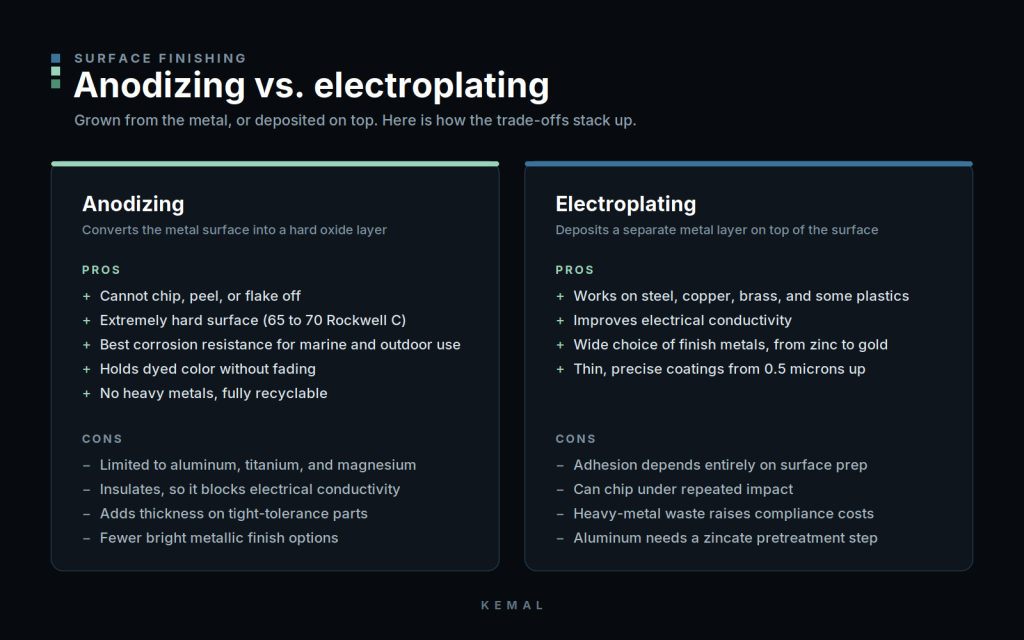
Electroplating deposits a metal coating onto a conductive surface, while anodizing electrochemically converts the surface of a compatible metal—most commonly aluminum—into a controlled oxide layer.1 I recommend choosing between them based on substrate compatibility, corrosion resistance, wear, appearance, electrical requirements, tolerances, and production volume rather than comparing price alone.

The basic distinction sounds simple, but real manufacturing decisions involve more detail. I usually clarify the exact alloy, coating specification, masked areas, color, thickness, and inspection method before requesting a reliable quotation from a qualified finishing supplier.
What Is the Main Difference Between Electroplating vs. Anodizing?
The terms are sometimes treated as interchangeable finishing options. That assumption creates problems because the two processes change a component in fundamentally different ways. If I do not understand how the surface is formed, I cannot assess dimensions, adhesion risks, or material compatibility correctly.
Electroplating uses an electrical current to deposit metal ions from a solution onto a conductive part. Anodizing uses an electrochemical reaction to convert the existing surface into an oxide layer. Electroplating adds another material, while anodizing modifies the surface of the base material.
How electroplating works
During electroplating, the workpiece acts as an electrode in an electrolyte containing the desired coating material. The process deposits a metallic layer onto the part. Common examples include:
- Zinc plating on steel
- Nickel plating on steel, copper alloys, or suitable undercoats
- Copper plating as an intermediate or functional layer
- Chromium plating for decorative or engineering applications
- Tin plating for electrical and soldering applications
- Precious-metal plating for selected electronic components
The exact preparation sequence matters. A supplier may need cleaning, activation, etching, strike layers, or intermediate coatings before applying the final deposit. Plastics can also be plated, but they generally require specialized surface preparation and conductive layers.2 Plating ordinary molded plastic is not the same process as plating a metal component.
How anodizing works
Anodizing increases and controls the oxide layer on a compatible metal. Aluminum is the most familiar substrate, although specialized anodizing processes also exist for titanium, magnesium, and certain other metals.
For aluminum, common categories include:
- Sulfuric acid anodizing for general protection and decorative coloring
- Hard anodizing for thicker, more wear-oriented oxide layers
- Chromic acid anodizing for specific aerospace and corrosion-related requirements
- Phosphoric acid anodizing for selected bonding applications
The alloy strongly affects the result. Two aluminum alloys can produce different colors, coating characteristics, and cosmetic consistency under similar processing conditions.3
| Comparison point | Electroplating | Anodizing |
|---|---|---|
| Basic action | Deposits a metallic coating | Converts the base-metal surface |
| Typical substrates | Conductive metals; prepared plastics in specialized processes | Compatible metals, especially aluminum |
| Added material | A different metal or coating system | Oxide derived from the substrate |
| Color options | Depend on deposited metal and topcoat | Natural, dyed, or electrolytically colored options |
| Dimensional behavior | Coating builds onto surfaces | Oxide develops partly inward and partly outward |
| Main limitation | Deposit compatibility and adhesion system | Substrate and alloy compatibility |
I use this distinction as the starting point, but I never select a finish from the process name alone.
Which Materials Are Compatible With Electroplating vs. Anodizing?
Material compatibility is the first question I ask when a customer requests either finish. A note such as “black anodize” is incomplete if the drawing does not identify the aluminum alloy. A request to anodize carbon steel is not merely expensive; it is generally the wrong process category.
Electroplating can be applied to many conductive substrates when the correct cleaning and undercoat system is available. Conventional anodizing is mainly associated with aluminum and specific other reactive metals. The exact alloy, heat treatment, casting condition, and surface condition can affect whether the required result is practical.
Why the exact alloy matters
I ask for a complete material designation rather than accepting “aluminum,” “steel,” or “plastic.” Useful descriptions include 6061-T6 aluminum, 7075-T6 aluminum, 304 stainless steel, or a specified ABS grade.
For aluminum anodizing, alloying elements can influence:
- Final color and shade
- Surface brightness
- Coating uniformity
- Cosmetic consistency
- Corrosion performance
- Maximum practical coating thickness
- Risk of visible casting or machining defects
Cast aluminum often needs special attention. Porosity, silicon content, and the casting surface can make the anodized appearance less uniform than a machined wrought alloy.4 I therefore avoid promising an exact cosmetic match until a finishing supplier reviews the alloy and, when needed, processes samples.
Electroplating also has compatibility limits
Electroplating offers broader substrate options, but it is not automatically suitable for every material. Stainless steel, aluminum, zinc die castings, and engineering plastics can require different activation or undercoat sequences.
Hydrogen embrittlement also deserves attention when plating high-strength steel.5 Cleaning and plating operations can introduce hydrogen, so applicable standards may require controlled processing and post-plating baking. The engineering team should define the material strength, governing specification, and risk controls rather than relying on a general finish note.
Before selecting either process, I confirm:
- The exact base material and alloy
- The heat treatment or temper
- The manufacturing method, such as machining, casting, stamping, or molding
- The required coating specification
- The intended environment
- Any restricted substances or compliance requirements
This short material review often prevents multiple rounds of requoting.
How Do Electroplating vs. Anodizing Compare in Performance and Appearance?
A finish that looks attractive may not provide the required electrical contact, wear behavior, or corrosion protection. Likewise, a technically strong coating may not produce a uniform cosmetic surface on the selected alloy. I separate functional requirements from visual preferences before I compare the options.
Anodizing is often selected for aluminum parts that need an integrated oxide surface, corrosion protection, color, or improved wear characteristics. Electroplating is often selected when a part needs the properties of another metal, such as conductivity, solderability, sacrificial corrosion protection, reflectivity, hardness, or a metallic appearance.
Functional differences
No process is universally more durable. Performance depends on the substrate, coating type, thickness, sealing, pretreatment, environment, and acceptance standard.
| Requirement | Anodizing may be suitable when | Electroplating may be suitable when |
|---|---|---|
| Corrosion protection | A compatible aluminum alloy needs a controlled oxide finish | Steel or another substrate needs zinc, nickel, or a specified coating system |
| Wear resistance | Hard anodizing is appropriate for an aluminum surface | Engineering chromium, nickel, or another specified deposit is required |
| Electrical conductivity | Insulation or controlled contact masking is acceptable | A conductive surface or contact finish is required |
| Solderability | Usually not the primary choice | Tin or another solderable coating is specified |
| Decorative color | Dyed or colored anodized aluminum meets the appearance target | Nickel, chromium, gold, or other metallic finishes are desired |
| Base-metal identity | The aluminum surface should remain integral | The surface needs properties different from the base material |
Anodized aluminum is generally electrically insulating at the treated surface.6 If a component needs grounding points, threaded electrical contacts, or conductive mating areas, I define masking or post-process removal requirements on the drawing.
Appearance needs measurable requirements
Words such as “black,” “matte,” and “bright” are subjective. I prefer to specify:
- Approved color sample or reference standard
- Gloss range when important
- Acceptable shade variation
- Surface preparation, such as bead blasting or polishing
- Cosmetic inspection distance and lighting
- Critical viewing surfaces
- Rack-mark locations
- Acceptance limits for scratches, pits, burns, and stains
I once received a drawing where the finish note only said “anodize, black.” My first response was not to request a price. I asked whether the part needed a decorative finish, corrosion protection, or a hard functional surface. Those goals can lead to different specifications and costs.
For regulated or high-reliability projects, I also look for an established standard. Examples include ISO 7599 for sulfuric acid anodizing of aluminum and ASTM B633 for zinc electrodeposits on iron and steel.7 The project team should verify the current revision and confirm that the chosen standard matches the application.
How Do Electroplating vs. Anodizing Affect Tolerances and Part Design?
Surface treatment is often added late in product development. That timing can create undersized holes, tight threads, poor electrical contact, and visible rack marks. I prefer to review finishing requirements during design for manufacturability rather than after machining or mold production has been approved.
Both processes can change dimensions, but they do so differently. Electroplating builds deposited material onto exposed surfaces, and its thickness can vary with current distribution and part geometry.8 Anodizing consumes part of the base material while growing outward, so designers must consider both surface conversion and external buildup.9
Features that need early review
I pay particular attention to:
- Precision bores and bearing seats
- Threads and tapped holes
- Sealing surfaces
- Press-fit features
- Sliding or rotating interfaces
- Electrical contact areas
- Sharp edges and deep recesses
- Blind holes that can trap processing chemicals
- Welded or brazed assemblies
- Cosmetic faces where rack marks are unacceptable
Thickness distribution is not always perfectly uniform. In electroplating, high-current-density areas, edges, and projections may receive more deposit than deep recesses. Process selection, part orientation, auxiliary anodes, and racking can improve distribution, but they do not remove the need for realistic tolerances.
Anodizing thickness also depends on the process, alloy, and geometry. Engineers sometimes assume that exactly half of an anodic layer grows outward. That approximation may be useful during preliminary design, but I do not treat it as a universal rule. I ask the finishing supplier to confirm the expected dimensional change for the specified process.
A better drawing note
A useful surface-treatment callout should identify more than a color. I recommend including:
- Base material and alloy
- Applicable finish standard and classification
- Required thickness or thickness range
- Color and cosmetic reference
- Sealing or post-treatment requirements
- Masked and uncoated areas
- Critical dimensions before or after finishing
- Permitted rack-contact locations
- Required inspection or testing
- Restricted-substance requirements
I also distinguish between pre-finish dimensions and final acceptance dimensions. If a critical bore must meet tolerance after finishing, the machinist and finishing supplier need that information before production begins.
A low-cost finish can become expensive when the part must be reworked because the drawing did not define post-treatment dimensions.
What Determines Electroplating vs. Anodizing Costs?
Buyers often ask which process is cheaper before sharing the alloy, part size, thickness, or annual volume. I cannot give a useful answer from the process name alone. A small decorative batch, a tightly controlled medical component, and a large automotive order create very different cost structures.
Electroplating and anodizing costs depend on part material, geometry, preparation, coating specification, thickness, color, masking, racking, batch size, testing, environmental controls, and quality documentation. Anodizing is not always cheaper than plating, and electroplating is not always more expensive. The complete requirement determines the quotation.
Main quotation drivers
| Cost driver | Why it affects price |
|---|---|
| Part dimensions and surface area | Larger areas consume more chemicals, energy, and tank capacity |
| Order quantity | Setup and inspection costs are spread across more parts |
| Alloy and substrate | Difficult materials can require specialized pretreatment |
| Finish type and thickness | Longer or more complex processing adds cost |
| Masking | Manual masking can add significant labor |
| Racking | Complex parts may need custom fixtures or low-density loading |
| Cosmetic standard | Tight visual limits increase handling and rejection risk |
| Testing | Thickness, adhesion, corrosion, color, and other tests add cost |
| Documentation | Certificates, traceability, and regulated records require resources |
| Packaging | Finished surfaces may need individual protection |
Minimum batch charges can dominate prototype pricing.10 In mass production, fixture design, line capacity, yield, and cycle efficiency become more important. A finish that is economical for ten thousand simple brackets may not be economical for twenty complex cosmetic housings.
Information needed for an accurate quote
I normally request the following package:
- 2D drawing and 3D model
- Exact material specification
- Part weight and overall dimensions
- Annual and batch quantities
- Required finish standard
- Thickness and color
- Masking instructions
- Cosmetic requirements
- Critical post-finish dimensions
- Inspection and testing requirements
- Packaging expectations
- Delivery location and schedule
This approach explains cost instead of presenting a fixed price that may later change. It also lets the manufacturer suggest practical alternatives. For example, a minor change to a hidden masking area or rack location may reduce labor without affecting product performance.
Frequently Asked Questions
Can steel be anodized?
Conventional anodizing is primarily associated with aluminum and certain other reactive metals, not carbon steel.11 Steel parts usually use processes such as zinc plating, nickel plating, phosphating, painting, or other specified treatments. I always confirm the exact steel grade and service environment before recommending an alternative.
Can plastic parts be electroplated?
Some plastics can be electroplated through specialized preparation that creates an adherent, conductive surface. ABS is commonly associated with decorative plastic plating, but grade, geometry, molding quality, and coating requirements matter.12 I recommend involving a qualified plastic-plating supplier early because ordinary molded parts are not automatically plating-ready.
Is anodizing more corrosion-resistant than electroplating?
Neither process is universally more corrosion-resistant. Results depend on the base material, coating system, thickness, sealing or topcoat, exposure conditions, and test requirements. I compare the complete specification and actual service environment instead of using the process name as a durability guarantee.
Which finish is better for aluminum parts?
Anodizing is often suitable when an aluminum part needs an integrated oxide finish, color, or controlled wear and corrosion properties. Electroplating may be preferred when the surface needs another metal’s properties. The aluminum alloy and pretreatment requirements must support the selected process.
Should coating thickness be included in CAD dimensions?
The model can represent either the base component or the finished component, but the drawing must clearly state which dimensions apply before and after treatment. I recommend identifying critical post-finish dimensions and coating exclusions so machinists, molders, finishers, and inspectors use the same tolerance basis.
Conclusion
The right choice in electroplating vs. anodizing starts with the substrate, not the price. I first confirm the alloy, then compare function, appearance, tolerances, production volume, testing, and documentation. Anodizing modifies a compatible metal surface, while electroplating deposits another material onto it. Neither process suits every design.
Kemal can review your custom part drawings, material choices, finishing notes, and post-treatment tolerances as part of our DFM support. Send us your 2D drawings, 3D files, quantities, and surface requirements to request a manufacturing review and quotation.
"Anodizing", https://en.wikipedia.org/wiki/Anodizing. National technical guidance describes electroplating as electrodeposition of a metallic coating and anodizing as an electrochemical process that produces an oxide coating on a metal surface, particularly aluminum. Evidence role: definition; source type: government. Supports: Definitions of electroplating as electrodeposition of a metal coating and anodizing as electrochemical formation of an oxide coating on a metal substrate.. ↩
"1. Introduction", https://repository.sustech.edu/jspui/bitstream/123456789/9393/2/Research.pdf. Technical literature on plating on plastics documents that polymer substrates are commonly etched, activated, and metallized—often by electroless deposition—before subsequent electrolytic metal deposition. Evidence role: mechanism; source type: paper. Supports: The pretreatment and electroless-metallization steps used to create an adherent conductive surface on plateable plastics before electroplating.. Scope note: Specific pretreatment sequences and achievable adhesion depend on the polymer grade, molding condition, and coating system. ↩
"Ion Leakage and Color Stability of Anodized Titanium in ...", https://etd.ohiolink.edu/acprod/odb_etd/ws/send_file/send?accession=osu1752807112094681&disposition=inline. Materials research shows that aluminum alloy composition and microstructure affect anodic-film growth and appearance, so different alloys can yield different color and coating characteristics under comparable anodizing conditions. Evidence role: mechanism; source type: research. Supports: Evidence that alloying elements and microstructure influence oxide growth, appearance, and properties during aluminum anodizing.. Scope note: The magnitude and direction of the effect vary with alloy, pretreatment, electrolyte, dyeing, sealing, and process control. ↩
"College of Engineering - SUST Repository", https://repository.sustech.edu/bitstream/handle/123456789/19842/Aluminum%20Alloys%20and%20effect%20of%20adding%20copper.pdf?sequence=1&isAllowed=y. Studies of anodizing aluminum alloys report that silicon-rich phases, porosity, and heterogeneous cast microstructures can affect film formation and visual uniformity relative to many wrought alloys. Evidence role: mechanism; source type: paper. Supports: The relationship between cast-aluminum microstructure, especially silicon-rich phases and porosity, and nonuniform anodized appearance.. Scope note: Not all cast alloys perform identically; alloy composition, machining removal, pretreatment, and the specified anodizing process remain decisive. ↩
"The Mechanism of Hydrogen Embrittlement in Steel", https://ntrs.nasa.gov/api/citations/19670021605/downloads/19670021605.pdf. Engineering guidance identifies acid cleaning and electrodeposition as potential sources of absorbed hydrogen in susceptible high-strength steels, for which process controls and, where specified, relief baking are used. Evidence role: mechanism; source type: government. Supports: That acid cleaning and electroplating can introduce hydrogen into susceptible high-strength steels and contribute to delayed cracking or embrittlement.. Scope note: Susceptibility depends on steel strength, microstructure, stress state, coating process, and applicable specification. ↩
"(PDF) Anodizing of high electrically stressed components", https://www.academia.edu/49917457/Anodizing_of_high_electrically_stressed_components. Materials literature characterizes anodic aluminum oxide as a dielectric oxide layer, meaning that an anodized surface generally presents substantially greater electrical resistance than bare aluminum. Evidence role: mechanism; source type: paper. Supports: The dielectric or electrically insulating character of aluminum oxide formed by anodizing.. Scope note: Electrical resistance varies with film thickness, porosity, sealing, moisture, contact pressure, and any local removal of the coating. ↩
"ISO 7599:2010 - Anodizing of aluminium and its alloys", https://www.iso.org/standard/46061.html. ISO 7599 specifies requirements for anodic oxidation coatings on aluminum and its alloys, while ASTM B633 specifies electrodeposited zinc coatings on iron and steel. Evidence role: definition; source type: institution. Supports: The published scopes of ISO 7599 and ASTM B633.. Scope note: Users must consult the current editions and applicable project requirements for classifications, test methods, and exclusions. ↩
"modeling and experimental validation of", https://collections.lib.utah.edu/dl_files/19/81/1981424c19a7adb5cc1ff779d3f946055e41bf2b.pdf. Electroplating theory explains that local current density is influenced by part geometry and electrode arrangement, causing electrodeposit thickness to be greater in some exposed areas than in recessed or shielded regions. Evidence role: mechanism; source type: education. Supports: The dependence of electrodeposit thickness distribution on current density, geometry, and shielding or recess effects.. Scope note: Racking, auxiliary anodes, shielding, bath chemistry, and process control can improve but do not necessarily eliminate thickness variation. ↩
"Incorporation of Ions into Nanostructured Anodic Oxides ...", https://pmc.ncbi.nlm.nih.gov/articles/PMC8587705/. Research on anodic oxidation describes oxide-film formation as involving conversion of substrate aluminum together with growth of the film beyond the original metal surface, which is relevant to dimensional allowances. Evidence role: mechanism; source type: research. Supports: The inward substrate-consumption and outward-growth components of anodic oxide formation on aluminum.. Scope note: The inward-to-outward growth relationship is process-dependent and should not be used as a universal fixed ratio for tolerance calculations. ↩
"Graduate Thesis Or Dissertation | ID: 3t9460076", https://ir.library.oregonstate.edu/concern/graduate_thesis_or_dissertations/3t9460076. Manufacturing cost research on batch processes shows that fixed setup and handling costs are allocated across the batch, making their unit-cost effect substantially larger at low volumes. Evidence role: general_support; source type: research. Supports: That fixed setup, handling, and batch-processing costs have a disproportionate effect on unit cost at low production volumes.. Scope note: This supports the cost mechanism generally; actual minimum charges and prototype pricing are set by individual finishing operations and specifications. ↩
"Anodizing", https://en.wikipedia.org/wiki/Anodizing. Reference descriptions of anodizing identify aluminum as its principal industrial substrate and also discuss applications to metals such as titanium and magnesium; conventional aluminum anodizing is not a standard finishing route for carbon steel. Evidence role: definition; source type: encyclopedia. Supports: The metals commonly treated by conventional anodizing and the distinction from standard carbon-steel finishing processes.. Scope note: Specialized electrochemical oxidation and conversion treatments for steel exist, but they are distinct from the conventional anodizing context discussed here. ↩
"Development of electroplating setup for plating ABS plastics", https://www.academia.edu/11892021/Development_of_electroplating_setup_for_plating_ABS_plastics. Plating-on-plastics literature commonly identifies ABS as a widely used substrate for decorative metallization because its surface can be chemically prepared for electroless and electrolytic deposition. Evidence role: case_reference; source type: paper. Supports: The widespread use of ABS in plating-on-plastics systems and the importance of substrate and processing quality to adhesion and appearance.. Scope note: Plateability and cosmetic quality vary among ABS grades, molding conditions, design geometry, and the specified metallization sequence. ↩