The injection molding process is pivotal in the manufacturing of complicated plastic parts. While, have you ever faced issues like inconsistent product quality, high production costs, or long cycle times. Don’t worry! During the injection molding design phase, engineers and designers will work hand in hand with you to customize your plastic parts and improve their functionality. In this complete guide, we’ll explore essential design elements, common challenges, and best practices.
Key Elements of Injection Molding Design
Here are some of the key elements of injection molding design:
Common Materials Used in Injection Mold Making
The choice you make on the type of mold material to use has a great influence on the performance and durability of the final product.
Tool Steels
1. P20 Steel
- Properties: P20 steel is pre-hardened, and has good machinability and moderate strength.
- Advantages: This type of steel is suitable for mid-volume production and cost-effective for general molds. You do not require additional heat treatment since it is pre-hardened.
- Applications: You should use P20 steel to create plastic components such as automotive interiors and appliance housing.
2. H13 Steel
H13 steel has high heat resistance and excellent toughness and can tolerate high temperatures while maintaining its strength.
Its used in the manufacture of automotive and aerospace parts such as engines and other structures that require high durability.
3. S136 Steel
This type of steel has characteristics that guarantee a high degree of polishability and corrosion resistance.

Aluminum alloys offer excellent performance and flexibility during injection molding.
They are ideal for prototype molding machines or low-volume production due to faster machining and shorter lead times. These types of molds require less initial capital investment than steel molds. If you prioritize speed during manufacturing, these are the perfect types of molds.
Copper Alloys
Copper alloys have unique cooling properties that make it easier to manage heat during injection molding.
The production speed increases when you use molds made from copper alloys. Faster cooling times result in faster production cycles and minimal cooling defects. This increases your company’s production efficiency.
Copper alloys are frequently used for manufacturing mold inserts and components that require faster cooling such as beverage containers and thin-walled parts.
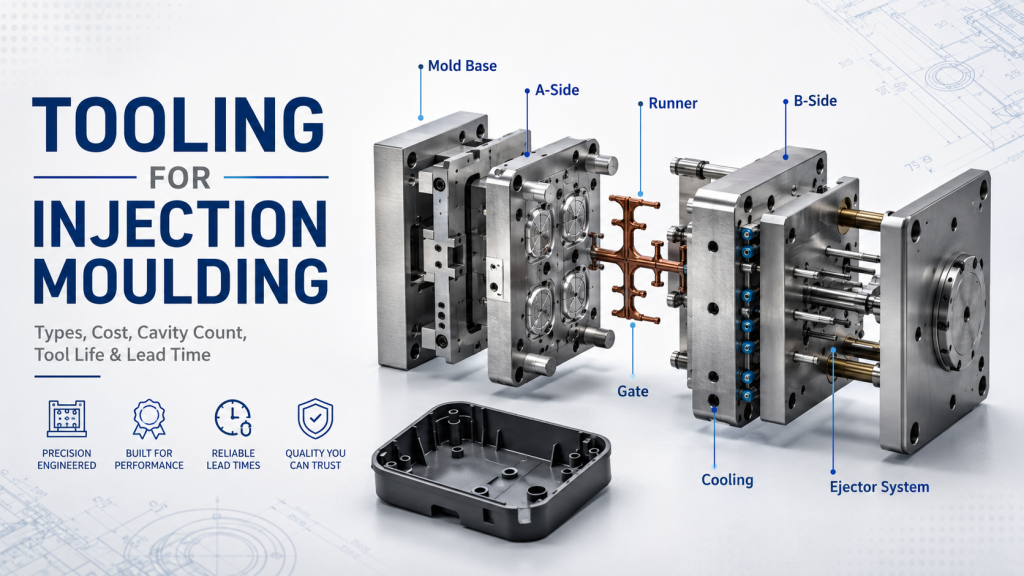
Cavity design
The layout of the cavity is important because it determines the shape and size of the final product. A proper cavity design ensures that the part comes out looking exactly like the cavity.
Cooling system
Injection molds have a cooling system with a coolant that absorbs heat from the liquid plastic. This transforms molten plastic into its solid state.
Ejection Mechanisms
After solidification, ejector pins push the plastic part out of the mold. This is done carefully using air release mechanisms to prevent damaging the part. Deforming the plastic parts compromises the quality of the product.
Challenges encountered during designing
Warping
Warping is a molding defect that involves bending the molded part post-ejection from the mold. This deformation is caused by uneven cooling of the plastic part outside the mold.
Causes:
- Uneven cooling rates: Some molded plastic parts cool and solidify faster than others. This distorts the balanced shrink rate, leading to internal stress in the plastic part.
- Mold design issues: Difference in wall thickness results in uneven cooling and shrinkage.
- Material shrinkage: A material lacking uniform thermal properties is a predisposing factor to uneven shrinkage and cooling.
How to Fix Warping?
- Enhance cooling time and temperature: Allow the molded parts to cool sufficiently and use standard mold temperatures in molding.

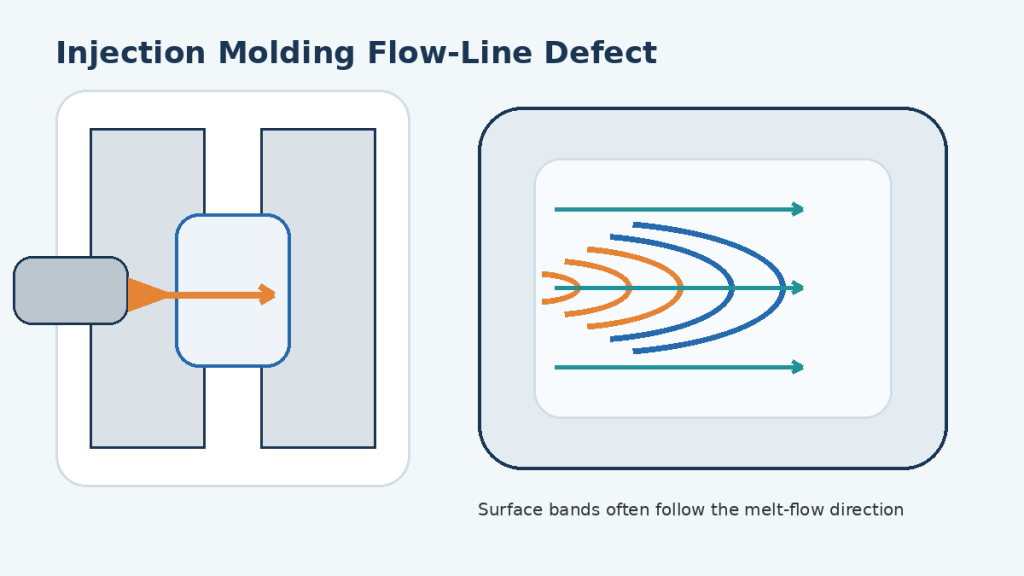
Air traps and flow lines
Air traps are caused by the entry of air into the cavity while flow lines occur as a result of differences in shrinkage rates. These defects prevent the molten plastic from filling the cavity. They reduce the quality of the final products. You should control the temperature and pressure inside the mold cavity to avoid such defects.
Material shrinkage
This is the gradual or rapid decrease in the size of a material during cooling. Uneven shrink rates lead to defects such as sink marks. You must calculate the shrink rate of each material to get the dimensions needed to make the mold.
Irregular cooling rates
Plastics have varying cooling rates. Uneven cooling can form sink marks and cause warping. Choose materials that cool and shrink slowly and by controlling temperatures inside the cavity.
Secret ways on how you can make injection molding more efficient
- Reducing the cycle times: This is achieved by making parts with simple designs and the same thickness. You should use materials that cool quickly.
- Ensure that minimal or no material is wasted. Recycle and reuse the faulty parts. Constantly perform maintenance tests on your molds.
- Increase mechanization and reduce human labor in your industry. Doing this will guarantee you consistent results. Machines work faster than humans without fatigue thus you can practice mass production of parts.
- Perform routine maintenance checks on your molding machines. This ensures that your molds are functioning optimally during the entire production process. It prolongs the mold’s lifespan and minimizes delays caused by machine breakdowns.
Material Selection for Injection Molding Design
Have a look at some factors to consider when selecting materials
- Strength and durability of the material: Nylon has high tensile strength and can make parts that carry and bear heavy loads.
- Impact resistance: This is important especially when making parts that encounter sudden forces. A material with good impact resistance is able to maintain its functionality even after shock.
- Hardness: It influences the ability of a material to resist tear and scratching. It ensures the plastic does not lose its aesthetics.
- Resistance to chemicals and corrosion: You can manufacture parts and packaging containers using polyethylene because of its ability to withstand corrosion from chemicals.
- Ability to withstand heat: Select plastics that can tolerate heat such as nylon, especially when dealing with vehicle parts and electronic devices.
Popular Injection Molding Materials and Their Applications
1. Thermoplastics
Thermoplastics are the popular injection molding materials. They easily melt and cool. You should consider using thermoplastics in the mass production of parts.
Common Thermoplastics used:
- Polypropylene: Polypropylene has a high tolerance to chemicals and wear. Its low density enables you to make light vehicle parts and packaging containers. This plastic is pocket-friendly. You should avoid using it in harsh environments of extreme sunlight and friction.
- Polystyrene: Polystyrene is a transparent plastic. It is used to make casing for electric devices and consumer goods. It is relatively cheap and simple to mold cracks easily.
- Polyethylene: Polyethylene has a low density and is durable but has low heat resistance. This plastic is used to make toys and in the packaging industry at a lower cost than other plastics.
- Polycarbonate: Polycarbonate is a tough material. It can tolerate harsh environments and is used in the vehicles and electronics industries.
- Nylon: Nylon is strong and can resist wear. It is widely used in the automotive industry to manufacture parts with intricate designs. The major disadvantage of nylon is that it takes in moisture. This makes it less stable.

2. Thermosets
Thermosets are plastics formed from thermosetting. The process involves the crystallization of liquid resin by curing. This unique polymer solidifies on heating to form a part. You cannot reshape an already-formed thermoset structure.
Types of thermosets:
- Epoxy forms tough solid plastics: It easily chips off without extra support. You can use it for cementing and coating products.
- Phenolic resin: It can be used to produce insulators. It has a high tolerance to heat.
How material’s properties affect the design of the mold?
| Material Property | Impact on Mold Design | Design Adjustment Recommendations |
| Shrinkage Rate | Affects part dimensional accuracy | Adjust mold dimensions based on the shrinkage rate |
| Flowability | Affects flowability and injection pressure | Optimize gate and runner design |
| Melt Temperature | Affects mold temperature resistance | Choose high-temperature resistant mold materials, optimize cooling system |
| Wear Resistance | Affects mold life | Use high-hardness, wear-resistant materials or coatings |
| Corrosiveness | May damage mold surfaces | Use corrosion-resistant materials, perform regular maintenance |
| Stiffness & Toughness | Affects ejection difficulty | Increase draft angles, design stronger ejection systems |
| Thermal Conductivity | Affects cooling speed and cycle time | Optimize cooling system design |
| Surface Finish | Affects part appearance | Choose appropriate mold surface treatments |
| Material Cost & Longevity | High-cost materials require more durable molds | Choose high-quality mold materials, design for easy maintenance |
Today, injection molding manufacturers are shifting to sustainable solutions. These include biodegradable and recyclable plastics.
Best Practices for Injection Molding Design
These are the practices to follow in the mold design phase:
| Best Practice | Description | Design Tips |
| Part Design Guidelines | Uniform Wall Thickness: Ensure uniform wall thickness for consistent flow and reduced shrinkage. | Aim for wall thickness between 1.5mm and 5mm. |
| Avoid Sharp Corners: Sharp corners can lead to stress concentration and defects. | Use radiused corners to evenly distribute stress. | |
| Design for Easy Ejection: Ensure parts can be easily removed from the mold. | Add draft angles (typically 1-3 degrees) to facilitate smooth ejection. | |
| Gate and Runner Design | Gate Location: Proper gate placement ensures uniform filling. | Place gates at the thickest section of the part to reduce air traps. |
| Runner Sizing: Optimizing runner design minimizes material waste and reduces cycle time. | Use hot runner systems to improve flow efficiency and minimize material waste. | |
| Minimize Runner Length: Long runners waste material and increase cycle time. | Shorten runner paths and optimize for balanced flow. | |
| Proper Venting | Venting Importance: Proper venting ensures air escapes without defects, such as burn marks or incomplete fills. | Add vents near thick sections to allow trapped air to escape. |
| Vents Placement: Ensure vent placement avoids air pockets and allows for proper mold filling. | Use fine vents for thinner sections and larger vents for thicker areas. | |
| Mold Flow Simulation | Using Mold Flow Analysis: Helps predict material behavior and prevent defects before mold production. | Perform simulations to identify potential problems like air traps and cold shuts, then adjust the design accordingly. |
| Pre-production Testing: Simulate different conditions to optimize speed, temperature, and pressure. | Test and adjust injection speed and pressure during the simulation phase to fine-tune the design. | |
| Mold Material Selection & Cooling | Mold Material: Select mold materials with high wear resistance and temperature tolerance. | Use materials like H13 steel for toughness and thermal conductivity. |
| Cooling Efficiency: Optimize the cooling system to reduce cycle time and ensure uniform part quality. | Design cooling channels close to thick sections and parting lines to improve cooling. | |
| Avoid Hot Spots: Uneven cooling can lead to defects. | Ensure balanced cooling channels and maintain consistent thermal gradients throughout the mold. | |
| Minimizing Material Waste | Runner Optimization: Use a hot runner system to minimize material waste during production. | Reduce the need for secondary operations like trimming. |
| Material Recirculation: Consider using recyclable or reusable materials to lower waste. | Choose eco-friendly materials and implement systems to recycle waste material back into production where possible. | |
| Easy Mold Maintenance | Design for Maintenance: Simplify mold disassembly and access for easier cleaning and repairs. | Incorporate modular inserts and easy access to cooling channels. |
| Lubrication and Cleaning: Regular mold maintenance ensures longevity. | Design molds with easy access for lubrication and cleaning to reduce wear and prevent clogs in cooling systems. |
In conclusion, whether you are designing new parts or optimizing existing products, injection molding design has a profound impact on production efficiency and final quality. By applying these design insights and best practices to your projects, and collaborating with an experienced injection molding company, you can create efficient and innovative plastic components together.