In modern manufacturing, CNC machining technology serves as the core foundation for industries such as aerospace, automotive, and mold making. Among the various technologies, 3-axis and 5-axis machining are two of the most prevalent. The choice between them directly impacts product precision, efficiency, and cost. This article provides a systematic analysis of their fundamental differences, core advantages, and typical application scenarios to help you make the optimal decision for your production needs.
3-Axis Machining: A Stable and Efficient Standardized Solution
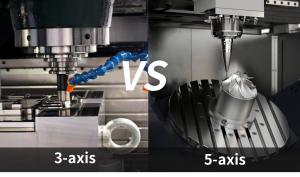
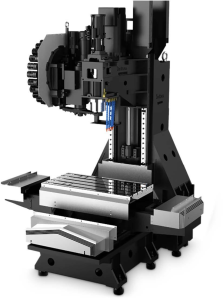
3-axis machining operates by controlling the cutting tool along three linear directions: X, Y, and Z. The tool orientation remains fixed relative to the worktable, making it one of the most fundamental and widely used technologies in CNC machining.
Core Advantages:
- Cost-Effectiveness: Lower investment in equipment, maintenance, and programming, making it suitable for budget-conscious projects or simple parts.
- Ease of Use: Straightforward programming logic and lower skill requirements for operators shorten training cycles and enable rapid deployment.
- High Stability: Simple mechanical structure offers excellent rigidity and stability when machining planes, regular contours, and simple cavities.
Limitations:
- Inability to Machine Complex Surfaces: Parts with complex spatial surfaces, such as turbine blades or impellers, present “machining blind spots” for 3-axis machines.
- Error Accumulation from Multiple Setups: Machining multi-sided parts requires repeated repositioning, each time introducing potential errors that accumulate and compromise positional accuracy.
- Fixed Tool Orientation: When machining steep surfaces, the suboptimal contact angle between the tool and workpiece can lead to poor surface finish and accelerated tool wear.
5-Axis Machining: The Ultimate Solution for Complex Parts and High Precision
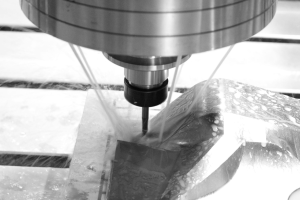
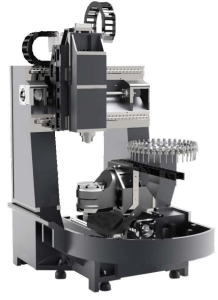
5-axis machining builds upon the 3-axis foundation by adding two rotational axes (typically A and C), enabling the tool to move from more angles and in more complex directions. This technology solves the challenges of machining complex surfaces and multi-angle parts, making it ideal for high-precision manufacturing and rapid prototyping.
Core Advantages:
1) Complete Machining in a Single Setup. By adjusting the angle of the workpiece or tool via the rotational axes, 5-axis machining can complete up to five sides of a part in one fixture. This eliminates the datum errors introduced by multiple setups, allowing positional accuracy to be consistently controlled within ±0.005mm. It is particularly suited for precision components like aerospace engine casings.
2) Optimized Tool Path for Superior Quality and Longer Tool Life. 5-axis technology enables the tool to maintain the optimal cutting angle throughout the operation.
- Enhanced Surface Quality: By utilizing side cutting and maintaining constant cutting speed, surface roughness can be optimized to Ra 0.4μm.
- Extended Tool Life: Adjustable angles ensure more even distribution of cutting forces and allow for the use of shorter, more rigid tools, potentially increasing tool life by over 30%.
3) Streamlined Process for Higher Overall Efficiency
The “multi-functional integration” capability of 5-axis machines allows processes like milling, drilling, boring, and tapping to be consolidated on a single machine, reducing part transfer between different stations. Coupled with an automatic tool changer, batch production efficiency can be increased by more than 50%.
Core Differences Between 3-Axis and 5-Axis Machining
While both 3-axis and 5-axis CNC machining share the same underlying technology, they differ significantly in several aspects. The table below outlines the key differences to help you decide which technology best suits your project.
| Parameter | 3-Axis CNC | 5-Axis CNC |
| Motion Capability | Limited to linear X, Y, and Z axis movement | Simultaneous movement along X, Y, Z linear axes and A, B/C rotational axes |
| Part Complexity | Simple geometries, planes, and contours | Complex surfaces, deep cavities, undercuts, and organic shapes |
| Surface Finish | Rougher finish, often requires secondary operations | Superior, smoother finish achievable directly |
| Typical Accuracy | ±0.001 inch (approx. ±0.025mm) | ±0.0005 inch (approx. ±0.0127mm) |
| Surface Roughness | Ra 1.6µm | Ra 0.4µm |
| Per-Part Cost | Lower machine investment, cost-effective for simple parts | Higher machine investment, suitable for high-value-added parts |
| Programming & Operation | Relatively simple | Complex, relies on advanced CAM systems and skilled technicians |
How to Choose: 3-Axis or 5-Axis?
I. Choose 3-Axis Machining if:
- The part geometry is simple, primarily consisting of planes, holes, and regular contours.
- The production budget is limited, and extreme efficiency is not critical.
- Production runs are typically small batches and do not require extremely tight geometric tolerances.
II. Choose 5-Axis Machining if:
- The part involves complex surfaces and multi-angle features (e.g., impellers, artificial joints, precision molds).
- There are stringent requirements for geometric tolerances and surface quality (e.g., in aerospace and medical fields).
- The goal is production process integration, aiming to shorten the overall delivery cycle by reducing setups and part handling.
Synergistic Strategy: Combining the Strengths of 3-Axis and 5-Axis
In a modern machine shop, 3-axis and 5-axis technologies are not mutually exclusive but rather complementary. The most optimal machining strategy often involves scientifically planning its synergy.
- Initial Roughing: Leverage the superior rigidity and cost-effectiveness of 3-axis machines for heavy stock removal from mold blanks and machining of basic datum surfaces, providing a stable foundation for finishing operations.
- Final Finishing: Utilize the 5-axis machining center to complete all complex surfaces, angled holes, and other intricate features in a single setup, ensuring final accuracy and superior surface quality.
This “3-axis roughing + 5-axis finishing” model significantly reduces total equipment investment while achieving the best balance between production efficiency and machining quality.
Kemal delivers cutting-edge 3-axis and 5-axis CNC machining services tailored to your customized needs. Our advanced technology and experienced professionals ensure precision, efficiency, and reliability for every project. From simple components to complex geometries, we deliver high-quality results with shorter lead times.
Conclusion
3-axis and 5-axis machining serve distinct purposes in manufacturing. 3-axis provides a cost-effective solution for simple parts and 2.5D geometries, offering stability and ease of use. 5-axis excels at complex components, enabling complete machining in a single setup with superior precision and efficiency.
The most strategic approach often combines both technologies: using 3-axis for roughing and 5-axis for finishing. This synergy balances cost control with high-quality results, ensuring optimal manufacturing efficiency for diverse production needs.
Frequently Asked Questions (FAQ)
1) Is a 5-axis machine always more accurate?
Not necessarily. For simple parts, a high-precision 3-axis machine can achieve comparable accuracy with greater stability. 5-axis excels in maintaining accuracy across complex geometries where multiple setups would otherwise accumulate errors.
2) What are the main disadvantages of 3-axis machining?
Key limitations include the inability to machine complex geometries effectively, the requirement for multiple setups leading to potential error accumulation, and difficulties with features like deep cavities and undercuts due to limited tool access.
3) What materials can 5-axis machines process?
5-axis machining handles diverse materials from metals (titanium, aluminum) to plastics and composites. Its versatility makes it ideal for complex components across aerospace, medical, and automotive industries.
4) “3+2” vs. “5-axis simultaneous” machining?
“3+2” fixes rotational axes to machine-angled features efficiently. “5-axis simultaneous” moves all five axes continuously for smooth, complex contours, delivering superior surface finish on intricate geometries.