

If you’re evaluating injection mold services in China, you likely want clarity on tooling cost, expected quality, and the risks that may affect your project. This guide explains how China-made molds are priced, what capabilities you can expect from established suppliers, and which technical factors matter most when selecting a reliable partner. It also outlines key considerations to help you make informed decisions before outsourcing.
Why Companies Outsource Injection Molding to China
Companies evaluate China for injection molding when local manufacturing constraints begin to limit cost, schedule, or program scale. The decision is typically driven by four practical pressures rather than sourcing preference.
1. Tooling Costs in Western Markets Are Too High for Multi-Mold Programs
In the U.S. and Europe, mold pricing has increased sharply due to labor shortages, higher shop rates, and limited machining capacity. When one mold costs as much as an entire product phase, you lose flexibility for design revisions, alternate cavity layouts, or backup tools. For programs requiring several molds, local budgets often cannot support the required tooling volume.
2. Local Lead Times Do Not Match Modern Development Schedules
Many Western tool shops operate with extended CNC/EDM queues. Medium-complexity tools frequently take 8–12 weeks to reach T1. This timeline conflicts with compressed product launch cycles in automotive, consumer electronics, and industrial markets. When internal milestones cannot shift, companies look for a supply chain that can meet the schedule.
3. Regional Capacity Is Insufficient for Parallel or High-Volume Builds
Large programs often require multiple molds to be built at the same time or need molding capacity across several presses. Most local suppliers do not have enough machines, manpower, or flexible shifts to support parallel tool construction or high-volume production. This creates delivery risk that many OEMs cannot accept.
4. Early-Stage Engineering Changes Are Difficult to Support Locally
During early development, wall thickness, draft, gating, sealing features, and tolerance schemes are revised frequently. Many local toolmakers operate with limited engineering bandwidth, making each update slow to process. When design changes pause tooling progress for days or weeks, the entire timeline slips.
When evaluating domestic production against overseas options, many companies compare U.S. tooling with China-built molds.
Chinese Molds vs. U.S. Injection Molds
When companies compare U.S. tooling with China-built molds, they usually look at total tooling cost, lead time to T1, the effort required to manage projects across time zones, and the impact of logistics on the overall schedule. The table below summarizes these practical differences at a high level.
|
Category |
U.S. Injection Molds |
China Injection Molds |
|
Tooling Cost Level |
Higher overall cost driven by labor rates, overhead, and compliance requirements |
Generally, 30–60% lower due to lower labor and operating costs |
|
Lead Time to T1 |
Commonly 8–12 weeks for medium-complexity molds (varies by shop) |
Commonly 4–8 weeks for similar complexity (varies by supplier) |
|
Project-Management Effort |
Same time zone; easier for on-site reviews and direct coordination |
Requires structured communication across time zones; strong documentation needed |
|
Logistics & Shipping |
No international freight; domestic logistics only |
International shipping and customs clearance need to be planned into the schedule |
|
IP & Legal Framework |
Operates under the buyer’s home legal and IP system |
Requires contracts and IP strategies aligned with local legal frameworks |
|
Impact of Design Changes |
Changes in high-cost tooling may significantly affect the budget |
Lower tooling cost can make some iterations more acceptable, though still time-consuming |
How Much Does It Cost to Make a Mold in China?

The cost of building an injection mold in China varies by tool size, cavity count, part geometry, and whether the design requires hot runners or advanced cooling. As a general reference, most production tools fall within the following ranges:
- Simple single-cavity mold: USD $3,000–$6,000
- Medium-complexity tool (2–4 cavities): USD $6,000–$15,000
- Multi-cavity or complex geometry tool: USD $15,000–$40,000+
- Tools with hot runners or specialty steel: higher due to component cost and machining time
Several technical factors drive mold pricing:
- Steel grade (e.g., P20, H13, S136) influences machining time, hardness, and polishing quality.
- Cavity count directly affects tool size, machining hours, and cooling layout complexity.
- Runner type — hot runner systems increase cost due to components and wiring.
- Surface requirements — optical finishes, textures, or mirror polish add labor.
- Cooling design — conformal or high-performance cooling may require additional machining steps.
- Tolerance targets — tighter tolerances increase CNC and EDM time.
- Expected mold life — higher shot requirements often call for hardened steel and more robust construction.
Compared with Western markets, Chinese toolmakers typically reduce overall tooling cost by 30–60%, largely because of multi-shift machining schedules, high spindle utilization, and localized sourcing of mold components. These cost differences apply to the tool only; part price will depend on resin selection, shot weight, and annual volume.
For cost accuracy, suppliers typically require:
- 3D CAD data
- target resin
- estimated annual volume
- surface and tolerance requirements
These inputs determine machining hours, cooling layout, and mold class.
Related Reading:
https://www.kemalmfg.com/china-injection-mold-pricing/
China Injection Molding and Manufacturing Advantages
China’s injection molding industry offers several practical advantages rooted in machining capacity, supply-chain integration, and production scalability. These advantages are measurable and directly influence tooling speed, part quality, and overall project economics.
1. Lower Tooling Cost and Competitive Part Pricing
Tooling produced in China is often 30–60% less expensive than comparable tools built in the U.S. or Europe. The cost advantage comes from several structural factors rather than simple labor differences. In most established shops, the savings are driven by:
- Multi-shift CNC and EDM utilization, which keeps equipment running and spreads overhead across more machining hours
- Local sourcing of mold bases and standard components, reducing procurement cost and lead time
- High-volume purchasing of P20, H13, S136, and similar steels, lowering material cost per tool
- Integrated machining and fitting operations, which minimize outsourcing and shorten production cycles
For buyers, this translates into lower initial tooling investment and more flexibility to refine the design before finalizing the mold.
2. Short Lead Times Through Integrated Manufacturing
Many mold makers in China keep CNC machining, EDM, polishing, fitting, sampling, and molding within the same facility. This integrated setup removes hand-offs between vendors and keeps scheduling predictable. In practical terms, it often enables:
- T1 samples in 4–6 weeks for medium-complexity tools
- Faster revisions when design or tolerance updates are required
- Stable trial scheduling because machining and molding teams work in the same workflow
For programs with tight launch windows or frequent engineering changes, this level of integration reduces downtime and shortens the overall development cycle.
3. Capability to Produce Complex or High-Precision Tools
Chinese mold shops manage complex and high-precision tooling on a daily basis. Many projects involve thin-wall structures, multi-cavity layouts, or overmolding features that require tight control over gating, cooling, and steel selection. Typical capabilities include:
- Thin-wall parts where filling pressure and cooling uniformity must be tightly controlled
- Multi-cavity molds for high-volume consumer and industrial components
- Overmold and insert-mold designs that demand precise alignment and stable repeatability
- Optical-grade surfaces polished to strict Ra requirements
- Advanced cooling channels are used to shorten cycle time and reduce thermal variation
These capabilities are supported by high-density tooling ecosystems in regions such as Dongguan, Shenzhen, and Ningbo, where component suppliers and heat-treatment facilities are located within short distances.

4. Broad Material Availability
Material availability is one of the strengths of China’s molding ecosystem. Most suppliers stock a wide range of engineering resins, so you can match performance requirements without waiting for imported materials. Common options include:
- ABS, PC, PP, HDPE for general-purpose structural and cosmetic parts
- PA66 GF30 and other reinforced grades are used when higher stiffness or heat resistance is required
- PEEK, PPS, and PSU for high-temperature or demanding industrial applications
- TPE/TPU for overmolded grips and soft-touch surfaces
Because these materials are sourced locally in large volumes, lead times are shorter, and design iterations can move faster—even when your project needs multiple resin grades or varied performance profiles.
5. Scalable Production Capacity
Many injection molding facilities in China are structured for continuous, high-volume production. Shops often operate multiple presses in 24-hour cycles, which gives you more flexibility when scaling a program. In practice, this setup allows:
- Faster transitions from prototype tooling to production molds
- High-volume output without waiting for machine availability
- Parallel mold builds for programs involving multiple SKUs or tools
For OEMs with recurring orders, this capacity is not just convenient—it reduces supply risk and helps maintain delivery stability across long production cycles.
6. Experienced Workforce and Established Engineering Practices
Chinese mold shops with established engineering teams don’t just cut steel. They help you refine the design before tooling begins. In most projects, the early engineering work includes:
- DFM reviews to address wall thickness, draft, gating, and ejection
- Moldflow analysis for flow balance, weld lines, and potential air traps
- Material and steel-grade recommendations based on expected load and resin shrinkage
- Tolerance guidance aligned with tooling capability and functional requirements
- QC documentation, such as FAI, CPK, or SPC, when the application demands it
These steps remove uncertainty early and reduce the risk of rework during T0/T1 trials.
7. Efficient Communication Structures
Chinese injection mold manufacturers that work extensively with overseas customers typically operate with structured communication systems. Most projects are managed by English-speaking engineers who coordinate design reviews, provide weekly progress updates with machining and fitting status, and deliver clear trial reports for each T0/T1/T2 milestone. When available, U.S. or EU contact points support time-zone alignment and issue resolution. This level of project reporting reduces ambiguity, maintains traceability across tooling stages, and helps prevent delays caused by misaligned expectations.

8. Supply-Chain Density Supporting Faster Adjustments
China’s main molding hubs operate within dense industrial zones. Machining, texturing, hot-runner service, heat treatment, and surface-finish providers are all located close to each other. This proximity shortens waiting time for tool steel rework, texture changes, or hot-runner adjustments. As a result, modifications that might take a week in other regions can often be completed in 24–48 hours. This helps keep tooling trials on schedule and reduces downtime.
Risks When Outsourcing to China — and How to Mitigate Them

Outsourcing tooling and molding work to China offers clear cost and lead-time advantages. However, the process also presents risks that engineering teams must evaluate and control. Most concerns are not unique to China; they relate to cross-border manufacturing in general. When approached with defined procedures, these risks become manageable technical and project-management items rather than obstacles.
Intellectual Property Risks
Customers often want to gain financial benefits from their unique product designs. To achieve this, they obtain patents for their property, which grant them exclusive rights to manufacture them.
However, these intellectual property (IP) rights may only cover your home country and not countries like China, where you might be considering outsourcing your production. This makes the enforcement of your IP rights harder and more expensive.
Therefore, it is best to invest in a lawyer who is well-versed in Chinese law and IP rights coverage. Doing so will protect your product, helping you maintain your competitive edge.
Finding the Right Factory

Once you have decided to hire a China-based manufacturer, your next step will be to select the right factory. This might turn out to be a complex process, as not every factory will have the production capacity, variety of injection molding materials, quality of finish, and customer service that you want.
Hence, choosing the right service might take more time and effort on your end.
Barriers to Communication

Successful businesses are often built on long-lasting partnerships, and the key to forming one is communication. Not every customer can converse in Chinese, and not every plastic injection mold service in China is proficient in English.
This language barrier often necessitates the use of a translator when engaging in business with such manufacturers. The time zone differences also affect the periods during which you can exchange information with each other.
Furthermore, cultural barriers also exist between Chinese and Western business settings. These need careful study to be overcome, which often hinders the development of strong business relationships.
A Higher Minimum Order Amount
In China, plastic injection molders often face lower profits due to cheaper production processes. To counter this, they set high minimum order limits to make it financially feasible for them.
This makes them unsuitable for your needs if you want to order only a few parts. You are then forced to choose another manufacturer, who charges more for low-volume production. Your costs go up as a result, which reduces your profits.
However, with Kemal, you do not have to go through all that since we have no minimum order quantity (MOQ) policy, ensuring that you receive efficient, high-quality service regardless of your order size.
Transport Costs

Once your product has been successfully molded in China, you then have to ship it to your home country. Depending on where you are based, this process can take a significant amount of time as well as money in the form of shipping costs, taxes, and tolls.
To reduce these long lead times, you may have to pay for costly air shipments, which further increases your costs.
Quality Assurance and Quality Control
Suppliers range from highly sophisticated facilities to low-cost shops focused on price rather than consistency. Quality concerns usually arise when selection is based solely on the lowest quote without evaluating engineering processes, material control, or inspection standards.
To ensure consistent results, many companies rely on structured QC procedures—including material verification, dimensional inspection, and documented T0/T1/T2 trials—or engage third-party quality representatives to review production on-site. With proper supplier qualification and defined inspection criteria, quality performance becomes stable and predictable.
Packaging and Handling Control
Packaging practices can vary widely among suppliers, especially when the molding facility outsources this step to external partners. Inconsistent material selection, labeling, or palletization may lead to issues during long-distance transport if packaging specifications are not defined early.
Most problems arise not from poor intent but from the absence of standardized export packaging requirements—such as foam density, carton strength, moisture protection, or drop-test criteria. When these details are not specified, different vendors along the chain may interpret requirements differently.
To maintain product integrity throughout international shipping, it is best to establish clear packaging standards, require sample approval, and verify that the same specifications are applied consistently for every batch.
How the Injection Molding Process Works in China
Chinese mold shops follow a standardized engineering process that links design, machining, trials, and QC into one continuous workflow.
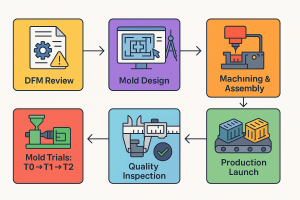
1. DFM Review
This step largely determines whether the mold will require rework later. Chinese suppliers typically deliver DFM feedback within 24–72 hours because design, moldflow, and tooling teams work in a coordinated workflow.
At this stage, engineers usually highlight issues that would affect molding stability, such as:
- areas likely to warp or sink due to local thickness or rib geometry
- undercuts that require sliders and add cost
- thickness transitions that may cause inconsistent filling
Experienced Chinese toolmakers treat DFM as a risk-control step, not a formality. Most delays, repeated trials, and dimension instability originate from problems that were not addressed here. When DFM is handled thoroughly, the downstream machining and sampling stages run far more predictably.
2. Mold Design
Mold design sets the foundation for tool life, cycle time, and dimensional accuracy. Chinese suppliers progress quickly here because steel grades and standard components are readily available, so design work is not slowed by procurement.
The critical design decisions focus on three areas:
- Cooling layout — this determines how fast the mold cycles and how well the part maintains its shape
- Steel selection — matched to the resin and expected wear to prevent premature tooling failure
- Gating and venting — controls flow balance and helps avoid cosmetic defects or incomplete filling
Good design in these areas reduces later corrections during machining and minimizes adjustments in T0/T1/T2 trials. The long-term cost and performance gap between suppliers often originates here.
3. Machining & Assembly
CNC machining, EDM, polishing, and fitting are typically completed under one roof in Chinese mold shops. This integrated setup allows the team to move from roughing to finishing without waiting for external vendors. Many facilities also operate multi-shift machining schedules, which compresses lead time and keeps tolerance control consistent.
During this stage, three elements shape the mold’s dimensional accuracy:
- CNC accuracy and machine stability, which determine how well critical shut-offs and sealing surfaces align
- EDM quality, especially for fine details, sharp corners, and textured areas
- Fitting workmanship, which affects flash control, parting-line quality, and long-term tool wear
When machining and fitting stay in the same workflow, the team can adjust electrodes, correct steel, or refine parting lines immediately. This reduces deviation stack-ups and prevents delays that typically occur when multiple vendors are involved.
4. Mold Trials: T0 → T1 → T2
Mold trials determine whether the tool can enter stable production. Chinese suppliers typically run T0 quickly to verify basic functionality, followed by T1 and T2 to refine dimensions, cosmetic performance, and cycle stability. Because machining, sampling, and QC are in the same facility, issues identified during trials can be corrected without long waiting periods.
Suppliers normally provide structured trial reports detailing molding parameters, observations, and corrective actions. This documentation shows how the tool progresses toward a stable production state.
5. Quality Inspection
Quality inspection ensures the tool is stable before entering mass production. Mature Chinese shops run structured QC at every trial stage, combining dimensional checks with functional evaluation. FAI and CMM reports confirm whether critical features are within tolerance, while cosmetic reviews identify flow marks, gloss variation, or gate-related defects. Depending on the product, suppliers may also conduct DuPont drop tests or basic functional checks to assess durability. Color matching is verified against master samples to ensure consistency across batches.
These checks allow you to evaluate the mold’s readiness remotely and make informed decisions without being on-site. When QC is handled systematically, potential issues are resolved before production volumes ramp up, reducing the risk of defects or line interruptions later.
6. Production Launch
Once the mold is validated, production can ramp up quickly. One of the advantages of manufacturing in China is the density of the local supply chain. Resin, colorants, hot-runner components, and tooling consumables can be sourced the same day, and maintenance teams can respond immediately when adjustments are needed. This keeps the transition from trials to steady production predictable and minimizes downtime.
How to Find the Correct Injection Molds Manufacturer

When sourcing molds in China, the key is to identify which suppliers have the engineering depth, machining resources, and process control to support your part requirements. Capability varies widely across factories, so a structured evaluation helps avoid delays, rework, and unstable dimensions during trials.
1. Start with clear project requirements
Before contacting suppliers, define the basics of your project—material, part complexity, required tolerances, and expected volume. These elements determine which factories are technically capable of handling your part. A shop focused on simple consumer goods, for example, may not be suitable for tight-tolerance engineering components. Clear requirements let you filter suppliers quickly and avoid conversations that lead nowhere.
2. Evaluate engineering and tooling capability
For injection molds, what matters most is not how large the factory looks, but whether the engineering team can control risk early. A capable supplier should be able to explain how they approach gating, cooling, venting, and steel selection—and why those decisions fit your part. The easiest way to judge this is to review their past DFM work or case studies. If they can show how they solved warpage, sink, or cycle-time issues on similar geometries, you’ll know their expertise goes beyond quoting.
3. Check machining, molding, and facility setup
What you need to confirm is not the size of the factory, but whether the full workflow—CNC, EDM, fitting, and sampling—runs under consistent control. A good supplier keeps these steps tightly linked so adjustments can be made without delays.
You should also make sure their press range fits your part and that they have enough machine availability for trials and production. When the local supply chain can deliver steel, components, or hot-runner parts quickly, the entire schedule becomes far more stable.
A well-organized mid-sized shop with integrated processes often performs better than a large facility that outsources critical steps. What ultimately matters is fast feedback and predictable lead time.
4. Confirm quality system and certifications
Quality systems tell you how the factory operates—not just what certificates hang on the wall.
A reliable supplier should be able to show how they manage inspections, document mold changes, and control materials throughout the build. ISO-based processes (and industry-specific standards when needed) are a good sign, but what matters more is how these systems appear in actual project files.
Ask for a recent FAI or CMM report, or a quick walkthrough of their QC workflow. These examples reveal consistency, traceability, and whether the shop maintains tooling and production data in a structured way—far more valuable than a certification logo alone.
5. Review relevant project experience
What matters is not how many years a factory has operated, but whether it has solved problems similar to yours. A supplier who has already worked with the same resin family or comparable part complexity will move faster through DFM, machining, and trials because the learning curve is smaller.
You can confirm this by asking for a few case examples—preferably parts made in similar materials or industries. When a manufacturer can show how they handled warpage, thin-wall filling, surface requirements, or multi-slider structures on past projects, you gain confidence that your tool will not become a trial-and-error exercise.
6. Assess communication and project management
For overseas tooling projects, communication often determines whether timelines stay on track. What you need is a team that manages the build in a structured, predictable way—not one that responds only when problems appear.
A dependable supplier will assign a clear project owner, provide consistent progress updates with machining photos, and deliver trial reports that document parameters and corrective actions. These habits let you follow the tool’s status without being on-site. If communication already feels slow or unclear during quotation, it rarely improves once the project begins.
Supplier Evaluation Summary Table
|
Evaluation Dimension |
What You Should Verify |
Why It Matters |
|
Project Fit |
Experience with similar part geometry, resin, and volume requirements |
Reduces early technical risk and shortens development time |
|
Engineering Capability |
Quality of DFM reviews, availability of Moldflow, clarity of gating/cooling decisions |
Determines mold stability, cycle time, and likelihood of rework |
|
Tooling Execution |
In-house CNC/EDM/fitting, proven capability for the required mold class |
Ensures consistency and avoids delays caused by outsourcing |
|
Quality System |
ISO framework, CMM measurement capability, structured FAI process |
Confirms the factory can control tolerances and maintain traceability |
|
Communication & Project Management |
Named project owner, structured reporting, predictable response times |
Essential for managing a remote tool build without losing schedule control |
If a supplier scores well on these points and can explain their decisions in a straightforward way, you are much closer to choosing a reliable injection molding partner.
Related Reading:
https://www.kemalmfg.com/injection-molding/companies/china/
How to Get a China Plastic Injection Mold Quote?

Getting a mold quotation from a China-based manufacturer is straightforward when you prepare clear design data. For most projects, you only need to submit the 3D model and basic specifications. Once received, the engineering team can assess manufacturability, tooling class, steel selection, and projected cycle time.
If you use Kemal’s online quote system, the process typically includes:
- Upload your CAD files securely
- Engineers review DFM-related risks, including wall transitions, gating, and expected shrinkage
- Cost estimation for tooling + molding based on your target resin, volume, and quality requirements
- Initial lead-time assessment for T0/T1 trials
All files are handled under strict confidentiality, and the quote reflects both prototyping and production options so you can evaluate cost and schedule together.
Related Reading:
https://www.kemalmfg.com/injection-molding/quoting/
FAQs:
Kemal: Your Leading Injection Molding Manufacturer in China
Kemal Precision Manufacturing Ltd. is dedicated to delivering superior quality, custom-made injection molding productions from its setup in China. Backed by a team of industry professionals, our highly-equipped manufacturing workshops guarantee perfect solutions for all your prototyping and mass production needs.
With an ISO9001:2015 certification, our 28-year experience has led us to successfully serve more than 2,000 companies across more than 80 countries, ranging from the aerospace, automotive, and medical device industries to the electronics, robotics, and energy sectors.
Do you still have any questions? Please don’t hesitate to contact us or visit our website to find out more!


