If you’re planning to produce parts from a few dozen to a few thousand units, low-volume manufacturing is your best ally. It lets you move from concept to real-world parts fast, without locking in the high upfront cost of mass production tooling.
It’s also a growing part of the manufacturing world. Industry reports show the global low-volume production market is expanding steadily. In 2024, the global Low-Volume Production Service market was already worth around USD 3.9 billion, with a projected growth to USD 5.2 billion by 2031, showing steady long-term expansion at a CAGR of 4.2%. That growth reflects rising demand from agile product teams, custom manufacturing, and businesses needing flexibility without sacrificing quality.
In this guide, you’ll see when low-volume manufacturing makes sense, how to choose between processes like CNC, 3D printing, and injection molding, and what to plan for if you’re scaling to mass production.
What Counts as Low Volume?
Low volume doesn’t mean the same thing for every product or industry. In general, we’re talking about production runs from as few as 10 units up to a few thousand—enough to validate a design, fulfill early orders, or serve a niche market without committing to mass-production tooling.
Typical Ranges by Industry:
- Medical Devices: For clinical trials or early-stage regulatory submission, even 50–500 parts may be considered “low volume.” Once approved, the same design may ramp to tens of thousands annually.
- Consumer Electronics: Pilot runs of 1,000–3,000 units are common for crowdfunding campaigns or first-to-market launches.
- Automotive: For specialty trims or aftermarket accessories, 5,000–10,000 units per year can still be “low volume” compared to mainstream models.
An aluminum mold that’s perfect for 2,000 parts might wear out too quickly if you actually need 20,000. On the other hand, over-investing in hardened steel for a 500-piece run ties up capital without real ROI.
Core Advantages & Limitations
Low-volume manufacturing offers a mix of speed and flexibility that’s hard to match with mass production. But like any approach, it comes with trade-offs you need to weigh early.
Advantages of Low Volume Manufacturing
- Faster to Market: With simplified tooling and shorter setup times, you can move from design freeze to production in weeks, not months.
- Lower Upfront Risk: You avoid tying up large amounts of capital in long-life steel molds or high-volume production runs before demand is proven.
- Easier Design Iteration: If a part needs a tweak after testing or market feedback, modifying an aluminum mold or switching process is faster and cheaper.
- Customization Potential: Smaller runs make it feasible to produce variations for niche markets, seasonal demand, or different customer segments.
Limitations
- Higher Unit Cost: Tooling is amortized over fewer parts, so the cost per part is higher than in high-volume production.
- Limited Output: Tooling and process choices may not handle hundreds of thousands of parts without major upgrades.
- Scaling Constraints: Some low-volume methods (e.g., certain additive processes or soft tooling) cannot be pushed to mass production without new investments.
Cost vs. Volume Relationship
Below is a simplified view of how the cost per part changes with production volume for different manufacturing methods.
| Volume Range | 3D Printing | CNC Machining | Low-Volume Injection Molding | High-Volume Injection Molding |
| 1–50 pcs | High ($40–$200) | High ($30–$150) | Not cost-effective | Not cost-effective |
| 100–500 pcs | Moderate–High | Moderate–High | Moderate ($8–$25) | Not cost-effective |
| 1,000–5,000 pcs | Very High | High | Low–Moderate ($3–$15) | Low ($1–$5) |
| 10,000+ pcs | Not feasible | Not feasible | Moderate–Low | Very Low ($0.50–$2) |
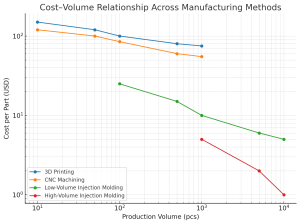
Low-volume injection molding typically becomes more economical than CNC or 3D printing once you pass the 500–1,000 part mark—but before high-volume steel tooling pays off.
Common Low-Volume Manufacturing Processes
1. CNC Machining
When you need a part in metal or an engineering-grade plastic—and you need it to be tough, precise, and ready to use—CNC machining is often the first tool we reach for. I’ve had projects where we skipped tooling entirely and went straight to CNC, simply because the timeline didn’t allow for mold build. The result? Parts that hit ±0.05 mm tolerances right out of the machine, with surfaces smooth enough to assemble without extra finishing.
The trade-off is cost. Each part spends hours on a machine, and if you start asking for 1,000 pieces, the math gets painful fast. But for a run of 50 or 200 units—especially when the design might change—CNC saves both time and headaches. We’ve even run short batches as a bridge, getting real parts in the field while waiting for injection molds to be cut.
2. 3D Printing (Additive Manufacturing)
There are times when the clock is ticking, and the last thing you want is to wait for a mold. I’ve had projects where we were able to go from a CAD file to a physical part in under 48 hours using industrial 3D printing. The freedom it gives you in geometry is unmatched—you can create internal channels, complex lattice structures, or organic shapes that would be impossible to machine.
Of course, there are trade-offs. The material library, while growing, still can’t match the range of options you get with molding or machining. And if you need the part to have the exact mechanical properties of an injection-molded component, you may need to test a few print processes or add post-processing steps. Still, when your priority is speed and design freedom—and the part count is in the tens, not hundreds—additive manufacturing can get you real, testable parts while the rest of your production plan is still coming together.
3. Low-Volume Injection Molding
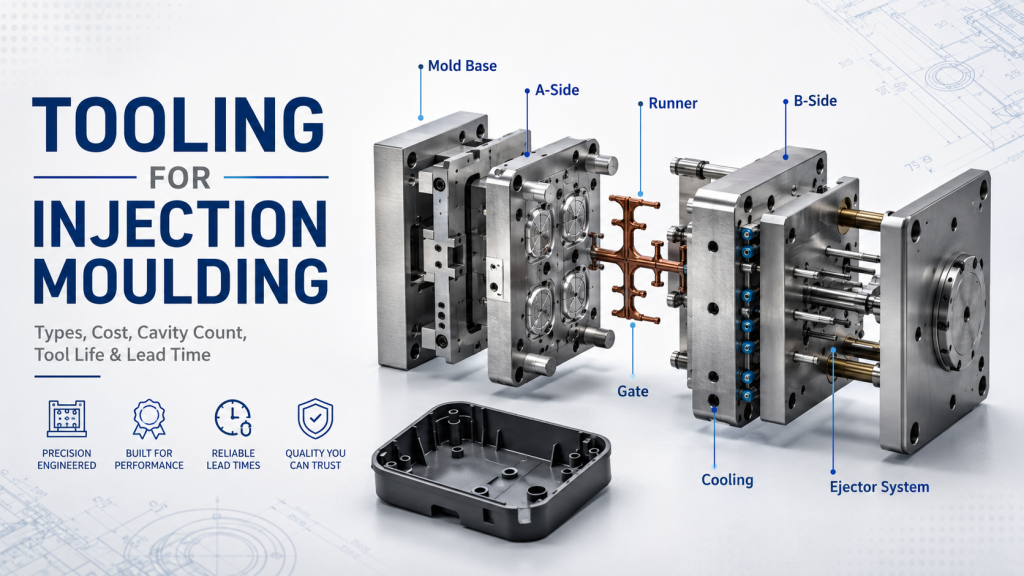
We’ve had plenty of projects where the design was already close to final, but the team wasn’t ready to commit to a full production mold. In those cases, aluminum or soft steel tooling becomes a game-changer. I remember one medical device housing we ran—1,200 units, all in the same PC/ABS blend planned for mass production. The tooling was cut in under three weeks, and the first shots came off the press with only a minor gate adjustment needed.
This approach gives you production-grade parts you can actually ship, not just test. You see exactly how the material behaves in a real mold, which means fewer surprises when you eventually move to high-volume steel tooling. Yes, there’s still an upfront investment, and if you only need 50 pieces, it’s probably overkill. But when your batch size is in the hundreds or low thousands, and you care about getting the final material and surface finish right, low-volume injection molding can bridge the gap between prototype and mass production better than anything else I’ve used.

4. Sheet Metal Fabrication
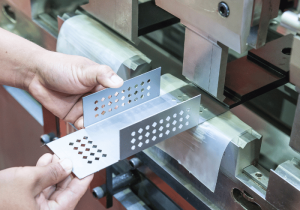
One of the most satisfying projects I’ve worked on started with nothing more than a rough CAD model for an electronics enclosure. The client needed just 300 units for a beta launch, and they wanted them in less than a month. We went with sheet metal fabrication because it gave us flexibility—laser cutting the flat patterns, bending them into shape, and welding where necessary.
I remember the first samples coming off the press brake: clean bends, tight tolerances, and a surface that took powder coating beautifully. We could tweak hole positions or adjust mounting tabs mid-run without scrapping expensive tooling. That kind of adaptability is exactly why sheet metal works so well for low-volume builds. It’s not the right choice if your design calls for deep, organic curves or complex 3D geometry—that’s when you start stitching multiple pieces together—but for housings, brackets, and frames, nothing beats the balance of speed, cost, and durability.
5. Vacuum Casting (Urethane Casting)
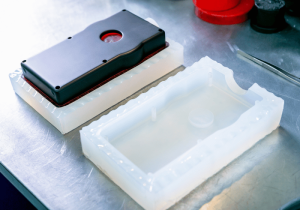
I once worked with a startup that needed just 40 units of a wearable device for early user testing. The design was locked, but they weren’t ready to invest in injection molds yet. We used vacuum casting—starting with a master model, then making silicone molds to replicate each part in polyurethane.
What stood out to me was how close the cast parts felt to the injection-molded version they’d eventually produce. The surface finish was smooth, the colors matched exactly, and the fit between components was tight. The catch? After about two dozen pulls, the silicone mold started to lose definition, so we had to remake it. But for their timeline and budget, it worked perfectly—they had production-quality samples in hand in just over a week, ready for demos and user feedback, without locking into mass production.
Manufacturing Process Comparison Table
| Process | Typical Quantity | Materials | Lead Time | Tooling Cost | Unit Cost (500 pcs) | Surface Finish | Dimensional Accuracy |
| CNC Machining | 1–500 | Metals, plastics | 3–10 days | None | $30–$150 | Excellent | ±0.025–0.125 mm |
| 3D Printing | 1–200 | Plastics, resins, metals (limited) | 1–5 days | None | $20–$50 | Good–Medium | ±0.1–0.5 mm |
| Low-Volume Injection Molding | 100–5,000 | Thermoplastics, LSR | 2–4 weeks | $3k–$20k | $3–$15 | Excellent | ±0.05–0.1 mm |
| Sheet Metal Fabrication | 1–1,000 | Metals | 1–3 weeks | Low | $15–$80 | Excellent | ±0.25–0.5 mm |
| Vacuum Casting | 5–100 | Polyurethane, silicone | 1–2 weeks | Low | $20–$80 | Very Good | ±0.2–0.5 mm |
Cost Structure in Low Volume Manufacturing
When we talk about low-volume production, cost isn’t just about how much each part comes off the line for—it’s about how that cost is built. And in small-batch manufacturing, the balance between fixed and variable costs looks very different from high-volume work.
Tooling Cost vs. Per-Unit Cost
One of the biggest shifts you notice in low-volume projects is how much weight tooling carries in the overall budget. I’ve seen aluminum molds that cost $8,000 spread over 500 parts, making tooling alone $16 per part. Yet drop to under $3 per part when the same mold runs 3,000 pieces. The same logic applies to CNC fixturing or custom jigs: their impact on unit price fades as volume climbs, but it can be a deal-breaker for a tiny batch.
Where the Money Goes
Even after tooling, you still have the big three:
- Material costs: Often higher per kg than mass production, since you’re buying smaller lots. Specialty resins, medical-grade metals, or imported alloys can tip the budget fast.
- Processing costs: Machine time and labor are spread over fewer parts, so efficiency is critical. Every extra setup, tool change, or process adjustment carries more weight.
- Post-processing and finishing: In low volumes, finishing steps like painting, coating, or polishing often can’t be automated, so you’re paying for manual work.
Cost Comparison at Different Volumes
Here’s a real-world style snapshot for a plastic enclosure project using low-volume injection molding. (Costs are indicative and vary by design complexity, material, and supplier location.)
| Quantity | Tooling Cost (USD) | Material Cost/Unit (USD) | Processing Cost/Unit (USD) | Post-Processing/Unit (USD) | Total Unit Cost (USD) |
| 500 pcs | $8,000 | $2.50 | $5.00 | $1.50 | $24.50 |
| 1,000 pcs | $8,000 | $2.50 | $3.50 | $1.25 | $15.25 |
| 5,000 pcs | $8,000 | $2.30 | $2.00 | $1.00 | $5.60 |

You can see how the fixed tooling cost gets diluted as volume rises, while variable costs stay relatively stable. That’s why low-volume manufacturing requires a different mindset—one that weighs speed and flexibility against unit cost, and focuses on matching the right process to your volume sweet spot.
From Low Volume to Mass Production
Moving to mass production isn’t just about hitting a bigger number—it’s about knowing the timing, the technical pathway, and how to prepare your supply chain for a higher gear.
When to Scale Up
I’ve seen companies hold back too long, missing market momentum, and I’ve also seen them jump too soon, burning capital on tooling they didn’t end up using. The sweet spot is usually when three things line up:
- Demand is stable: Orders are consistent over several cycles, not just one launch or trade show buzz.
- The design is locked: You’ve tested the final geometry and material in real-world conditions with no major changes pending.
- ROI is clear: The cost per part in high-volume tooling will pay back the investment within your target timeframe.
Technical Transition Path
One of the smoothest transitions is moving from bridge tooling—like aluminum molds—to hardened steel molds that can run hundreds of thousands of cycles. If you’ve been using a single-cavity tool for low volume, this is also the time to consider multi-cavity designs to multiply your output. Sometimes, we’ll even reuse certain inserts or gating designs from the bridge tool in the production mold to reduce risk.
Upgrading the Supply Chain and QA
Scaling isn’t just a tooling exercise. Your suppliers need to be ready for increased material volumes, tighter delivery windows, and possibly new compliance requirements (ISO, FDA, IATF, depending on your sector). On the QA side, low-volume projects might get by with 100% visual inspection, but high-volume runs require robust in-line QC—automated measurement, statistical process control, and full traceability.
I’ve seen projects succeed not because they had the best mold, but because their team built the production ecosystem alongside the tooling. By the time the steel mold was ready, so was everything else.
Industry-Specific Applications
Low-volume manufacturing plays out differently depending on the sector, but the underlying value—speed, flexibility, and risk reduction—remains the same. Here’s how it comes to life in three major industries, with real-world style scenarios to show the ROI.
Medical Devices
In the medical device industry, regulatory approval can take months or years, and tooling decisions often happen long before full-scale production. I worked with a surgical instrument startup that needed 200 functional units for clinical trials. Using aluminum tooling, they had production-grade stainless-steel components in just four weeks. That batch secured the data needed for FDA submission and allowed them to refine ergonomic features before committing to $80k+ steel molds. The cost per part was higher, but the total investment stayed low enough to pivot if feedback from surgeons required design changes.

Automotive
Automotive OEMs and tier suppliers often need small batches for low-volume models, aftermarket parts, or special trims. One client needed 1,500 interior panel kits for a luxury edition SUV—parts that would never hit mass-production volumes. We used low-volume injection molding with P20 steel, balancing durability for the run size with shorter lead times. By avoiding over-engineered tooling, the client saved nearly 30% on upfront costs, freeing budget for premium finishes that elevated the brand value.

Consumer Electronics
For a crowdfunding campaign, a hardware startup needed 800 enclosures for the first production wave. They weren’t sure how many orders would come in after launch, so locking into high-volume tooling would have been risky. We went with a hybrid approach: CNC-machined prototypes for influencer reviews, then low-volume injection molding for the campaign backer shipments. The total turnaround from design freeze to shipping the first batch was under eight weeks. That speed meant they could start fulfilling orders while still negotiating high-volume pricing for the next run.

Choosing a Low-Volume Manufacturing Partner
Finding the right partner for low-volume work isn’t just about who can make the part—it’s about who can adapt with you as your product and demand evolve. In small-batch production, flexibility and communication often matter as much as technical skill.
- Technical and Process Capability: Look for a partner who can work across multiple processes—CNC, injection molding, 3D printing—so you’re not locked into a single option. In some projects where we started in additive manufacturing for prototypes, moved to aluminum tooling for 500 parts, and then transitioned to hardened steel without switching suppliers. That continuity saves time and avoids miscommunication.
- Quality and Certifications: If your parts will go into regulated industries—medical, automotive, aerospace—you’ll want a partner with relevant certifications (ISO 9001, ISO 13485, IATF 16949). I once worked with a medtech client who had to change suppliers mid-project because their original partner couldn’t pass an FDA audit. That delay cost them three months.
- Lead Time Reliability and Scalability: Low-volume projects move fast. You need a partner who can hit short lead times now, but also has the capacity to support you if volumes double. A good litmus test: ask them for case studies where they’ve scaled a project from hundreds to thousands without quality loss or schedule slips.
Procurement Checklist — Key Points to Verify
| Evaluation Area | What to Look For | Why It Matters |
| Process Range | CNC, molding, additive, sheet metal | Ensures flexibility as needs change |
| Material Expertise | Metals, thermoplastics, silicones | Prevents costly trial-and-error |
| Certifications | ISO, FDA, IATF, as applicable | Compliance and market access |
| Lead Time Performance | Proven delivery track record | Avoids schedule slip penalties |
| Scalability | Equipment & workforce to expand | Smooth transition to higher volumes |
| Communication | Clear updates, quick response | Keeps projects aligned and predictable |
Case Study — From Concept to Delivery in 6 Weeks
When a consumer electronics startup came to us, they were under pressure. Their crowdfunding campaign had surpassed expectations, but the reward was a problem they hadn’t prepared for—delivering 1,200 functional enclosures in time for a high-profile product launch event.
Background & Challenge of This Project
The design was almost final, but the team didn’t have the budget or time for high-volume steel tooling. Every week counted, and the enclosures had to match the final production material (PC/ABS) and surface finish so that what shipped to early backers would be indistinguishable from the mass-produced version.
Our Solution:
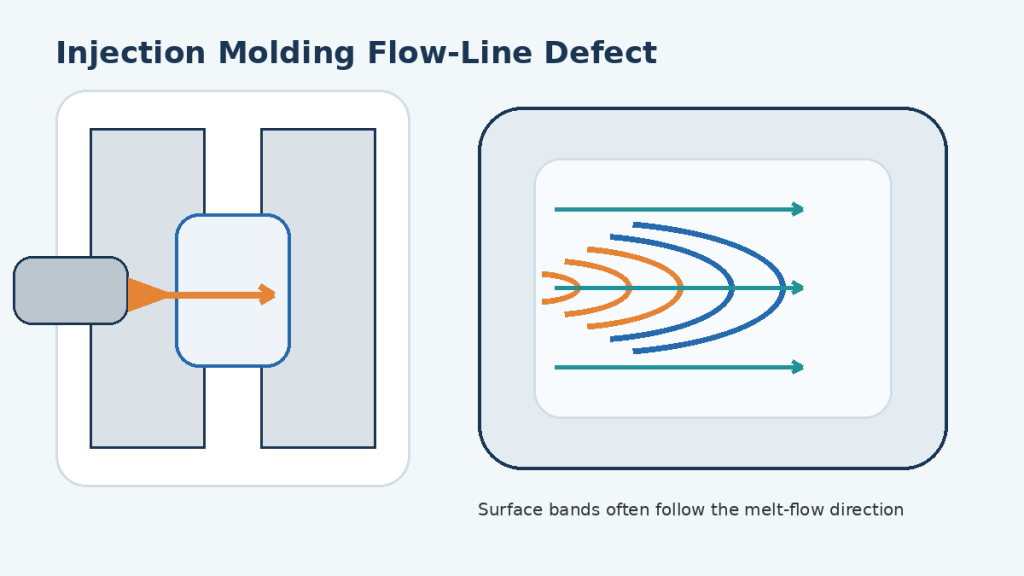
We proposed an aluminum bridge tool with a two-cavity layout to balance speed and cost. CAD to first shots took 2.5 weeks. The first T0 samples revealed a minor gloss inconsistency on one side, so we shifted the gate location and ran another test batch within three days. The adjusted parts met all cosmetic and dimensional specs.
Outcome:
- Timeline: Full run completed in just under six weeks.
- Budget: Total tooling and production stayed within $14,500.
- Impact: The early delivery gave the startup an extra four days for QA and packaging. At the launch event, they secured $180,000 in new pre-orders—enough to justify investing in high-volume tooling for the next phase.
Timeline Visualization
| Week | Milestone |
| 1 | Final CAD approval & tooling kick-off |
| 3.5 | T0 samples produced |
| 4 | Gate adjustment completed |
| 4.5 | T1 validation batch passed QC |
| 6 | All 1,200 units shipped to client |
Conclusion
Low-volume manufacturing allows you to reduce financial risk, speed up your path to market, and stay flexible when product requirements or market conditions shift. For startups, it means testing demand without overspending. For established manufacturers, it’s a way to serve niche markets, run pilot programs, or bridge production while high-volume tooling is underway.
The next step is to speak with manufacturing partners who can guide you through material selection, tooling strategy, and process optimization.