Metal casting remains one of the most efficient ways to turn molten metal into complex, functional components. Among the many casting methods available, die casting stands out for its speed, repeatability, dimensional consistency, and suitability for high-volume production.
But die casting is not always the best choice. When a part requires difficult geometries, undercuts, internal passages, or materials that cannot be processed economically by conventional die casting, investment casting can be a better fit.
So, when comparing die casting vs investment casting, the right question is not simply which process is more precise or less expensive. The better choice depends on material, geometry, production volume, tooling cost, tolerances, surface requirements, and the intended application.
This guide explains how each process works, compares their strengths and limitations, and shows when to choose die casting or investment casting for a new project.
What Is Die Casting?
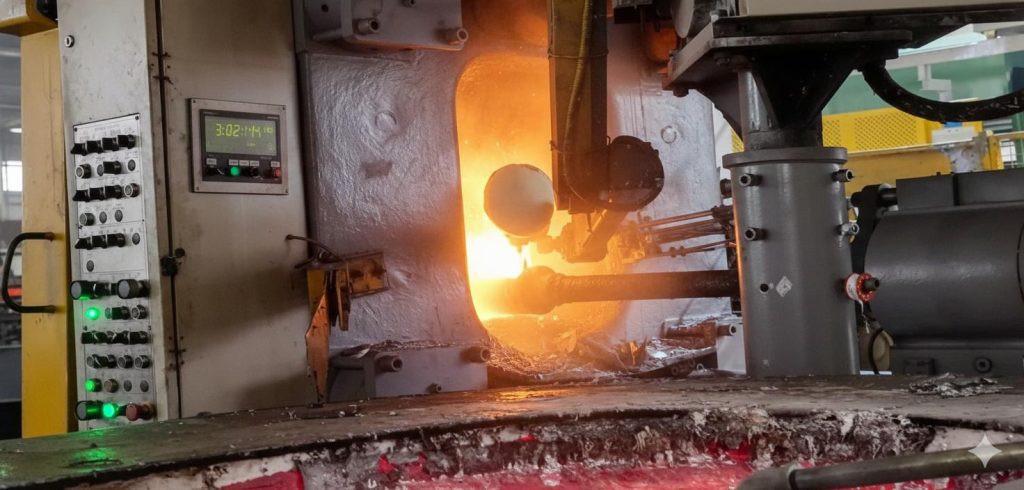
Die casting is a metal casting process in which molten metal is injected into a reusable steel die at high pressure. The die contains a precisely machined cavity that defines the final shape of the component.
Unlike sand casting or other expendable-mold processes, the die can be reused for many production cycles. This makes die casting particularly attractive for components that must be manufactured repeatedly with consistent dimensions and surface quality.
The process is especially common for non-ferrous alloys such as:
- Aluminum
- Zinc
- Magnesium
- Copper-based alloys in selected applications
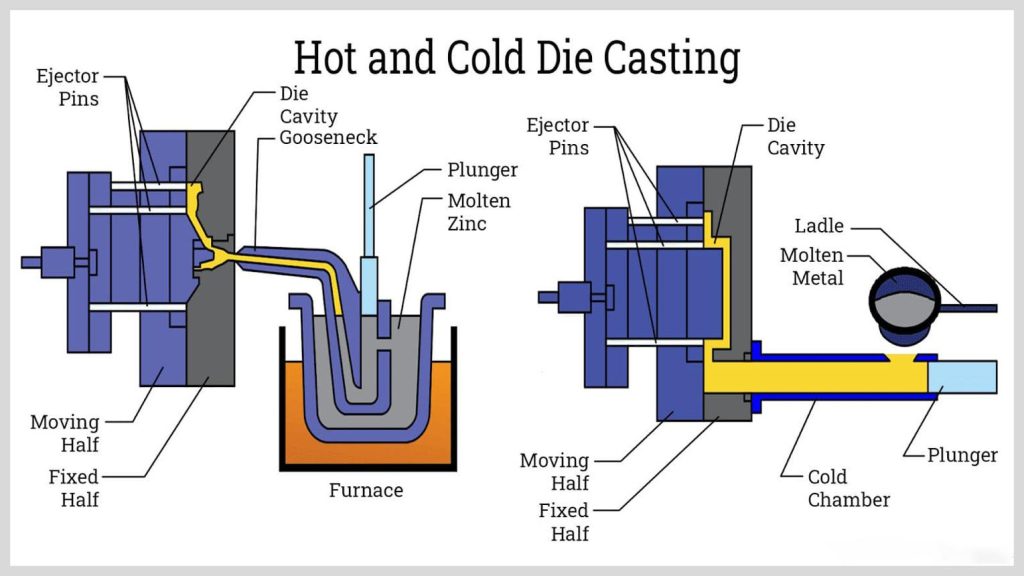
Hot Chamber vs Cold Chamber Die Casting
Die casting machines are generally divided into two types.
Hot chamber die casting keeps the injection mechanism in contact with the molten metal. It is mainly used for lower-melting-point alloys such as zinc and certain magnesium alloys. Because the metal supply is integrated with the machine, production cycles can be very fast.
Cold chamber die casting uses a separate furnace. A measured amount of molten metal is transferred into the shot chamber before each injection. This configuration is commonly used for aluminum and magnesium alloys whose processing conditions are unsuitable for a submerged hot-chamber injection system.
How Does the Die Casting Process Work?
A typical die casting cycle consists of four main stages.
Die Preparation
The steel die is cleaned, temperature-controlled, and coated with a suitable lubricant. The two die halves are then clamped together.
High-Pressure Injection
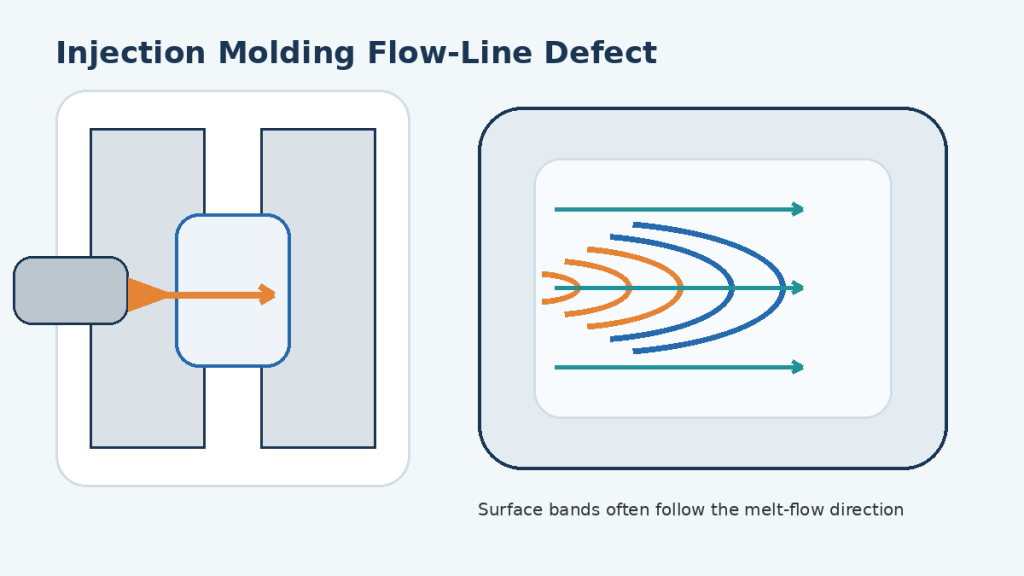
Molten metal is injected into the cavity at high speed and pressure. The rapid filling allows thin sections, ribs, bosses, and other detailed features to be reproduced.
Cooling and Solidification
The metal rapidly transfers heat to the die and solidifies. Pressure is maintained during the appropriate part of the filling and solidification cycle to help produce a sound casting.
Ejection and Finishing
After solidification, the die opens and ejector pins remove the casting. Gates, runners, and flash are trimmed away. Depending on the design, the part may then undergo CNC machining, deburring, surface finishing, coating, or other secondary operations.
Why Is Die Casting Suitable for Mass Production?
The key advantage is repeatability. Once the die has been developed and validated, the same cavity can produce a large number of substantially identical components.
That makes die casting particularly attractive when:
- Annual production volume is high
- The same part will be produced for several years
- Low unit cost matters
- Consistent dimensions are important
- The design is suitable for a reusable die
The trade-off is the initial tooling investment. A die casting tool is considerably more expensive than a simple expendable mold, so the economics become more favorable as production volume increases.
What Is Investment Casting?
Investment casting, also known as lost-wax casting, creates a disposable ceramic mold around a wax pattern.
Instead of injecting molten metal directly into a permanent steel die, manufacturers first create a wax replica of the desired component. The wax pattern is coated repeatedly with ceramic material until a sufficiently strong shell is formed. The wax is then removed, leaving an empty cavity into which molten metal is poured.
The ceramic shell is destroyed after casting, so each casting cycle requires a new shell.
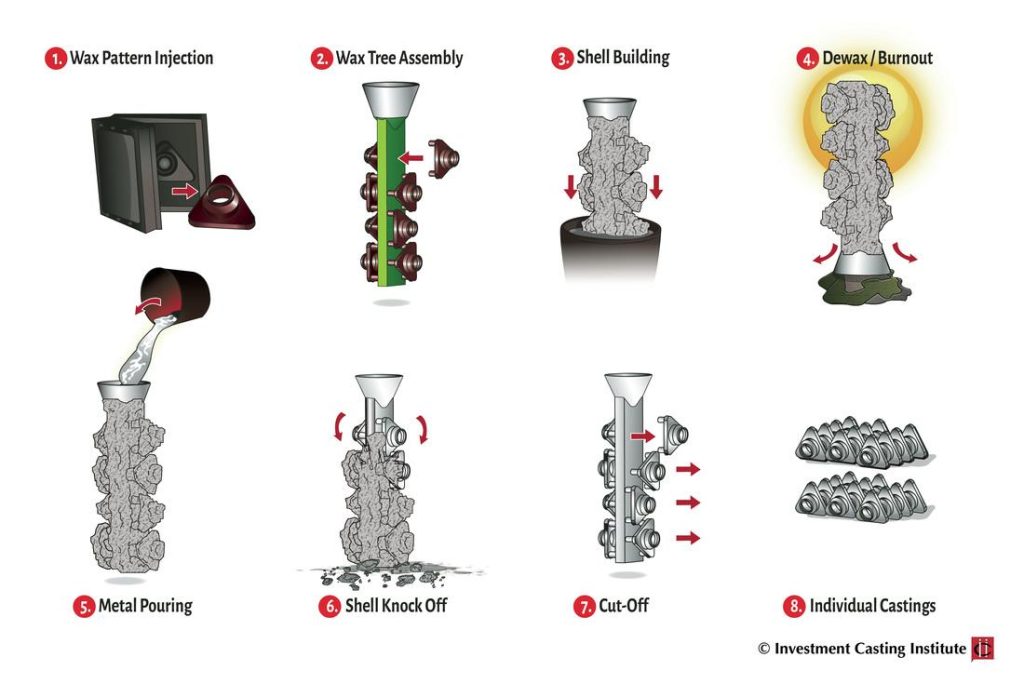
How Does Investment Casting Work?
The process typically follows these steps:
Create the Wax Pattern
Molten wax is injected into a pattern die to create a replica of the final component.
Assemble the Patterns
Multiple wax patterns can be attached to a central runner system, often creating a tree-like assembly. This allows several parts to be cast simultaneously.
Build the Ceramic Shell
The wax assembly is repeatedly dipped into ceramic slurry and coated with refractory material. Multiple layers create a rigid shell capable of withstanding molten metal.
Remove the Wax
The shell is heated, causing the wax to melt and drain away. This leaves the negative cavity of the component inside the ceramic shell.
Pour the Metal
The ceramic shell is heated and filled with molten metal.
Break the Shell
After the metal cools and solidifies, the ceramic shell is removed mechanically.
Cut and Finish the Parts
Individual components are separated from the runner system and then cleaned, machined, polished, or otherwise finished as required.
Why Use Investment Casting?
Investment casting offers a major advantage in geometric freedom.
Because the ceramic shell is removed after casting, the process does not rely on opening a permanent two-piece die around the finished component. This makes it possible to manufacture shapes with:
- Complex contours
- Undercuts
- Thin sections
- Internal passages
- Fine surface details
- Difficult-to-machine geometries
It also supports a much broader range of alloys than conventional high-pressure die casting, including many steels and stainless steels.
Die Casting vs Investment Casting: Key Differences
The choice between investment casting vs die casting should be based on the complete manufacturing requirement rather than one specification.
| Factor | Die Casting | Investment Casting |
| Mold type | Reusable steel die | Disposable ceramic shell |
| Typical materials | Aluminum, zinc, magnesium | Steel, stainless steel, aluminum, nickel alloys, and others |
| Production volume | Medium to very high | Low to medium, with some higher-volume applications |
| Tooling cost | Relatively high | Generally lower initial tooling cost |
| Unit cost at high volume | Very low | Usually higher |
| Production speed | Very fast | Slower |
| Automation | Highly suitable | More labor-intensive |
| Geometry | Complex, but must accommodate die opening | Highly complex shapes and undercuts |
| Surface finish | Good | Very good |
| Dimensional consistency | Excellent for suitable designs | Excellent, depending on geometry and process control |
| Large production runs | Excellent | Possible, but generally less economical |
| Steel/stainless steel | Generally unsuitable for conventional HPDC | Excellent |
| Secondary machining | Often limited to critical features | Common where tighter tolerances are required |
The most important differences are tooling economics, material compatibility, geometry, and production volume.
Material Selection
Material is often the first factor to consider.
Conventional high-pressure die casting is primarily associated with non-ferrous alloys. Aluminum, zinc, and magnesium are widely used because they combine useful mechanical properties with casting characteristics suitable for high-pressure production.
Investment casting is much more flexible in material selection. Depending on the foundry and process, it can accommodate stainless steels, carbon and alloy steels, nickel-based alloys, aluminum alloys, and other engineering materials.
Which process is better for stainless steel?
Investment casting is generally the better choice.
If your component must be manufactured from stainless steel or another high-temperature alloy, investment casting can offer a practical route to complex near-net-shape components.
Production Volume and Cost
This is where the economics of the two processes diverge sharply.
Die casting requires a relatively expensive permanent die. However, that die can be used repeatedly. Once the tooling investment has been absorbed across thousands or millions of parts, the cost per component can become very attractive.
Investment casting uses expendable ceramic shells. Initial tooling can be less expensive, but every casting requires a new shell and involves more processing steps.
Which process is cheaper?
For high-volume production, die casting is usually more economical.
For lower-volume projects where the tooling investment is a major concern, investment casting may be more competitive, especially when the part geometry would otherwise require complicated die construction.
The correct comparison should therefore consider total cost, not just tooling price:
Total manufacturing cost = tooling + material + casting + finishing + machining + inspection + logistics
A lower tooling cost does not automatically mean a lower cost per finished part.
Production Speed and Automation
Die casting has a clear advantage in production efficiency.
Once the die, machine, and process parameters are established, the casting cycle can be highly automated. Filling, cooling, ejection, trimming, and other operations can be integrated into a production cell.
Investment casting requires more individual stages: wax production, pattern assembly, shell building, drying, dewaxing, firing, pouring, shell removal, and finishing.
As a result, investment casting generally has a longer manufacturing cycle and requires more process handling.
If the priority is maximum throughput, die casting is usually the stronger option.
Tolerance and Surface Finish
Both processes can produce accurate parts, but their strengths differ.
Die casting can provide excellent dimensional repeatability because the casting cavity is machined into a rigid steel die. It is particularly effective for small and medium-sized components with consistent wall thicknesses and well-designed draft angles.
Investment casting can reproduce fine details and complex contours with good surface quality. However, dimensional variation can be affected by wax shrinkage, ceramic shell behavior, thermal conditions, and metal solidification.
Neither process should automatically be described as “more precise” in every situation. The achievable tolerance depends on:
- Part size
- Alloy
- Geometry
- Wall thickness
- Feature location
- Tooling quality
- Process control
- Required secondary machining
For critical interfaces, holes, threads, bearing seats, or other tight-tolerance features, post-casting CNC machining may still be required.
Geometry and Design Freedom
This is one of the strongest arguments for investment casting.
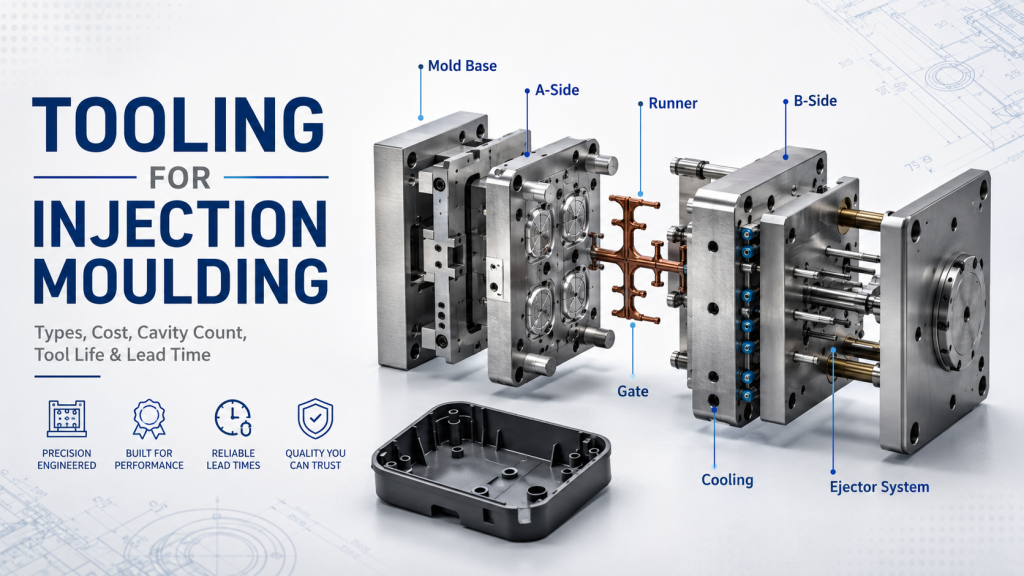
A die casting tool needs to open and release the finished component. That means designers must consider:
- Parting lines
- Draft angles
- Ejection
- Slides and cores
- Tool accessibility
- Die life
Investment casting does not have the same mold-opening constraint.
If a component contains complex curved passages, deep recesses, undercuts, or an irregular external profile, investment casting can often produce the shape more naturally.
Which process handles complex geometry better?
Investment casting generally offers greater geometric freedom.
However, that does not mean die casting is limited to simple shapes. Modern die casting can produce sophisticated housings, ribs, bosses, thin walls, and integrated structural features when the design is developed specifically for the process.
Applications: When Should You Use Each Process?
Typical Die Casting Applications
Die cast parts are widely used where high production volumes and repeatability are important.
Automotive
Common applications include:
- Transmission housings
- Motor housings
- Engine components
- Brackets
- Structural components
- Battery and powertrain housings
Aluminum and magnesium are especially attractive where weight reduction is important.
Electronics
Die casting is frequently used for:
- Heat sinks
- Motor housings
- Electronic enclosures
- Communication equipment housings
- Shielding components
The process can combine structural strength, thermal conductivity, and repeatable production.
Industrial Equipment
Examples include:
- Pump housings
- Gearbox housings
- Machine components
- Handles and brackets
- Actuator housings
Typical Investment Casting Applications
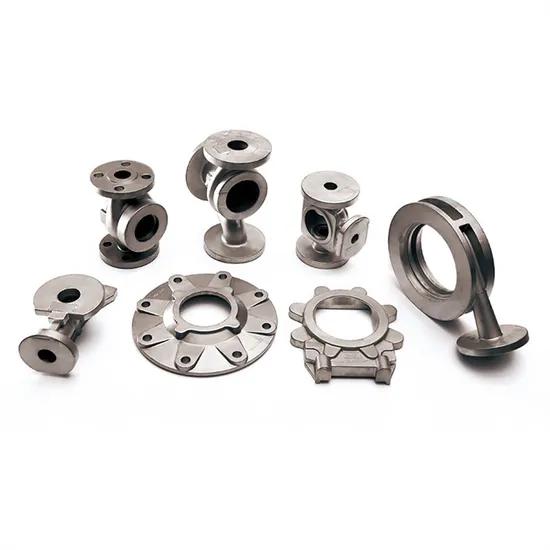
Investment casting is particularly useful when geometry or material requirements make conventional die casting impractical.
Aerospace
Applications can include:
- Turbine components
- Structural components
- Complex brackets
- High-temperature alloy components
Industrial Equipment
Investment casting is well suited to:
- Valves
- Pump components
- Impellers
- Complex fittings
- Stainless steel mechanical components
Medical Equipment
The process can produce intricate stainless steel and other alloy components where shape complexity and material performance are important.
Die Casting vs Investment Casting: Which Should You Choose?
There is no universal winner. Use the following decision framework.
Choose Die Casting When:
- Production volume is high
- Aluminum, zinc, or magnesium is suitable
- Low unit cost is important
- Fast production cycles are required
- The geometry is compatible with a reusable die
- High repeatability is required
- You expect long-term production
Choose Investment Casting When:
- Production volume is low or moderate
- Stainless steel or steel is required
- The geometry contains difficult undercuts
- Internal passages or complex contours are important
- A permanent die would be excessively complicated
- Near-net-shape production can reduce machining
- Material flexibility is more important than cycle speed
A Simple Decision Rule
High volume + non-ferrous alloy + production efficiency → Die Casting
Complex geometry + steel/stainless steel + lower volume → Investment Casting
There is one important caveat: production volume alone should never determine the process. A high-volume part with extremely complex geometry may still be better suited to investment casting, while a relatively simple low-volume aluminum component may be better produced through another process altogether.
What About CNC Machining After Casting?
Casting does not always produce the final dimensional condition required by an assembly.
Critical surfaces may need CNC machining after casting, including:
- Precision holes
- Threaded holes
- Bearing bores
- Sealing surfaces
- Mounting faces
- Tight-tolerance interfaces
This is particularly useful when only a few features require very tight tolerances. Rather than machining the entire component from a solid block, casting creates most of the geometry first, and CNC machining finishes the critical areas.
That combination can reduce material waste and machining time while maintaining functional accuracy.
For projects involving cast housings, brackets, covers, or other precision components, die casting + CNC machining + surface finishing can therefore be more practical than treating casting and machining as completely separate manufacturing choices.
Die Casting Design Considerations
A good die casting design starts before the tooling is built.
Wall Thickness
Try to maintain relatively uniform wall thickness where possible. Sudden changes can contribute to uneven filling and solidification.
Draft Angles
Adequate draft makes it easier to release the part from the die and reduces the risk of damage to both the component and tooling.
Ribs and Bosses
Ribs can increase stiffness without unnecessarily increasing wall thickness. Bosses should be designed with appropriate transitions to reduce stress concentrations.
Parting Line
The parting line should be considered during the initial CAD design rather than after the geometry has been finalized.
Machining Allowance
If certain surfaces require post-casting CNC machining, define the machining allowance during the casting design stage.
This is why an early DFM (Design for Manufacturability) review can have a major impact on both tooling cost and production stability.
Choosing a Die Casting Manufacturing Partner
Selecting the process is only half of the manufacturing decision. The supplier’s tooling capability, engineering support, inspection process, and ability to handle secondary operations can directly affect the final result.
For projects that require custom aluminum, zinc, or magnesium die cast parts, Kemal’s Die Casting Services supports custom die casting, die manufacturing, CNC machining, and surface finishing. Its engineering workflow includes DFM review before production, which can help identify manufacturability issues before tooling is committed.
For aluminum die casting in particular, Kemal describes its capabilities as supporting both prototypes and larger-volume parts, with automated equipment and integrated robotic production.
If you already have a CAD model or drawing, the best next step is to submit the design for an engineering review rather than choosing the process based only on general cost estimates. The manufacturer can evaluate the geometry, material, expected volume, tolerances, tooling requirements, and secondary machining needs before recommending the most economical route.
Upload your CAD file and request a die casting quote from Kemal
Frequently Asked Questions
Is die casting better than investment casting?
Not universally. Die casting is better for high-volume production of suitable non-ferrous alloys, while investment casting is often better for complex geometries, steel or stainless steel components, and applications where permanent-die constraints are undesirable.
Which is cheaper: die casting or investment casting?
For high-volume production, die casting usually has the lower unit cost because the tooling is reused over many cycles. Investment casting may have a lower initial tooling burden but higher recurring processing costs.
Is investment casting more precise than die casting?
Not necessarily. Both can produce accurate components. Die casting offers excellent repeatability with suitable designs, while investment casting provides strong detail reproduction and greater geometric freedom. Critical features may require CNC machining after either process.
Can stainless steel be die cast?
Conventional high-pressure die casting is generally not used for stainless steel because of its high processing temperature and the resulting demands on the die and injection system. Investment casting is a much more established option for stainless steel components.
Is die casting suitable for low-volume production?
It can be, but the tooling investment needs to be justified. For prototypes and small quantities, CNC machining, 3D printing, or other low-volume processes may be more economical. As volume increases, die casting becomes increasingly attractive.
Can die cast parts be CNC machined?
Yes. CNC machining is commonly used to finish critical dimensions, holes, threads, sealing surfaces, and mounting interfaces after casting.
Which process is better for complex shapes?
Investment casting generally offers greater freedom for highly complex geometries, especially those involving undercuts and difficult internal features. Die casting can still handle substantial complexity when the design accommodates parting, draft, ejection, and core requirements.
Final Verdict: Die Casting vs Investment Casting
The decision between die casting vs investment casting ultimately comes down to the interaction between material, geometry, production volume, tooling economics, tolerance, and finishing requirements.
| Your Priority | Recommended Process |
| Very high production volume | Die Casting |
| Low unit cost at scale | Die Casting |
| Aluminum/zinc/magnesium | Die Casting |
| Fast automated production | Die Casting |
| Steel or stainless steel | Investment Casting |
| Complex undercuts | Investment Casting |
| Highly irregular geometry | Investment Casting |
| Lower initial tooling commitment | Investment Casting |
| Critical precision features | Either + CNC machining |
The best manufacturing strategy is often determined during the design stage, not after the part has already been engineered. A DFM review can reveal whether a geometry is suitable for die casting, whether investment casting would reduce tooling complexity, or whether a hybrid approach with post-casting machining would deliver a better overall result.
If you are developing a new metal component, send your CAD drawing, material requirement, target quantity, and critical tolerances to a qualified manufacturer before finalizing the production process. For custom die cast parts, Kemal Manufacturing can review the design, provide DFM feedback, and help you move from quotation and tooling through casting, machining, finishing, and production.
Have a die casting project in development? Upload your drawing and request a quote to get an engineering assessment and manufacturing recommendation.